Odette Singapore: Julien Royer’s Modern French Cuisine Finds Its Sense of Place
At a certain level of fine dining, luxury becomes surprisingly difficult to define.
It is easy to point towards expensive ingredients, elaborate dining rooms, long tasting menus and carefully polished service. But those elements alone do not explain why some restaurants develop identities that extend beyond the price of dinner.
At Odette, the more interesting answer appears to be precision without losing warmth.
Chef-owner Julien Royer has built a restaurant where highly technical modern French cooking exists alongside ingredients, flavours and experiences accumulated during his years in Singapore and Asia. It is unmistakably French in its foundations, but increasingly difficult to describe as French cuisine isolated from the place in which it is cooked.
That distinction has become increasingly central to Odette.
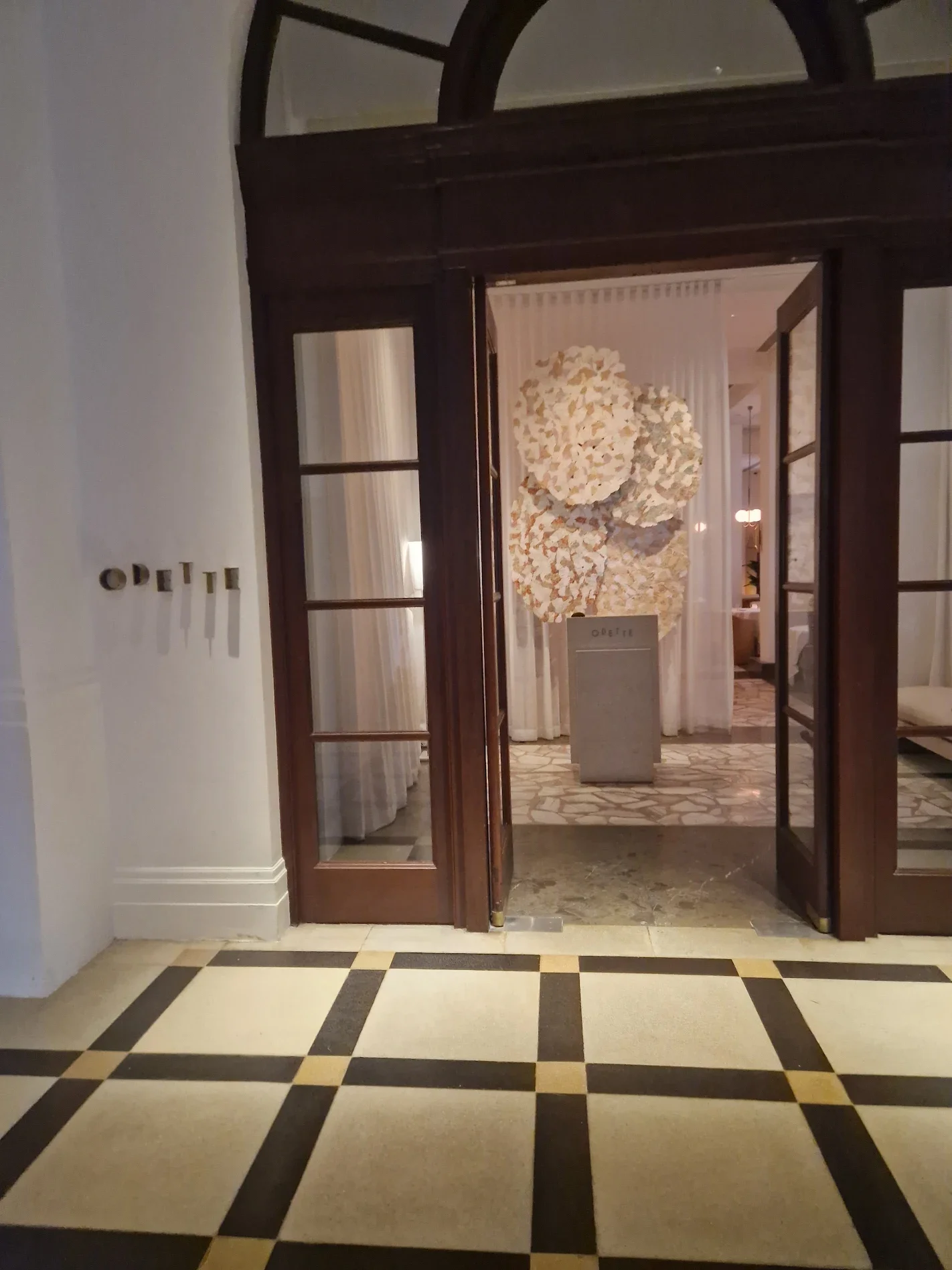
Located inside National Gallery Singapore, the restaurant opened in 2015 and entered its second decade after a substantial refurbishment in 2025. The new chapter did not attempt to replace the restaurant's identity. Instead, it sharpened something that had been developing for years: lighter cooking, greater regional influence and an increasingly confident understanding of what a French restaurant in Singapore can become.
Among the many restaurants documented through The Cuisine Journal’s collection of Singapore venues, Odette occupies a particularly interesting position.
It is an international fine-dining restaurant, but also unmistakably the product of Singapore.
A Restaurant Named After a Grandmother
Understanding Odette begins with its name.
The restaurant is named after Royer's grandmother, Odette.
Royer grew up in Cantal in central France in a family of fourth-generation farmers. His childhood was surrounded by produce, harvesting and the rhythms of agriculture, with his grandmother playing an important role in shaping how he understood food.
This background is important because Odette's cooking is frequently described through the language of luxury, yet Royer's own culinary philosophy repeatedly returns to something more fundamental: ingredients.
His grandmother demonstrated how simple ingredients could become meaningful through care.
That idea eventually followed him far beyond rural France.
Royer trained in the kitchens of Michel Bras before his career took him through the French West Indies and London. He ultimately arrived in Singapore, where years of working in Asia began to reshape his cooking.
The French foundation remained.
The boundaries around it became considerably wider.
The restaurant's identity today consequently rests on a useful tension.
Odette is deeply concerned with technique, but technique is not supposed to overpower ingredients.
It is luxurious, but luxury is frequently expressed through sourcing and precision rather than sheer extravagance.
It is French, but it no longer treats France as the only culinary geography worth exploring.
And although Julien Royer remains inseparable from the restaurant's identity, Odette increasingly presents itself as the product of a large team rather than the performance of a single chef.
That last point is particularly important.
French Technique, Asian Experience
Royer's years in Singapore changed the way he cooks.
Early in his career, his culinary vocabulary was considerably more conventionally French. Time spent in Singapore introduced him to ingredients, spices, citrus, culinary traditions and producers from across Asia.
Rather than abandoning French technique, he began using it as a foundation upon which a broader vocabulary could be built.
That makes Odette different from both a classical French restaurant and a restaurant built primarily around fusion.
Fusion can imply that two culinary traditions are being deliberately placed together.
Odette's evolution feels less literal.
The restaurant's French identity remains structural.
Sauces, reductions, precision cooking, pastry, careful treatment of proteins and an almost obsessive concern with texture remain fundamental. But individual ingredients can lead the kitchen elsewhere.
Kampot pepper from Cambodia can become part of a pigeon dish.
Japanese ingredients can sit beside French produce.
Asian citrus can introduce acidity.
Seaweed can alter the direction of a butter sauce.
A dish might begin with French technique without being required to finish in France.
Royer discussed this evolution when reflecting on Odette's first decade, describing precision, patience, craft and the importance of the team behind the restaurant in a CNA Luxury profile of Julien Royer and Odette.
It is a useful framework for understanding the restaurant.
Odette is not searching for novelty simply because novelty is expected at this level of dining.
It is searching for refinement.
The National Gallery Setting
Location contributes enormously to the restaurant's identity.
Odette sits within National Gallery Singapore at 1 St Andrew's Road, occupying part of one of the country's most significant civic and cultural buildings.
The contrast is interesting.
Outside the restaurant is monumental architecture.
Inside, Odette has historically pursued softness.
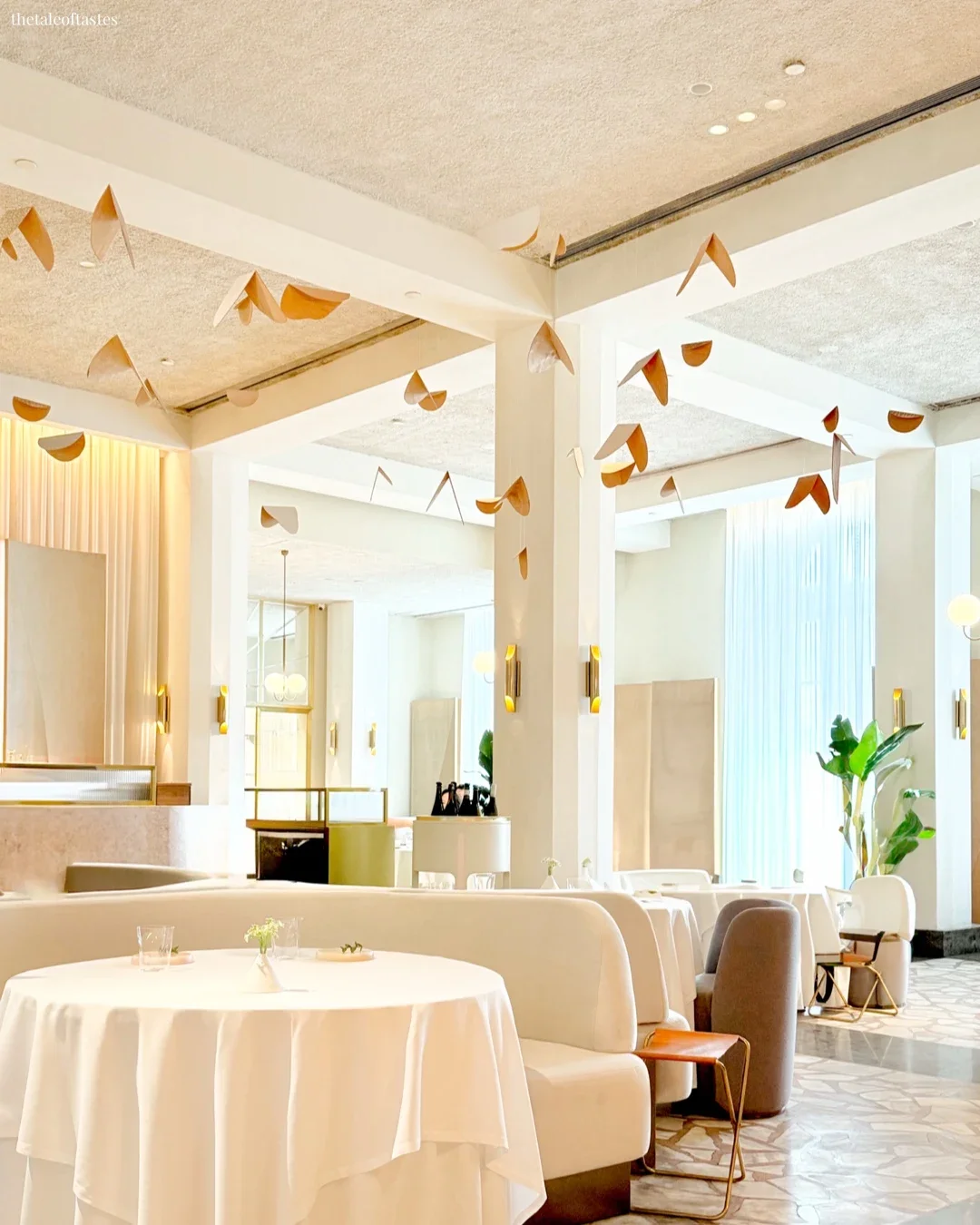
For much of its first decade, pale pinks and a distinctly delicate visual language became closely associated with the restaurant. Following its 2025 refurbishment, that palette became warmer and more mature, with softer buttery and neutral tones replacing some of the earlier visual signatures.
The change suited a restaurant moving into its second decade.
Odette did not need to become louder.
It needed to look as though it had grown older without becoming old.
That approach differs significantly from restaurants where spectacle is deliberately foregrounded. KOMA Singapore, for example, makes architecture and visual drama a central component of the dining experience.
Odette's room operates differently.
It creates quietness around the food.
Recent diners consistently describe the restaurant as elegant, comfortable and calm. Several also mention how easy conversation remains despite the ceremony of the meal.
That matters.
A fine-dining room can become so self-conscious that the diner feels as though they are participating in someone else's performance.
Odette appears determined to prevent that.
The Cooking Begins With Lightness
"Lightness" is a useful word when discussing Odette.
Not because the food is necessarily austere.
Butter, foie gras, sauces and rich ingredients remain part of the restaurant's vocabulary.
Rather, richness is frequently balanced by acidity, herbs, vegetables, fruits, aromatics and carefully controlled portioning.
The objective is rarely to make a plate feel heavy merely because the ingredients are luxurious.
A tasting menu needs rhythm.
A rich course becomes more satisfying when preceded or followed by something clean.
Hot and cold preparations can alternate.
Raw and cooked elements can interrupt one another.
Acidity can reset the palate.
Texture can change completely between courses.
One diner compared the experience to an orchestra, noting the way warm and cold dishes, cooked and raw preparations and different levels of complexity seemed to flow into one another.
That observation captures something important about long tasting menus.
The individual plate matters.
The sequence matters more.
The Rosemary-Smoked Egg and the Value of Memory
One of Odette's most recognisable dishes has been its rosemary-smoked organic egg.
On paper, an egg seems almost deliberately modest for a restaurant operating at this level.
That is precisely why the dish is useful.
Fine dining sometimes depends upon transforming ingredients diners believe they already understand.
The egg has been cooked with extraordinary precision and paired with elements such as smoked potato, chorizo and meunière flavours, while rosemary smoke adds aroma and theatre.
The smoke arrives before the taste.
That matters because flavour is not experienced exclusively by the tongue.
Smell establishes expectation.
Temperature changes perception.
Texture changes pacing.
Presentation tells the diner where to look.
Odette's egg transforms a familiar ingredient not by disguising what it is, but by creating a more elaborate sensory environment around it.
That approach appears throughout the restaurant.
The ingredient remains legible.
The experience becomes larger.
Crab, Pear and the Importance of Contrast
Another recurring feature in diner accounts is the restaurant's handling of seafood.
Normandy brown crab has appeared alongside avocado, nashi pear and coriander.
That combination demonstrates the restaurant's approach particularly clearly.
Crab naturally brings sweetness.
Avocado contributes richness.
Pear introduces crispness and freshness.
Coriander changes the aromatic profile.
None of those flavours needs to dominate.
The interest comes from contrast.
Texture is equally important.
Fine crab can become monotonous when every accompanying component shares the same softness. Crisp fruit and colder elements interrupt that texture and keep the dish moving.
This is one reason Odette's food often appears complex despite individual flavours remaining relatively clear.
Complexity does not necessarily require adding more.
Sometimes it comes from controlling the relationship between a small number of things.
Scallop, Seaweed and a Different Kind of French Butter Sauce
Seafood also allows Odette to demonstrate how French technique can move naturally towards Asian ingredients.
A seaweed-butter-poached scallop, for example, retains the recognisable luxury of classical French cooking while introducing an ingredient deeply embedded across East Asian cuisines.
Seaweed contributes salinity, minerality and umami.
Butter supplies richness.
A precisely cooked scallop offers natural sweetness.
Vegetal accompaniments provide relief.
Nothing about the technique needs to stop being French for the flavour profile to become broader.
This gradual expansion of culinary language may be one of the most successful ways to think about modern French cooking in Asia.
The kitchen does not need to insert an obviously Asian dish into the tasting menu to prove where it is.
The location can reveal itself more quietly.
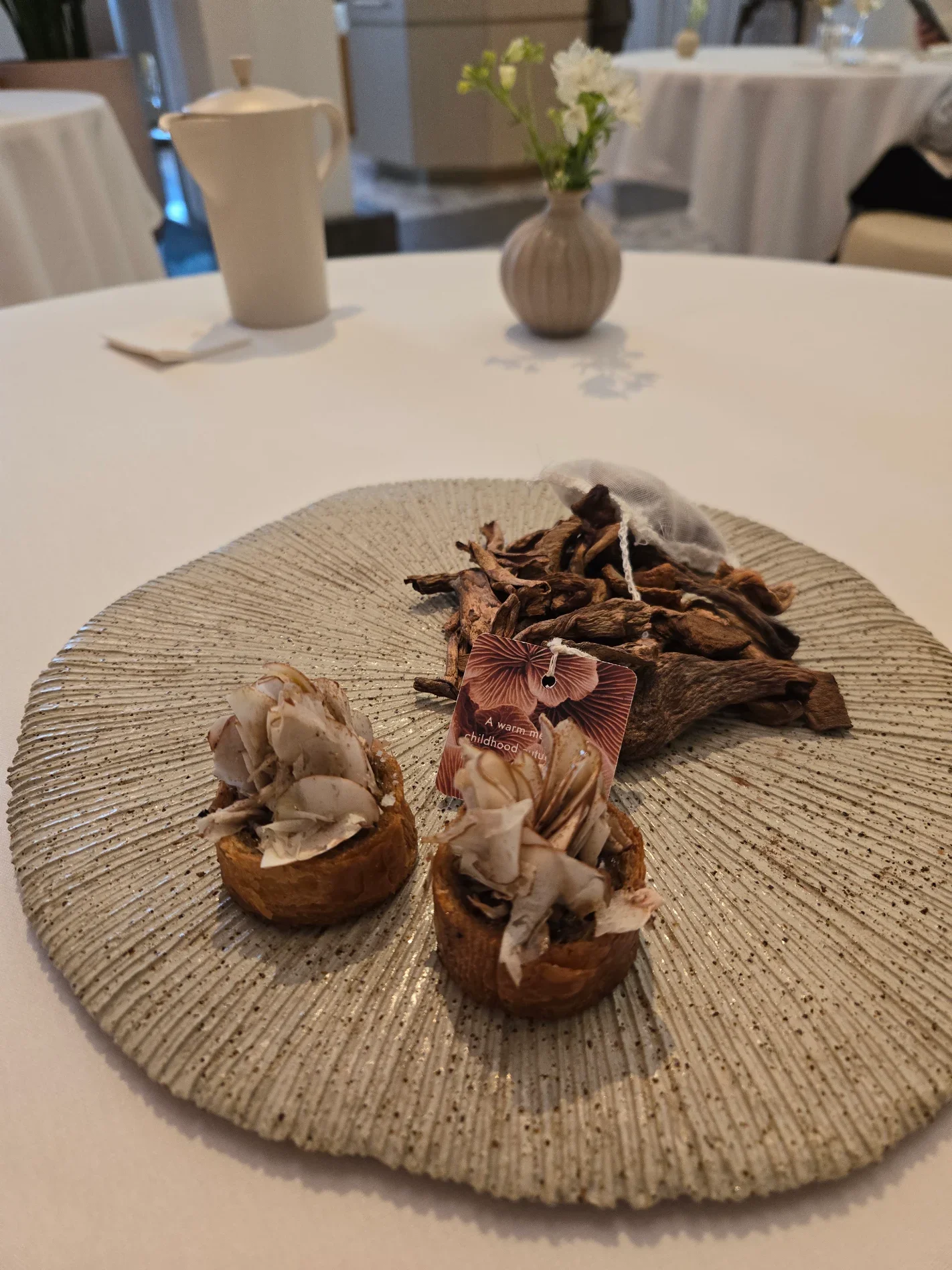
Mushroom Tea and the Power of Restraint
One of the dishes mentioned repeatedly by diners is mushroom tea.
The name sounds almost aggressively simple.
That is part of its appeal.
Mushrooms offer an enormous range of flavours depending on variety and preparation: earthy, nutty, woody, savoury, almost meaty.
A concentrated mushroom preparation allows the kitchen to work with aroma and umami without relying upon a large protein at the centre of the plate.
It also demonstrates a wider principle at Odette.
Not every important course needs to arrive as a visual monument.
Sometimes the most memorable part of dinner can be a liquid.
The confidence required to serve something called mushroom tea within an elaborate fine-dining menu is considerable.
The dish has nowhere obvious to hide.
If the extraction lacks concentration, it becomes weak.
If it is reduced too heavily, it can become muddy.
When the balance is correct, simplicity becomes the point.
Abalone, Lobster and the Restaurant's Relationship With Luxury
Odette certainly does not avoid conventionally luxurious ingredients.
Abalone appears in diner accounts.
So does lobster.
Foie gras remains part of the restaurant's culinary vocabulary.
Premium seafood, carefully sourced meats and artisanal produce all play roles within the menu.
The more interesting question is how those ingredients are used.
Luxury ingredients can become a shortcut.
Put enough caviar, truffle, lobster or foie gras onto a plate and the diner immediately understands that the dish is expensive.
Odette's cooking is generally more concerned with integration.
A premium ingredient is expected to function within the architecture of a dish rather than exist purely as a status symbol.
That is an important distinction because genuine tasting-menu fatigue often arrives when every course attempts to be more luxurious than the course before it.
After enough foie gras, caviar and truffle, luxury stops feeling luxurious.
Contrast restores value.
Vegetables help.
Acidity helps.
Broths help.
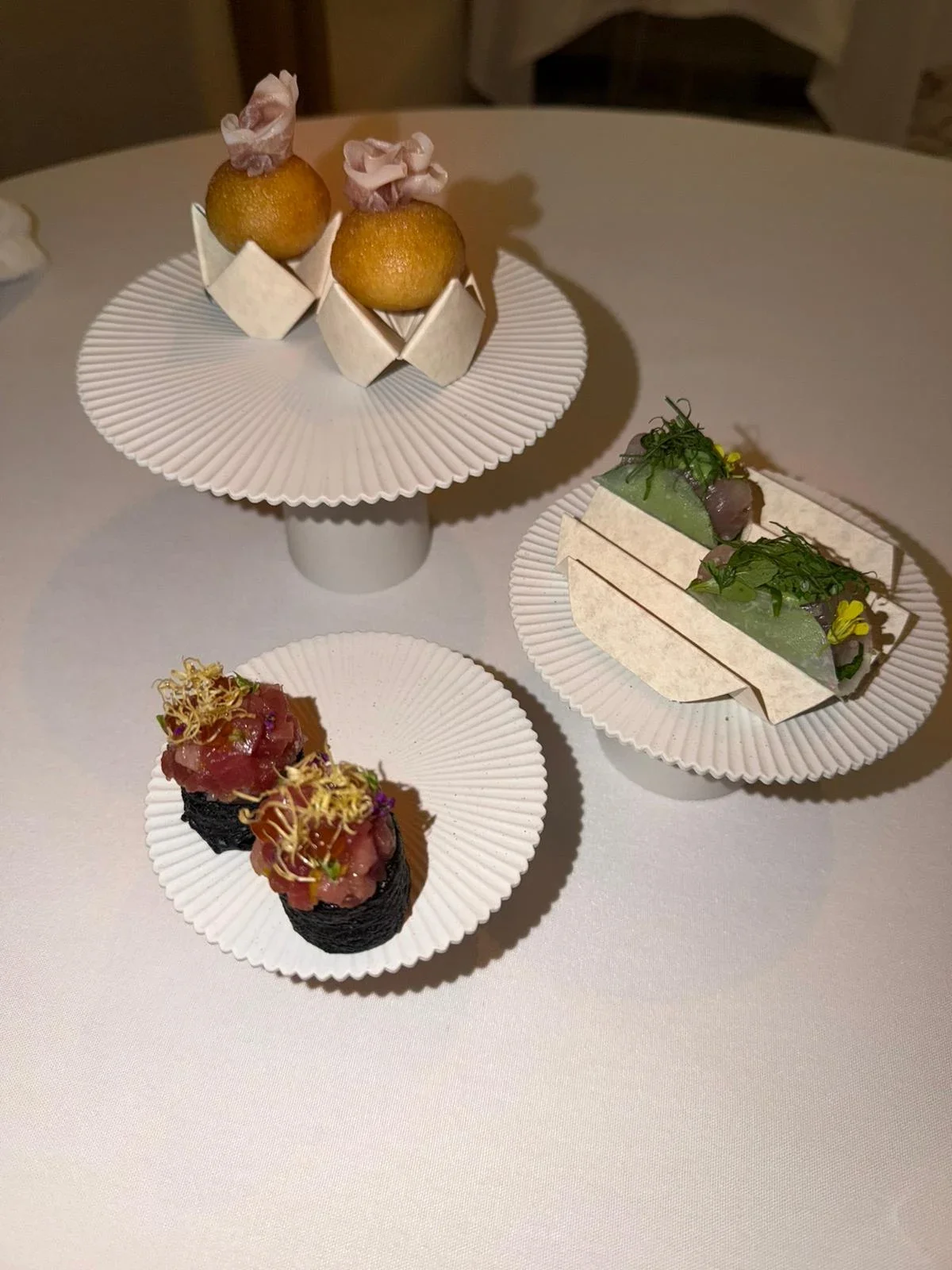
Small bites help.
Odette's ability to move between these registers allows richer ingredients to retain their impact.
The Pigeon
If one dish most clearly connects Royer's current philosophy, French technique and regional sourcing, it may be the pigeon.
Kampot pepper-crusted pigeon has become closely associated with the restaurant.
The pairing is revealing.
Pigeon is deeply familiar within French haute cuisine.
Kampot pepper immediately points towards Southeast Asia.
The pepper does not merely exist as an exotic garnish.
Its floral, aromatic heat gives the meat a different context.
The sourcing matters as well.
Royer has repeatedly emphasised long-term relationships with producers, treating the people who grow, rear and supply ingredients as part of the restaurant's creative ecosystem.
That philosophy separates ingredient-driven cooking from ingredient shopping.
Buying expensive produce is easy if budget allows it.
Understanding producers, seasons, varieties and the precise characteristics of an ingredient requires something else.
For a restaurant serving tasting menus year after year, those relationships become part of its memory.
Dishes change.
The supply chain becomes part of the institution.
Why Pigeon Works Particularly Well at Odette
Pigeon also demonstrates the restaurant's comfort with deeper flavours.
Much of Odette's cooking is visually delicate.
That can create the mistaken expectation that every flavour will be similarly gentle.
Pigeon prevents that.
The meat is darker, more mineral and more assertive than poultry such as chicken.
Pepper gives it aromatic intensity.
Sauce can provide concentration.
The course consequently provides a useful anchor within a menu otherwise capable of moving through shellfish, vegetables, delicate broths and lighter preparations.
Several diners identify the pigeon as a favourite.
That consistency suggests more than the appeal of one particular protein.
It demonstrates the importance of pacing.
A tasting menu needs moments of greater intensity.
Without them, refinement can gradually become monotony.
Vegetables Are Not Supporting Actors
One of the most important developments in contemporary fine dining has been the changing role of vegetables.
For much of classical European restaurant history, vegetables frequently acted as accompaniments.
Protein occupied the centre.
Everything else supported it.
Restaurants such as Odette increasingly challenge that hierarchy.
Vegetables, herbs and flowers can determine the structure of a plate.
This does not mean Odette has become a vegetable restaurant.
It means the kitchen treats produce with enough seriousness that the vegetable does not automatically become garnish.
Royer's agricultural upbringing likely matters here.
When vegetables are understood through variety, terroir, maturity and seasonality, "carrot" stops being a sufficiently precise description.
The variety matters.
The farm matters.
The growing conditions matter.
When it was harvested matters.
The same logic that diners comfortably apply to wine can also be applied to produce.
That philosophy has parallels elsewhere in Singapore's fine-dining scene, where restaurants increasingly build identities around very specific ingredients, techniques or ecosystems rather than simply around national cuisine.
Fine Dining as Choreography
Odette's food attracts much of the attention, but diner feedback repeatedly returns to another subject:
Service.
Many diners describe the hospitality as exceptionally warm.
That adjective matters.
At this level, technically correct service should already be expected.
Glasses should be filled.
Cutlery should arrive.
Courses should be explained.
Wine should be handled properly.
The more difficult challenge is performing all of this without turning the dining room into a demonstration of service technique.
Odette appears particularly concerned with making hospitality feel human.
Guests mention individual servers by name.
They describe staff remembering dietary requirements.
Personalised birthday details appear.
Menus can carry celebratory messages.
Food preferences are recorded.
Courses are explained without conversations turning into lectures.
One diner specifically praised the team for providing the right amount of information while avoiding the impression that the server was trying to demonstrate how much they knew.
That is an extremely fine balance.
Four Hours That Do Not Feel Like Four Hours
One recurring review described a meal lasting nearly four hours without the guests realising how much time had passed.
That might be one of the better measurements of successful fine dining.
A four-hour meal can feel extraordinary.
It can also feel endless.
The difference is pacing.
Long tasting menus demand far more logistical coordination than the diner sees.
The kitchen needs to know where every table is within the sequence.
The service team needs to read whether guests want conversation or privacy.
Wine must arrive before the food it accompanies.
Cutlery needs to change.
Plates must move almost simultaneously across the table.
Dietary substitutions must reach the correct diner.
Bread needs replenishing without becoming intrusive.
Water appears almost invisibly.
A course might take minutes to eat but represent considerably more time in preparation.
The objective is to make all of this labour disappear.
That is hospitality as choreography.
The diner should experience dinner.
Not the machinery required to produce it.
When the Machinery Becomes Visible
Odette's feedback is overwhelmingly positive, but not every diner experiences complete invisibility.
One guest noted that pacing became rushed towards the end of a meal.
Another found the initial champagne interaction awkward because pricing was not communicated as clearly as expected.
Another observed that the physical arrangement of tables made some sight lines less private.
These are useful details precisely because restaurants at this level are judged differently from casual restaurants.
A minor service irregularity that would barely register elsewhere becomes more noticeable during a highly orchestrated tasting menu.
Expectations scale with ambition.
When virtually everything is polished, the unpolished detail becomes easier to see.
That is not unique to Odette.
It is inherent to fine dining.
Perfection is impossible, but restaurants built around precision invite diners to notice precision.
The Team Behind Julien Royer
Although Odette remains closely identified with Julien Royer, the restaurant today operates through a substantial leadership and culinary team.
That matters because no serious restaurant at this scale can function as a one-person creative project.
Executive chefs, head chefs, chefs de cuisine, pastry cooks, bakers, sommeliers, restaurant managers, hosts and floor staff all contribute to the final experience.
Recent diner reviews frequently mention chefs Adam, Levin and Noboru alongside members of the dining-room team.
This aligns closely with the way Royer talks about the restaurant.
The team is not simply labour supporting the chef.
The team is part of the restaurant's identity.
That philosophy becomes particularly important once a restaurant survives beyond its opening years.
A chef can personally control almost everything in a tiny restaurant.
An institution requires systems.
It requires training.
It requires people capable of transmitting standards to new people.
It requires a culture strong enough to continue when the chef is not physically standing over every plate.
Odette's second decade will depend at least as much upon this institutional knowledge as it does upon Royer's next dish.
A Different Form of Chef-Driven Restaurant
Singapore contains several compelling examples of restaurants built around a strong culinary personality.
At Burnt Ends, Dave Pynt developed a restaurant around fire, smoke and custom-built ovens.
Sushi Masaaki approaches omakase with a comparatively more playful personality.
Odette shares the same dependence upon a clear culinary point of view, but its structure is different.
It operates more like an institution.
The room is larger.
The brigade is larger.
The meal involves more departments.
The wine programme carries substantial responsibility.
The pastry and bread programmes contribute separate disciplines.
The service team must choreograph numerous tables simultaneously.
That makes consistency particularly difficult.
Producing one exceptional plate is hard.
Producing an entire sequence of them while another table is fifteen minutes ahead and another is dealing with a dietary restriction is much harder.
Fine dining at this scale is partly cuisine and partly systems engineering.
The Reopened Kitchen and the Restaurant as Theatre
Recent diners have also commented on views into Odette's renovated kitchen.
Watching a brigade work changes the relationship between diner and restaurant.
A finished plate hides labour.
A visible kitchen reveals fragments of it.
Hands move quickly.
Sauces are checked.
Plates are wiped.
Garnishes are placed.
Courses leave in groups.
The contrast between the calm dining room and the controlled intensity behind it becomes part of the experience.
That dynamic is not entirely different from a sushi counter, where guests witness much more of the preparation directly.
Yet the scale is different.
At a restaurant such as Sushi Sakuta, much of the performance can occur directly between chef and guest.
At Odette, the restaurant itself performs.
The kitchen, floor team, sommeliers and pastry section contribute different movements to the same service.
Bread, Petit Fours and the Things That Are Supposed to Be Secondary
One of the pleasures of ambitious restaurants is discovering how much effort is spent on food that technically does not form the centre of the menu.
Bread is one example.
Petit fours are another.
Neither needs to be particularly elaborate.
Yet they often reveal how seriously a restaurant treats completeness.
Bread appears before the dishes diners came to eat.
Petit fours arrive when the official dessert has already ended.
There is little commercial reason to obsess over either beyond the restaurant's desire to control the beginning and end of the experience.
At Odette, bread belongs to a dedicated discipline within the kitchen.
Petit fours provide the final punctuation.
These details explain why fine dining cannot be judged entirely by asking whether one main course tasted good.
There may not even be a conventional "main course."
The restaurant is building an accumulation of small experiences.
Dietary Adjustments Without Breaking the Menu
One diner noted that the kitchen adjusted the tasting menu for a pregnant guest.
This sounds straightforward until the structure of a tasting menu is considered.
A tasting menu is built through progression.
Replace one ingredient and the substitution may affect texture, intensity, cooking technique and even the wine pairing.
A good dietary adaptation therefore cannot simply remove the problematic ingredient.
It should preserve the logic of the meal.
That requires preparation before the guest arrives.
It also explains why restaurants at this level ask detailed questions about allergies and dietary restrictions.
The objective is not merely safety.
It is continuity.
Two diners at the same table should still feel as though they are participating in the same dinner even when individual plates differ.
Wine as a Parallel Menu
Wine plays another important role at Odette.
In casual restaurants, wine frequently functions as an accompaniment selected from a list.
In fine dining, pairing can become another progression running alongside the food.
Acidity, sweetness, tannin, body, aroma and temperature can all alter the perception of a dish.
A rich sauce might require acidity.
Delicate seafood can be overwhelmed by excessive oak.
Spice can change the way alcohol is perceived.
Dessert presents an entirely different problem because a dry wine can suddenly taste aggressively sour beside sugar.
The sommelier therefore operates almost like another cook.
The difference is that the ingredients arrive in bottles rather than pans.
Recent diner feedback frequently praises Odette's sommeliers and beverage programme, suggesting that wine remains integrated into the broader choreography rather than being treated as a separate luxury add-on.
Non-alcoholic pairings and drinks such as kombucha also give the beverage programme more room to work with guests who do not want a conventional wine progression.
The Restaurant Has Matured Alongside Singapore
Odette's first decade also overlaps with an important period in Singapore's culinary development.
The city's fine-dining scene became increasingly international, increasingly ambitious and increasingly comfortable expressing identities that could not be reduced to a single national label.
Restaurants no longer needed to choose between being "French" and being "Singaporean" in the most literal sense.
A chef could be French.
The technique could be French.
The restaurant could still be shaped profoundly by Singapore.
Odette demonstrates this particularly well.
Its evolution mirrors Royer's own.
He arrived with one culinary language.
Singapore gave him additional vocabulary.
The original language did not disappear.
It became more expressive.
What Diners Consistently Remember
The review material around Odette is unusually consistent in several areas.
Guests talk about precision.
They talk about ingredient quality.
They talk about warmth in the service.
They talk about celebrations.
They talk about the pigeon.
They talk about mushroom tea.
They talk about abalone, crab and lobster.
They talk about the pacing of the meal and the attention paid to details.
Most importantly, many talk about wanting to return.
That final point matters because tasting-menu restaurants face a particular challenge.
The first visit contains novelty automatically.
Everything is new.
The room is new.
The menu is new.
The sequence is new.
The challenge is giving someone a reason to experience the format again.
Seasonality provides one answer.
Evolution provides another.
The kitchen can retain its philosophy while changing the ingredients through which that philosophy is expressed.
Odette in Its Second Decade
Ten years is an important age for a fine-dining restaurant.
It is long enough to establish history but not long enough to survive on history alone.
The restaurant must decide what should remain and what should change.
Odette's answer appears relatively clear.
The French foundation remains.
The respect for produce remains.
Royer's grandmother remains embedded in the restaurant's name and philosophy.
Precision remains important.
The team remains central.
What changes is the expression.
The room becomes warmer.
The cooking becomes lighter.
Asian influence becomes increasingly natural rather than something that needs explanation.
Local and regional ingredients gain confidence.
A restaurant that once demonstrated what Julien Royer could cook increasingly demonstrates what years of cooking in Singapore have taught him.
That may prove more important than any individual award.
Odette at a Glance
Restaurant: Odette
Chef-owner: Julien Royer
Cuisine: Modern French cuisine shaped by Asian ingredients and experiences
Location: National Gallery Singapore, 1 St Andrew's Road, #01-04, Singapore 178957
Opened: 2015
Setting: Contemporary fine dining within National Gallery Singapore
Known for: Ingredient-driven tasting menus, rosemary-smoked egg, mushroom preparations, premium seafood, pigeon, highly choreographed service and an extensive beverage programme
Best suited to: Celebrations, destination dining and diners interested in long-form tasting menus
More information on menus, reservations and the restaurant's current direction can be found through the official Odette Restaurant website.
Odette's achievement is not simply that it became one of Singapore's most internationally recognised dining rooms.
It is that the restaurant continued changing after recognition arrived.
Julien Royer began with French technique and a childhood understanding of produce.
Singapore provided another landscape, another pantry and another way of seeing food.
A decade later, Odette no longer needs to choose between those worlds.
Its identity exists in the space between them.