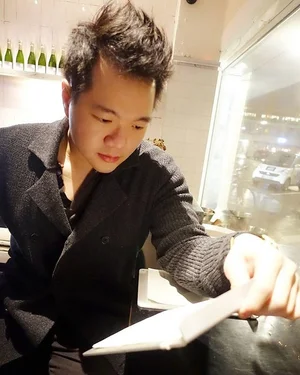
From his childhood in southern France to the prestigious kitchens of Guy Savoy and La Mamounia, French chef Rémy Carmignani has built an international career around the flavours of the Mediterranean, classical French techniques, and the belief that food should bring people together. Today, his experience finds a home at Maison Boulud in Singapore.
For Rémy Carmignani, cooking has always been closely connected to family, travel, and the memories created around a dining table. Raised in Montélimar, a town in southern France often described as the gateway to Provence, he grew up surrounded by the culinary traditions of both France and Italy.
Those early experiences eventually led him into professional kitchens across Europe, Asia, and North Africa, where he developed a style combining classical French cooking with the ingredients and regional traditions of the Mediterranean.
His career has included seven years working within the Guy Savoy restaurant group, almost five years at Marrakech's renowned La Mamounia hotel, and a prominent role at Riviera, a Mediterranean fine dining restaurant overlooking Singapore's Marina Bay.
In February 2024, Carmignani became the opening Executive Chef of Maison Boulud at Marina Bay Sands, working alongside internationally acclaimed French chef Daniel Boulud to introduce a restaurant celebrating French culinary traditions, seasonal ingredients, and Mediterranean influences.
The appointment brought together two chefs with different professional backgrounds but a shared appreciation for French gastronomy.
For Carmignani, it represented another chapter in a career shaped by international experience and a lifelong connection to the food of his childhood.
Growing Up in Montélimar: A Childhood Shaped by Mediterranean Cooking
Rémy Carmignani's earliest culinary influences came from his family.
Growing up in Montélimar, near the landscapes of Provence, he experienced the regional cooking traditions of southern France alongside the Italian influences introduced by his grandfathers.
His grandmothers regularly prepared meals using fresh local produce, while family gatherings provided opportunities to experience the importance of food in everyday life.
These meals would eventually become a defining influence on his professional philosophy.
In a 2020 interview with World Travel Magazine, Carmignani recalled one particularly memorable family dish: his grandmother's Langoustine à l'Américaine.
The preparation featured shellfish cooked in a rich sauce, and its aroma became one of his most enduring childhood food memories.
What remained important to him was not simply the flavour of the dish but the atmosphere surrounding its preparation.
His grandmother cooked for large gatherings, bringing relatives together through meals that were prepared and shared as a family.
This understanding of food as a social and emotional experience would continue to influence Carmignani throughout his career.
It also helps explain why his cooking has drawn inspiration from different Mediterranean cultures rather than restricting itself to the traditions of one country.
Southern France and regional Italy provided his earliest foundations, but his later travels would introduce him to the cuisines of Morocco and other parts of the Mediterranean.
Learning the Discipline of Professional French Kitchens
Carmignani's interest in food eventually led him to pursue formal culinary studies in France.
According to a biographical profile published by Riviera, he was recognised as one of the leading culinary students in the Drôme region before undertaking apprenticeships in professional kitchens.
One particularly important opportunity came when he was 17 years old.
He joined chef Philippe Groult at Domaine de la Valdaine, a Michelin-starred establishment where he gained early exposure to the demanding standards of French fine dining.
The experience introduced Carmignani to the discipline and technical precision expected in high-level restaurant kitchens.
It also encouraged his interest in travelling beyond France to discover different culinary traditions.
His early training provided a foundation in classical French techniques, which would later support the incorporation of ingredients and cooking methods encountered during his international career.
Rather than abandoning those techniques as he travelled, Carmignani continued using them as a framework for presenting regional flavours.
That combination of technical discipline and culinary curiosity would become particularly important during his subsequent years working with Guy Savoy.
Seven Years with Guy Savoy: Paris, Singapore, and Doha
One of the defining periods of Carmignani's professional development was his association with French chef Guy Savoy.
During approximately seven years within the Guy Savoy restaurant group, he worked across several international locations, developing experience in both kitchen operations and the management of fine dining teams.
His career within the organisation included a sous-chef position at Restaurant Guy Savoy in Paris.
He subsequently joined the opening team of Restaurant Guy Savoy at Marina Bay Sands in Singapore in 2010, marking an early stage in his professional relationship with the city.
The Singapore restaurant introduced Guy Savoy's approach to French fine dining to a market that was attracting increasing international culinary attention.
For Carmignani, the assignment offered an opportunity to participate in the development of a major restaurant operation outside France.
His experience with the group later took him to Doha, Qatar, where he became Chef de Cuisine at Quisine by Guy Savoy.
Across these assignments, Carmignani worked within an organisation associated with some of the highest standards of classical French gastronomy.
His responsibilities extended beyond cooking individual dishes to maintaining consistency, supervising kitchen teams, and translating an established culinary philosophy into different restaurant environments.
During his time with the Guy Savoy group, Carmignani also appeared as a contestant on Iron Chef Thailand, participating in a pastry-themed culinary challenge.
Although his professional experience was firmly rooted in French cuisine, the international nature of these assignments helped broaden his understanding of the restaurant industry.
Working in Paris, Singapore, and Doha exposed him to different ingredients, suppliers, dining preferences, and operational expectations.
This experience prepared him for a particularly influential chapter in Morocco.
La Mamounia: Discovering the Culinary Traditions of Marrakech
Following his work with Guy Savoy, Carmignani moved to Marrakech, Morocco, where he joined La Mamounia.
The historic luxury hotel is internationally recognised for its hospitality and dining establishments, and Carmignani spent almost five years working within its culinary operations.
He initially served as Chef de Cuisine at Le Français, the hotel's French fine dining restaurant.
During this period, he helped develop the restaurant's kitchen operations and led its culinary team.
After approximately three years, he was promoted to a broader supervisory role, taking responsibility for additional food and beverage operations, including Italian dining and room service.
The experience expanded his management responsibilities while exposing him to the culinary traditions of North Africa.
Although Carmignani continued practising French cooking professionally, Marrakech introduced him to ingredients, spices, and preparation methods that would become increasingly important to his personal culinary style.
One of the most memorable experiences from this period involved a traditional Moroccan dish known as tangia marrakchia.
In his 2020 interview with World Travel Magazine, Carmignani described visiting a butcher in Marrakech's old medina to experience the dish's preparation.
The butcher assembled meat, spices, saffron, and preserved lemon in a clay pot.
The vessel was then taken to a traditional hammam, where it was cooked slowly using the residual heat from the fires that warmed the bathhouse.
Approximately six hours later, the finished dish was ready.
For Carmignani, the experience demonstrated how an apparently simple preparation could express the history and identity of an entire culinary tradition.
The ingredients, cooking vessel, and preparation method were all connected to the everyday culture of Marrakech.
It was an experience that would later influence one of his signature dishes in Singapore.
Returning to Singapore: The Riviera Years
Carmignani returned to Singapore in 2020 to become Executive Chef at Riviera Forlino, a Mediterranean fine dining restaurant situated at One Fullerton.
Overlooking Marina Bay, the restaurant provided an opportunity for him to develop a menu reflecting his personal culinary experiences.
Rather than concentrating exclusively on French cuisine, Carmignani embraced influences from southern France, Italy, Spain, Greece, and North Africa.
The resulting style was described as modern Mediterranean cooking.
It combined French culinary techniques with ingredients and preparations encountered during his travels.
The influence of Marrakech was particularly apparent in his handmade tortellini featuring Moroccan tangia-style lamb shoulder.
Inspired by the traditional dish he had experienced in Morocco, the preparation incorporated slow-cooked lamb, saffron, goat cheese cream, and mustard seeds.
These ingredients were presented within handmade pasta and accompanied by a light broth prepared using classical French techniques.
The dish connected several different culinary traditions: the slow-cooking methods of Morocco, the pasta-making traditions of Italy, and the sauce-making techniques of France.
Rather than simply combining unrelated ingredients, Carmignani used the preparation to communicate an experience from his professional travels.
This approach reflected a broader philosophy that had developed throughout his career.
For Carmignani, travelling and eating local food were essential parts of understanding a culture.
He encouraged chefs to seek out traditional preparations and learn directly from the people who continued practising ancestral cooking methods.
His experience at Riviera demonstrated how these influences could be incorporated into a contemporary fine dining menu without losing their cultural origins.
Discover the People Behind Singapore's Restaurants
Singapore's culinary landscape is shaped by chefs whose experiences extend far beyond the island.
From the international career of Rémy Carmignani to Roberto Galbiati's journey from Milan to Singapore, every chef brings a different collection of traditions, experiences, and ideas to the dining table.
Explore more culinary stories through The Cuisine Journal, where we document the people and restaurants shaping Singapore's dining culture.
Discover more chefs, restaurants, and culinary traditions at The Cuisine Journal.
Cooking as an Expression of Memory and Culture
One of the most distinctive aspects of Carmignani's culinary philosophy is his emphasis on the relationship between food and memory.
Throughout his professional career, he has repeatedly connected his cooking to the meals prepared by his family during his childhood.
This relationship became especially apparent during his time at Riviera.
In November 2021, Carmignani participated in an interview with So Chic Singapore about his approach to festive dining.
The discussion centred on a special dining collaboration between Riviera and French fragrance house Diptyque.
For the occasion, Carmignani developed a menu featuring ingredients and preparations that reminded him of family celebrations in Montélimar.
Among the dishes were Loch Fyne Scottish salmon with spinach cream and caviar, smoked using oak chips from a retired whisky barrel, and a traditional French pithivier incorporating Bresse chicken, venison, foie gras, and black truffle sauce.
Both preparations reflected ingredients that Carmignani associated with festive family meals.
In the So Chic interview on festive dining, he explained how Christmas celebrations during his childhood involved family members preparing elaborate meals together.
The aromas of those preparations remained closely associated with the experience of gathering around the family table.
For Carmignani, recreating those memories through restaurant cooking offered an opportunity to communicate the warmth and emotion of those occasions to guests.
This philosophy also helps explain his interest in traditional regional recipes.
Whether preparing a French festive dish or incorporating Moroccan cooking methods into handmade pasta, his work often begins with an existing culinary memory or cultural experience.
The objective is not necessarily to reproduce that experience exactly, but to translate its character into a different setting.
Mediterranean Influences Beyond Traditional French Cuisine
Although Carmignani's formal training took place within the traditions of French gastronomy, his cooking has consistently demonstrated an interest in the wider Mediterranean region.
This approach became particularly visible through the dishes he developed at Riviera.
In April 2021, he participated in So Chic's En Cuisine With... series, presenting a recipe for Greek dorade royale en papillote.
The preparation featured sea bream with potatoes, olives, preserved lemon, and Moroccan-inspired accompaniments.
Among the components were chermoula, a North African herb and spice preparation, and tfaya, a Moroccan preparation featuring caramelised onions and raisins.
The dish illustrated Carmignani's willingness to combine ingredients from different Mediterranean culinary traditions while maintaining a coherent flavour profile.
The fish provided the central ingredient, supported by the acidity of preserved lemon, the savouriness of olives, and the aromatic characteristics of the North African accompaniments.
This combination reflects an approach based on the relationships between regional cuisines.
Southern French, Italian, Greek, and North African cooking traditions have developed independently, but they also share many ingredients and culinary characteristics.
Olive oil, seafood, herbs, citrus, and slow-cooked meats appear throughout different parts of the Mediterranean, although their preparations vary significantly between regions.
Carmignani's professional experience has allowed him to explore these connections through dishes grounded in classical French techniques.
His work at Riviera demonstrated that Mediterranean cooking could provide a broad creative foundation without requiring the complete abandonment of traditional recipes.
Maison Boulud: A New Chapter at Marina Bay Sands
In February 2024, Carmignani assumed the role of Executive Chef at Maison Boulud, the Singapore restaurant established by French chef Daniel Boulud.
Located at The Shoppes at Marina Bay Sands, the restaurant replaced db Bistro & Oyster Bar, which had operated in Singapore for approximately 13 years.
Maison Boulud officially debuted on 8 February 2024, introducing a dining concept inspired by French culinary traditions, seasonal produce, and the atmosphere of the Mediterranean.
While Daniel Boulud provided the restaurant's overarching culinary direction, Carmignani was appointed to lead its Singapore kitchen.
The appointment brought his extensive international experience into a restaurant combining classical French cuisine with the more relaxed character of a contemporary dining establishment.
According to Marina Bay Sands' official opening announcement, Carmignani was joined by Executive Sous Chef Vincent Yong and Executive Pastry Chef Mandy Pan.
Both contributed experience from the Marina Bay Sands restaurant environment, including the previous db Bistro operation.
The restaurant's opening menu incorporated traditional French preparations such as sole meunière and côte de boeuf, alongside familiar dishes associated with Daniel Boulud's restaurant group.
These included the Original DB Burger and seafood platters.
The combination reflected Maison Boulud's intention to present refined French cuisine in a setting that was approachable enough for different dining occasions.
For Carmignani, the appointment represented a return to the Marina Bay Sands dining environment where he had previously worked with Guy Savoy in 2010.
It also placed him alongside another internationally influential French chef.
Working with Daniel Boulud
The collaboration between Rémy Carmignani and Daniel Boulud brought together two different culinary experiences.
Boulud is internationally recognised for his restaurants in New York and other major cities, particularly for his interpretation of French cuisine through seasonal ingredients and contemporary influences.
Carmignani, meanwhile, brought experience from Guy Savoy, La Mamounia, and Riviera, alongside a cooking style shaped by the Mediterranean.
Their collaboration allowed Maison Boulud's Singapore menu to incorporate influences from both culinary backgrounds.
In a 2024 interview with So Chic Singapore, Daniel Boulud discussed working with Carmignani to develop dishes incorporating regional flavours and ingredients familiar to Singapore diners.
Among the preparations mentioned were sea bass with pepper sauce and a crab dish incorporating squid ink and pepper.
Boulud also acknowledged Carmignani's Mediterranean cooking style, explaining that the team was exploring combinations connecting Sicily, France, and Singapore.
These comments provide an indication of Carmignani's contribution to the restaurant.
Although Maison Boulud operates under Daniel Boulud's name and culinary direction, its Singapore kitchen benefits from the experience of a chef who has spent much of his professional life working across Mediterranean and international culinary environments.
The relationship also reflects an important characteristic of restaurants operated by internationally recognised chefs.
Maintaining the identity of a restaurant group requires experienced culinary leaders who can translate its philosophy into consistent daily service.
At Maison Boulud, Carmignani's responsibilities have included executing that vision while contributing knowledge developed throughout his own career.
French Classics with a Mediterranean Sensibility
The cuisine presented at Maison Boulud reflects the meeting of traditional French cooking and a broader appreciation for Mediterranean ingredients.
The restaurant's opening menu featured dishes such as bouillabaisse, sole meunière, and roasted duck, alongside seafood preparations and seasonal pasta dishes.
These preparations demonstrate the importance of classical techniques within the restaurant's culinary identity.
Sole meunière, for example, is a traditional French preparation in which fish is cooked with butter and typically finished with lemon and parsley.
Bouillabaisse draws from the seafood traditions of Marseille, bringing together fish and shellfish in a richly flavoured broth.
Both dishes belong to the culinary traditions of southern France, a region that has influenced Carmignani since childhood.
Other preparations introduced a more contemporary combination of ingredients.
A lobster pastilla presented a connection between French seafood cooking and the pastry traditions associated with North Africa.
The restaurant also offered seafood salads featuring Provençal ingredients, including olives and basil.
Such dishes were consistent with Carmignani's professional experience in Morocco and his previous work developing Mediterranean-inspired menus at Riviera.
Nevertheless, Maison Boulud remained primarily an expression of Daniel Boulud's culinary philosophy.
Its dishes were developed within the framework of the restaurant group rather than presented as an independent Carmignani concept.
The distinction is important when considering his career.
At Riviera, Carmignani had greater scope to establish a recognisable personal approach to Mediterranean cooking.
At Maison Boulud, his experience contributed to the execution and development of a concept created by another chef.
Both roles demonstrate different aspects of his professional abilities.
The Importance of Travel in a Chef's Education
Throughout his career, Carmignani has frequently emphasised the educational value of travelling and experiencing regional cuisine firsthand.
His years in France provided a foundation in classical cooking.
Singapore introduced him to an international restaurant environment, while Doha expanded his experience of operating within a different culinary market.
Marrakech subsequently exposed him to the traditional preparations of Morocco, including cooking methods that were closely connected to the city's everyday culture.
These experiences helped shape a philosophy that treats food as a means of understanding the people and places associated with it.
Carmignani's account of discovering tangia marrakchia provides a particularly clear example.
Rather than simply obtaining a recipe, he sought out the traditional preparation process, visited a local butcher, and observed how the dish was cooked.
The resulting experience became part of his culinary knowledge and later influenced a dish served in Singapore.
His approach illustrates how professional chefs can develop new ideas by studying existing traditions rather than pursuing novelty alone.
A regional dish may offer insight into ingredients, cooking methods, and flavour combinations that can be adapted thoughtfully to another culinary context.
For Carmignani, this process has remained closely connected to respect for the cultures from which those preparations originate.
A Career Connecting France, North Africa, and Singapore
Rémy Carmignani's professional journey has been shaped by a combination of classical French training and international culinary exploration.
His childhood in Montélimar introduced him to the importance of family meals, seasonal ingredients, and the overlapping traditions of southern French and Italian cooking.
His early professional education provided the technical foundation necessary to work in Michelin-starred kitchens.
Seven years within the Guy Savoy organisation then allowed him to develop experience in Paris, Singapore, and Doha.
His subsequent years at La Mamounia in Marrakech introduced a deeper appreciation for North African cooking, while his leadership at Riviera provided an opportunity to express those influences through a personal Mediterranean culinary style.
The opening of Maison Boulud in Singapore in February 2024 brought those experiences into a new professional setting.
Working within Daniel Boulud's restaurant organisation, Carmignani contributed to a concept that celebrated French gastronomy while incorporating the culinary influences of the Mediterranean.
Throughout these different stages, one idea has remained consistent: food is closely connected to the memories, traditions, and relationships of the people who prepare and share it.
For Carmignani, this understanding began with the meals prepared by his grandmother in southern France.
It continued through his exploration of traditional Moroccan cooking and his development of Mediterranean dishes in Singapore.
His career demonstrates how a chef can remain grounded in classical culinary techniques while developing an understanding of the regional traditions that surround them.
At Maison Boulud, those experiences contribute to the continued presentation of French cuisine within Singapore's international dining landscape.
Explore More Culinary Stories at The Cuisine Journal
Every restaurant has a story, and every chef brings a different collection of experiences to the table.
Discover more culinary personalities, including Antonio Manetto and his Neapolitan journey to Singapore, or explore the work of Ciro Sorrentino, the Neapolitan pizzaiolo who took his dough across the world.
For more restaurant discoveries, visit our Singapore restaurant and venue directory or explore our curated culinary collections.
The Cuisine Journal — Discover the people behind the plate.