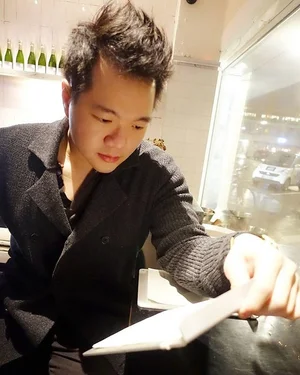
The chef-owner studied in Singapore, worked through kitchens in Spain, Japan and the United States, then came home to learn a different craft: building restaurants of his own.
Terence Chuah’s interest in food began early. Eleven Strands tells his story as a love affair that started at four years old. The restaurant he eventually opened in Serangoon occupies a corner he had passed many times, turning an ordinary part of his own landscape into the site of a long-held ambition. It is an inviting story, but the years between childhood fascination and ownership are what give it weight.
Chuah studied at the Culinary Institute of America’s Singapore programme through the Singapore Institute of Technology. He has described the opportunity to study locally as a way to preserve resources for international experience. The course demanded both kitchen hours and academic work, and he graduated as valedictorian in 2015 with a Best Chef Award. More than the distinction itself, he credits the programme with giving him the discipline to move from a junior position toward leading a kitchen.
Learning across three countries
In a detailed SIT account of his journey, Chuah traces a route through Mugaritz in San Sebastián, Narisawa in Tokyo and a three-star Italian restaurant in San Francisco. He associates the first with creative possibility, the second with precision and seasonality, and the work in the United States with a wider culinary perspective. The important point is not that the names make a glamorous résumé. He carried different ways of thinking about a dish back to Singapore and had to decide which lessons would serve his own guests.
He also names Chef Eve Felder, then a leader at CIA Singapore, as a continuing influence. The lesson Chuah emphasises is intent: knowing why one cooks, leads and makes a business decision in a particular way. That principle sounds simple until it is tested by the daily demands of a restaurant. Cooking skill may help a chef earn a chance to open a place; managing colleagues, finances and difficult choices determines whether it can keep serving people.
Chuah faced those realities quickly. In 2016, he opened South Union Park, a casual bistro in Singapore’s east and his first restaurant. He has spoken candidly about how ownership required him to grow in areas far removed from the stove. The overseas kitchens had sharpened his fundamentals; the new business taught him to lead a team and take responsibility for decisions that could not be solved by a better recipe.
Eleven Strands and a personal address
Eleven Strands followed as a Western restaurant with a particular focus on handcrafted pasta. Its 70-seat room at 66 Yio Chu Kang Road gives Chuah’s international training a neighbourhood setting. The restaurant’s name holds a private reference: it recalls a birthday shared by Terence and his wife, Alison Chen. A post from Eleven Strands celebrating their wedding makes that relationship part of the restaurant’s public story without needing to turn it into an invented origin myth.
This is where the trajectory becomes interesting. A chef who has worked at restaurants renowned for creativity and precision chose a place built for friends and families sharing pasta. That need not be a step away from ambition. Handcrafted pasta can carry the same concern for texture, timing and balance learned in a demanding kitchen, while meeting diners in a setting they can return to casually. The restaurant’s own description emphasises the joy of food shared with people close to you.
By the time SIT profiled him in 2025, Chuah was operating three restaurants: South Union Park, Eleven Strands and Tombok Tombok, a Peranakan-themed venture at Kaki Bukit Community Club. Each answers a different question about what he wants to cook and for whom. The movement between Western dining and a local culinary tradition also makes his career more varied than a simple progression from a student to a pasta specialist.
Passing the opportunity on
Chuah speaks to SIT juniors and mentors aspiring cooks when he can. It is a natural extension of a path made possible by teachers, workplaces and people who offered him a chance to learn. In his telling, a conversation, demonstration or useful piece of feedback can be enough to help someone else move forward. His professional profile offers a further route to his work, but the clearest account of his development remains his own reflections to SIT.
For readers interested in how other chefs translate a place into a plate, Antonio Manetto’s Neapolitan story and Ciro Sorrentino’s journey with pizza dough offer different routes through Italian craft in Singapore. More chef and restaurant stories sit in The Cuisine Journal’s collections.
Chuah’s story is ultimately about bringing a hard-won education home and making it useful to others. Eleven Strands gives that story a table: familiar enough to gather around, and personal enough that its name still means something to the person who built it.