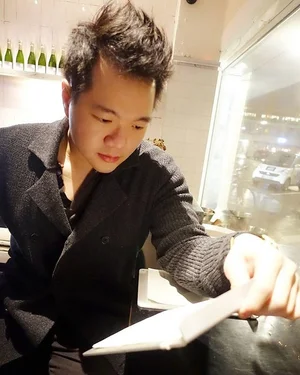
The French chef has spent decades refining the discipline behind haute cuisine. At Les Amis in Singapore, that work extends from the plate to the people who will cook after him.
When Sébastien Lepinoy took charge of Les Amis, he inherited more than a kitchen. The restaurant had opened in 1994 as one of Singapore’s formative independent fine-dining addresses, built by friends who wanted to bring the standards of France’s great restaurants to the city. To lead it meant respecting that history while deciding what a new generation of guests should experience at the table. Lepinoy’s answer has been exacting French cooking, supported by a team trained to care about the details around it.
Today, Les Amis identifies him as its director of culinary and operations. That title is a useful clue to the scope of his work. His responsibility reaches beyond creating recipes. A restaurant of this kind depends on the rhythm of a kitchen, the confidence of its service team, the quality of its wine programme and the consistency that allows a guest to trust the experience on an ordinary Tuesday as much as on a celebrated evening.
A career built across demanding kitchens
Before the Singapore chapter, Lepinoy spent more than a decade working closely with Joël Robuchon, according to a profile published by one of his fine-dining partners. In Hong Kong, he was executive chef at L’Atelier de Joël Robuchon when it earned two Michelin stars in 2008. He also led Cépage, a Les Amis Group restaurant in Hong Kong that held a star before closing in 2013. These were places where technical proficiency was a starting point. Running them required him to turn individual skill into a standard that an entire brigade could repeat.
His Singapore appointment in 2013 came with choices that were not simply about plating. In a Michelin interview, Lepinoy recalled proposing a significant reduction in menu prices and persuading the owners to invest in a rebuilt kitchen. The decisions suggest a chef interested in the conditions that make excellent cooking possible and accessible, rather than in the prestige of a dining room alone. They also required the trust of the restaurant’s owners and the people who would work in the new space.
Les Amis received two Michelin stars when the guide launched in Singapore in 2016, then a third in 2019. The chronology is important, but the awards are less revealing than what Lepinoy said about the work behind them: he revisited every recipe to improve the balance of its ingredients. Tatler Asia’s profile of Lepinoy describes a chef committed to pure French haute cuisine and the arts de la table, the customs and care that surround a meal. At Les Amis, the ambition is for food, service and wine to form one coherent experience.
What it means to cook French food here
Lepinoy’s cooking puts prized seasonal ingredients from France through precise, classical preparations. This does not mean a static collection of old recipes. It means knowing which parts of the tradition are worth preserving and how to make them vivid for someone dining in Singapore today. The restaurant describes his dishes as technically demanding and his approach as rooted in French gastronomy. A broader professional profile notes that his years in Asia have also informed the way he presents those techniques.
The plate is only one opportunity to tell that story. Les Amis says its team tries to explain the people, places and practices behind important ingredients, rather than stopping at a brief description of provenance. Its stated ideal gives equal weight to cooking and personalised service. For a guest, that can change a tasting menu from an exercise in recognising expensive produce into a chance to understand why a particular ingredient was chosen and how it was handled.
Lepinoy’s position is therefore partly that of a teacher. The restaurant says he makes a point of mentoring younger cooks and that former protégés have gone on to internationally recognised kitchens. The results of that effort are difficult to capture in one dish, but they matter to the future of French cooking in the region. A chef can protect a tradition by holding it tightly; Lepinoy’s stated aim is also to pass on the judgement needed to practise it well.
The person behind the standard
The pursuit of consistency can sound impersonal from outside a kitchen. Lepinoy’s own account of Les Amis’s first Michelin recognition is more human. After the 2016 ceremony, he returned to the restaurant to thank the team and celebrate with them. He has spoken about the support of the owners and guests, and about continuing to improve after the third star. Those comments locate the achievement in a group effort, even if the chef’s name is the one most readily attached to it.
His Instagram account offers another window onto the working chef, while his professional profile provides a direct way to follow his career. Neither substitutes for the meal, but both make it easier to see that a long-established restaurant is still a place of daily decisions, seasonal changes and people learning their craft.
For readers following the chefs shaping Singapore’s dining scene, Lepinoy’s story sits alongside very different paths: Roberto Galbiati’s journey from Milan and Shintaro Hozumi’s inherited sushi tradition each show how a cook carries a place or practice into a new setting. Browse more of the restaurants behind such stories in The Cuisine Journal’s venues.
Lepinoy’s contribution at Les Amis is measured in more than stars. It is in the discipline that makes a French meal feel complete, and in the younger cooks who may take that discipline somewhere he has not yet imagined.