Maison Boulud Singapore: French Comfort and Riviera Spirit at Marina Bay Sands
There is a particular difficulty in making French food feel luxurious without making it feel distant.
French gastronomy carries enormous historical weight. Its sauces, pastry, charcuterie, braises and restaurant traditions form part of the foundation upon which much of modern Western fine dining was built. Yet that history can also become baggage. A restaurant can become overly formal, excessively reverential or so concerned with refinement that the pleasure of simply eating disappears.
Maison Boulud approaches the problem differently.
The Singapore restaurant at Marina Bay Sands is built around French food that still wants to be eaten enthusiastically.
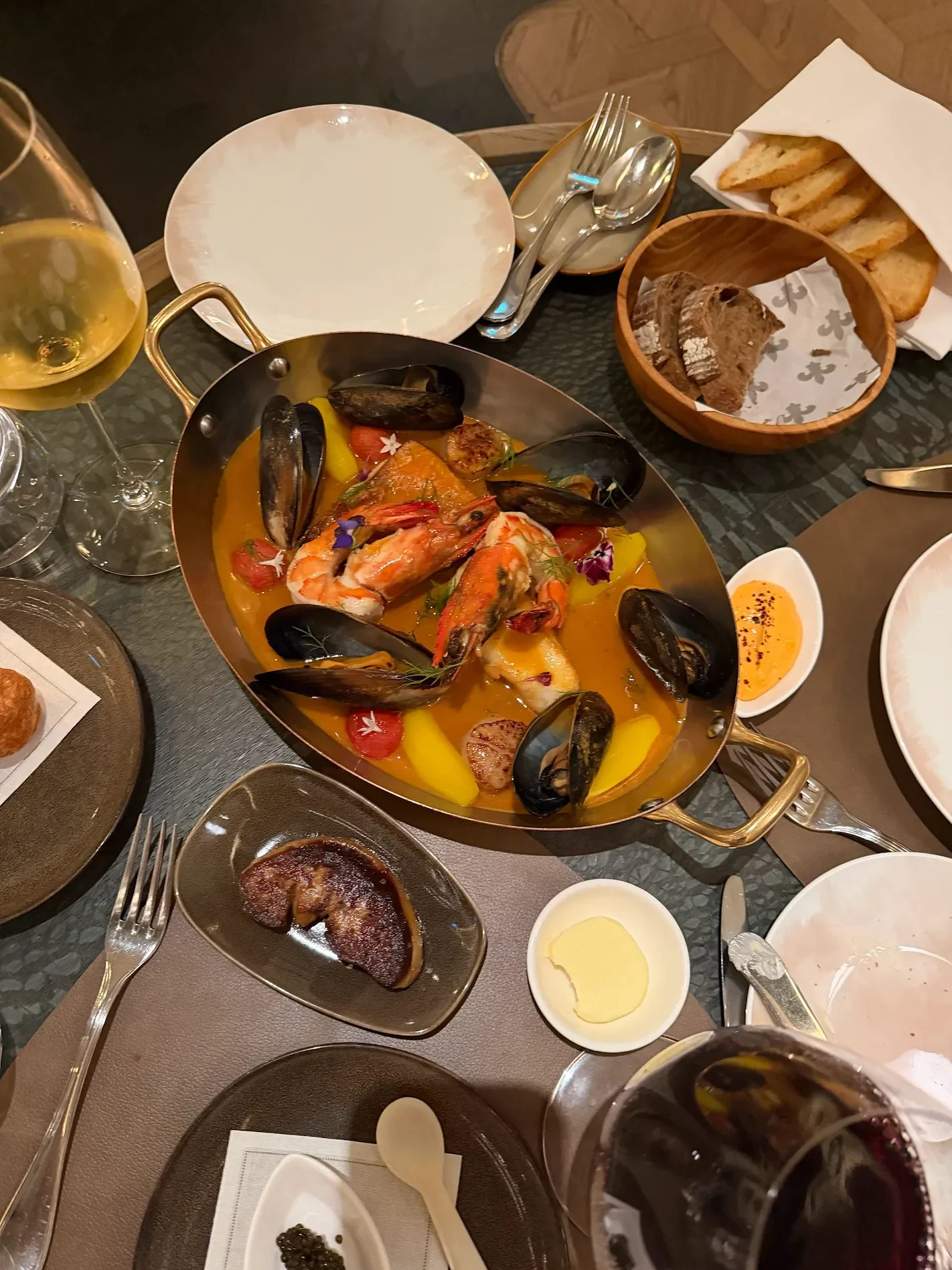
There is lobster bisque and duck confit. There are escargots, foie gras, seafood platters, coq au vin and substantial cuts of beef. Warm madeleines can arrive at the end. A burger can still exist alongside more elaborate dishes. Wine is important, but so is the ability to sit beside Marina Bay and order something simply because it sounds good.
That places Maison Boulud somewhere between the traditional French restaurant and the contemporary luxury dining room.
It is polished without depending entirely on ceremony.
It is ambitious without requiring every dish to explain itself.
And perhaps most importantly, it remains recognisably part of chef-restaurateur Daniel Boulud's larger philosophy: French cooking grounded in seasonality, hospitality and the pleasures of the table.
Within The Cuisine Journal's growing collection of Singapore venues, Maison Boulud represents a particularly useful example of how a major international chef can create a restaurant that feels substantial without turning dinner into an extended tasting-menu performance.
Daniel Boulud and the Idea of the French Family Table
Daniel Boulud's reputation was built in the world of serious French cooking.
Born near Lyon, he developed a career spanning classical French restaurants, New York fine dining and an expanding international collection of restaurants.
But Maison Boulud is not intended to operate as another version of his flagship fine-dining restaurant.
The name itself offers a clue.
A maison is a house.
That domestic reference matters.
Maison Boulud's Singapore identity is built less around the rarefied language of haute cuisine than around the idea of French food designed for gathering.
The restaurant's current official Maison Boulud page describes the concept through familiar French comforts and food intended to be shared: moules frites, substantial beef, wine and dishes drawn from the tradition of the French family table.
That does not mean the cooking is rustic in execution.
It means the emotional reference point is different.
A perfectly prepared duck confit can still feel comforting.
A rich bowl of lobster bisque can be technically refined without requiring intellectual interpretation.
A plate of coq au vin can carry culinary history while still functioning as something recognisably meant to satisfy hunger.
Maison Boulud's strongest dishes often exist in precisely this territory.
They are polished versions of food that already has a reason to exist.
A Restaurant Built Across Two Levels
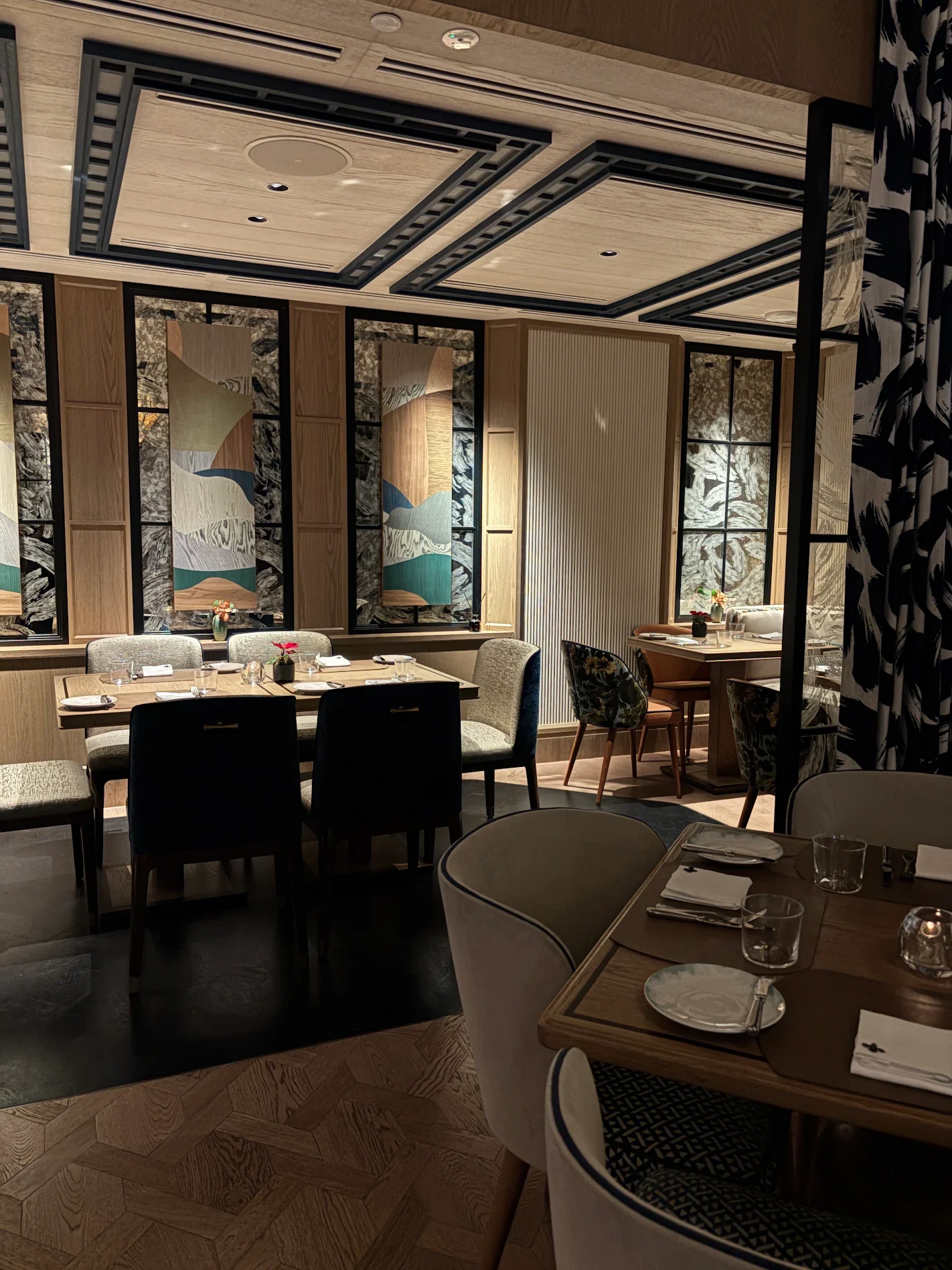
Maison Boulud's physical layout contributes significantly to its identity.
The restaurant occupies two levels at The Shoppes at Marina Bay Sands, and the experience can change considerably depending on where a guest sits.
Downstairs, the main dining room provides the more enclosed restaurant experience.
Upstairs, the promenade level connects the restaurant much more directly to Marina Bay.
That distinction appears repeatedly in diner feedback.
Some guests describe the lower dining room as comfortable and elegant. Others particularly recommend the upper level for its views. Outdoor seating introduces yet another atmosphere, especially later in the day when the waterfront becomes part of the dinner.
The result is almost two restaurants operating within the same culinary identity.
One is inward-looking.
The other faces the city.
That flexibility matters because Maison Boulud does not serve only one kind of diner.
Someone might arrive for a long celebratory dinner.
Someone else might stop for lunch while shopping.
Another guest might order drinks and something small while looking across the waterfront.
Weekend brunch introduces another rhythm again.
The restaurant can therefore shift from destination dining to something closer to an elegant neighbourhood brasserie — except that the neighbourhood happens to be Marina Bay Sands.
Why the Riviera Matters
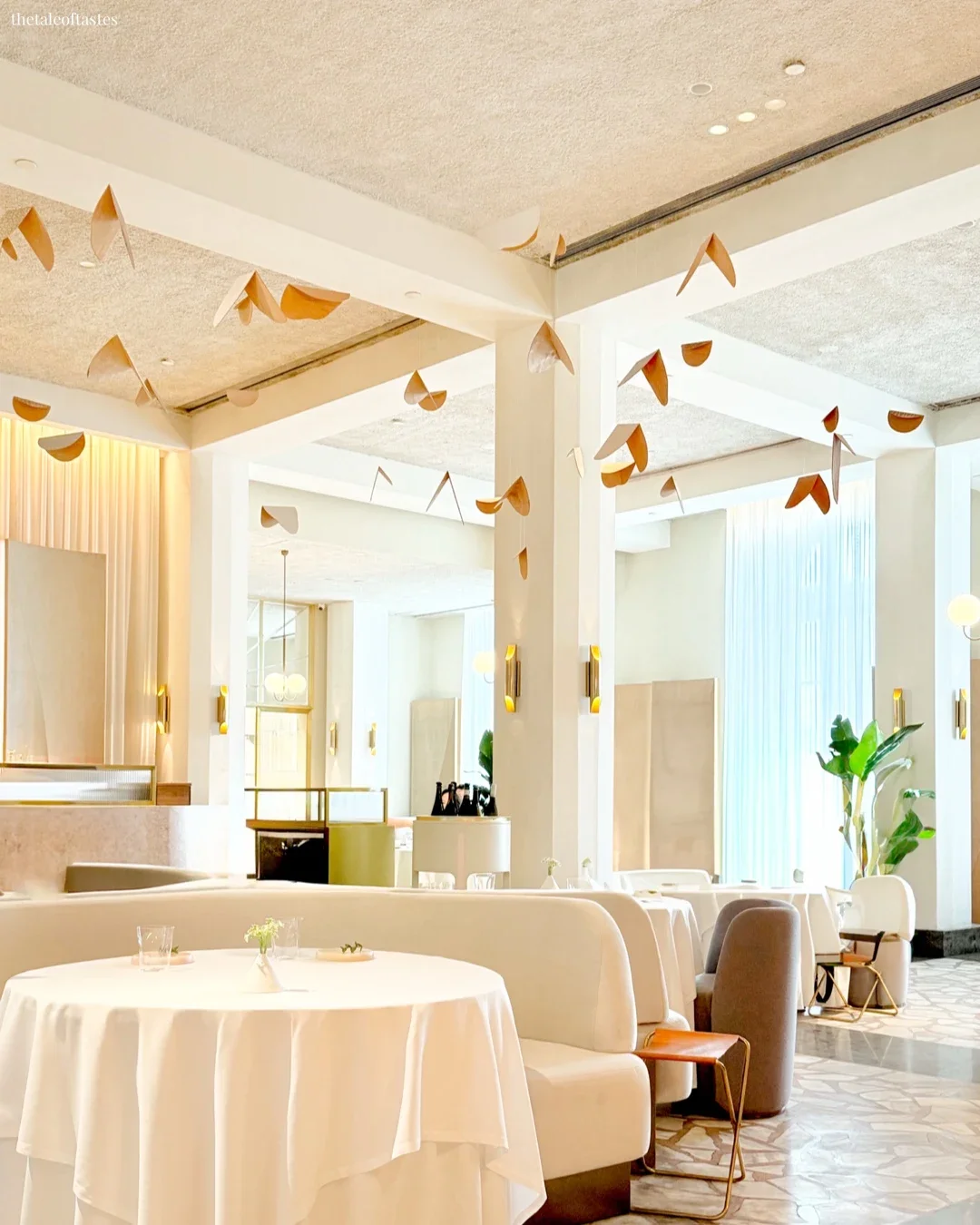
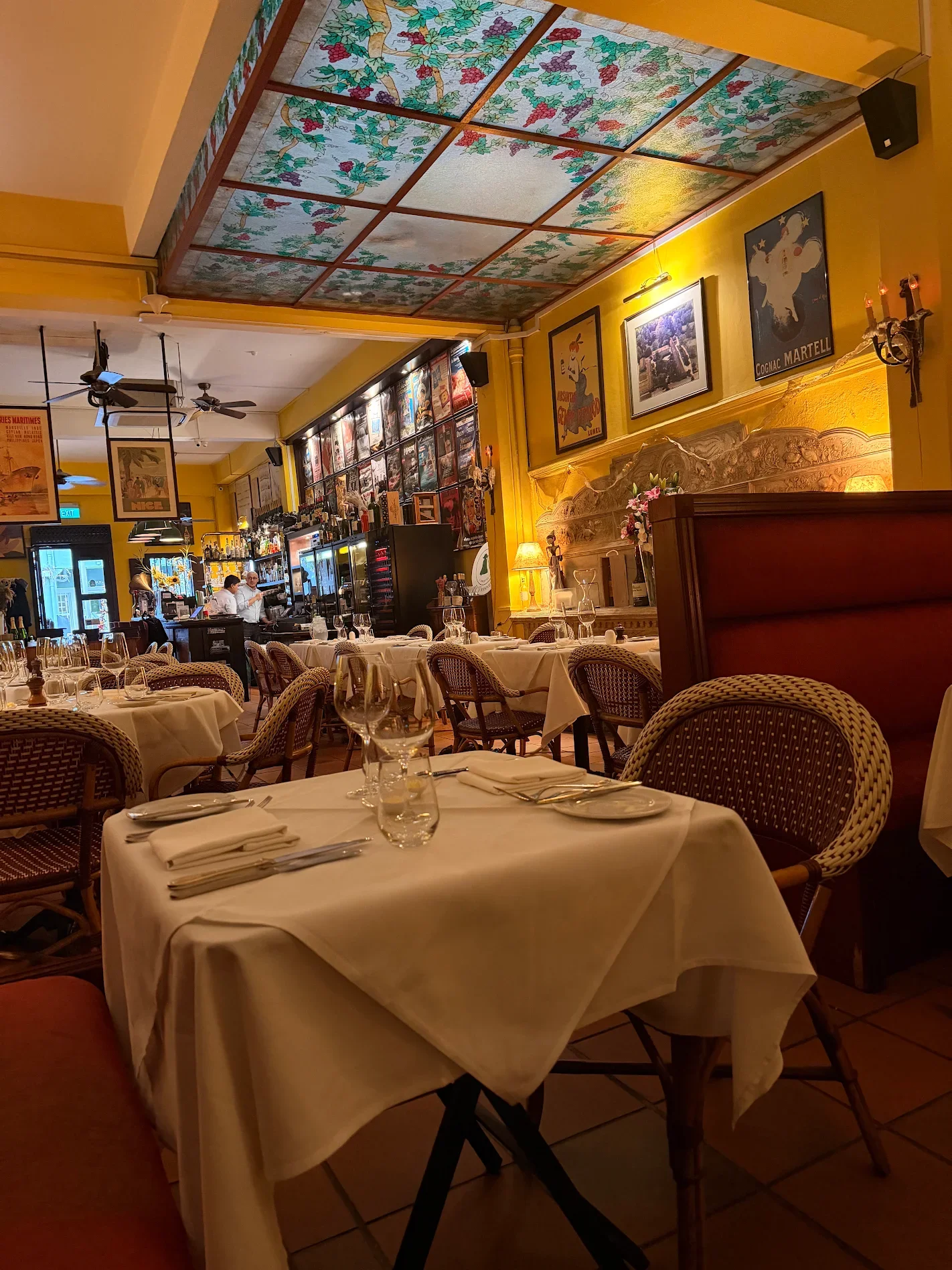
Maison Boulud's atmosphere often carries references to Southern France and the Mediterranean rather than to the darker visual language commonly associated with an old Parisian bistro.
That lighter identity suits Singapore.
French cuisine encompasses far more than butter-heavy sauces and braised meat.
Southern France provides another vocabulary entirely.
Seafood.
Tomatoes.
Olive oil.
Herbs.
Garlic.
Vegetables.
Bright sauces.
Grilled fish.
The flavours of Provence and the Mediterranean allow French cooking to feel considerably more natural in a tropical city.
This is also where the influence of the Singapore restaurant's opening team becomes relevant.
When Maison Boulud opened in Singapore, Executive Chef Rémy Carmignani played an important role in translating Boulud's approach for the local restaurant.
Carmignani had already developed a culinary identity shaped by Southern France, Italy, North Africa and his own years of travel. In an earlier World Travel Magazine profile of Rémy Carmignani, he described growing up in Montélimar in France, surrounded by fresh produce and family cooking, while Italian heritage and later experiences in Morocco broadened his understanding of Mediterranean cuisine.
That background made him an intuitive fit for a Maison Boulud built around French cooking that could move comfortably towards the Mediterranean.
Carmignani later left Singapore, but his role belongs to the restaurant's opening chapter rather than its current leadership.
The underlying idea remains.
French technique does not have to mean heaviness.
Lobster Bisque and the Pleasure of Concentration
Few dishes reveal the strengths and weaknesses of classical cooking as quickly as lobster bisque.
On paper, the concept is straightforward.
Shellfish.
Stock.
Aromatics.
Cream.
Perhaps alcohol.
Perhaps tomato.
But the difference between an ordinary bisque and a memorable one is enormous.
A good version needs concentration without becoming exhausting.
The lobster flavour should be obvious.
The texture should feel luxurious without turning into cream soup.
The seasoning needs enough intensity to carry the richness.
Maison Boulud's lobster bisque appears repeatedly in diner feedback.
Guests describe it as rich, velvety and strongly flavoured by lobster without becoming excessively heavy.
That balance is important because bisque can easily become an example of everything diners assume traditional French cuisine will be: thick, rich and tiring.
When properly controlled, it is something else entirely.
It is a demonstration of extraction.
The shell becomes flavour.
The stock becomes concentration.
The final bowl becomes a condensed expression of the ingredient.
Escargots Without Treating Tradition as Untouchable
Escargots are another useful example of how Maison Boulud approaches recognisable French dishes.
Snails in garlic and butter carry such a strong association with French restaurants that there is always a danger of treating them as museum pieces.
Maison Boulud has allowed more variation.
Diners have described versions incorporating tomato and pastry, introducing additional acidity and texture around the familiar richness of escargots.
This reflects a broader principle within Boulud's cooking.
Tradition is important.
But tradition does not mean immobility.
The core identity of the dish should remain understandable.
What surrounds it can change.
That philosophy separates reinterpretation from reinvention.
Maison Boulud rarely appears interested in making French food deliberately unrecognisable.
Instead, it asks whether familiar food can become slightly sharper, lighter or more suited to its environment.
Duck Confit May Be the Restaurant's Most Dependable Argument
If one dish emerges particularly strongly from diner accounts, it is duck confit.
Again and again, guests mention it.
Crisp skin.
Tender meat.
Properly rendered fat.
Balanced accompaniments.
It is easy to understand why the dish suits Maison Boulud.
Duck confit belongs to the great category of food that sounds simple because centuries of technique have already solved many of its problems.
The principle began as preservation.
Duck legs were salted, slowly cooked in fat and stored.
Modern restaurants no longer need confit primarily as a preservation method, but the process still produces something difficult to reproduce through ordinary roasting.
Slow cooking tenderises the meat.
Fat protects it.
A final crisping gives the skin contrast.
The finished plate contains two opposing textures: yielding meat underneath brittle skin.
That contrast is what makes badly executed confit disappointing.
If the skin remains soft, something is missing.
If the meat becomes dry, the entire point of the process has been lost.
Maison Boulud's duck appears particularly successful because diners repeatedly notice both.
The skin is crisp.
The meat remains moist.
In a restaurant serving many more elaborate dishes, that consistency may be more meaningful than any amount of decorative plating.
Coq au Vin and the Problem of Familiarity
Coq au vin faces a different problem.
It is almost too familiar.
Chicken braised in wine with mushrooms, bacon and aromatics belongs to the international image of traditional French cooking.
That familiarity creates high expectations.
There is nowhere for the dish to hide behind novelty.
Maison Boulud's version has generated both praise and occasional criticism.
Some diners describe tender chicken and a satisfying red-wine sauce.
Others have wanted greater depth or found particular preparations overly salty.
That variation is worth retaining in the picture of the restaurant.
Classical dishes create unusually personal reactions because many diners arrive with an internal reference point.
One guest may compare a coq au vin with another restaurant.
Another may compare it with France.
Another may compare it with something cooked at home.
When a restaurant serves recognisable food, memory becomes part of the seasoning.
The Restaurant Is Strongest When the Classics Feel Alive
This may be the central challenge facing Maison Boulud.
It does not have the protection of novelty.
Restaurants built around highly experimental food can create dishes diners have never encountered before. There is no direct comparison.
Maison Boulud often chooses the opposite route.
Duck confit.
Steak.
Mussels.
Lobster bisque.
Foie gras.
Roast chicken.
French onion soup.
These are names people recognise before the plates arrive.
The restaurant therefore has to earn attention through execution.
This puts it in a very different category from a restaurant such as Burnt Ends, where Dave Pynt built an entire culinary language around fire and custom ovens.
Burnt Ends can surprise through process.
Maison Boulud often has to surprise through how well something familiar has been cooked.
Neither challenge is easier.
They are simply different.
Seafood Keeps the Menu Moving
A restaurant inspired partly by the Mediterranean needs seafood.
Maison Boulud has plenty of it.
Oysters.
Lobster.
Mussels.
Trout.
Sea bass.
Seafood platters.
Crab.
Shellfish appears repeatedly across diner accounts and has become one of the more consistent parts of the restaurant's identity.
The seafood platter also maintains continuity with Daniel Boulud's earlier Singapore presence, giving long-time diners something familiar while the larger restaurant identity changed around it.
Seafood is important structurally as well.
Without it, a menu filled with foie gras, duck, braised chicken and beef could become overwhelmingly rich.
Shellfish provides sweetness.
Oysters provide salinity.
Fish allows cleaner sauces.
Tomatoes, herbs and vinaigrettes can become more prominent.
This is where the Riviera influence becomes particularly useful.
The kitchen can move away from the heavier stereotype of French cooking without moving away from France.
Trout and the Value of Proper Fish Cookery
Several diners specifically praise Maison Boulud's trout.
One described crisp skin with moist, flaky flesh accompanied by corn and tomato.
That sounds straightforward.
It is not.
Fish cookery exposes timing mercilessly.
A steak has a reasonable range between rare and medium.
Fish can move from properly cooked to dry within a much smaller window.
Crisping the skin adds another complication.
Moisture needs to leave the skin while the flesh underneath remains protected.
This makes a good piece of pan-seared fish a small technical achievement that diners often consume without thinking about the difficulty involved.
Maison Boulud's strongest seafood dishes seem to understand this.
The technique disappears.
The diner notices the texture.
That is usually the desired result.
The Seafood Platter and a Different Kind of Luxury
Seafood towers and platters occupy an interesting place in restaurant culture.
They are simultaneously luxurious and primitive.
Very little needs to be done to a good oyster.
A lobster does not require architectural plating.
Fresh shellfish can simply arrive cold, arranged generously and ready to share.
That makes the seafood platter almost the opposite of contemporary fine dining.
Its luxury comes from abundance rather than manipulation.
Maison Boulud's continuing emphasis on seafood makes sense within its broader philosophy of conviviality.
A platter changes how the table behaves.
People reach.
Share.
Compare.
Pass things across the table.
Conversation develops around the food.
That is entirely consistent with a restaurant presenting itself as a maison rather than a temple.
Foie Gras and the Richer Edge of the Menu
Foie gras remains another important part of the restaurant's French vocabulary.
Diners have mentioned it both in starters and as additions to larger meals.
Its appeal is almost entirely about texture and richness.
Foie gras can become overwhelming very quickly, which means the ingredients around it matter enormously.
Acidity becomes useful.
Fruit becomes useful.
Toast introduces texture.
Wine pairing changes the experience again.
Maison Boulud's broader menu helps here because foie gras does not exist in isolation.
A diner can move from seafood into foie gras, then towards fish or meat.
The progression can be constructed rather than simply accumulated.
Beef, Rossini and the Architecture of Indulgence
At the richer end of Maison Boulud sits beef.
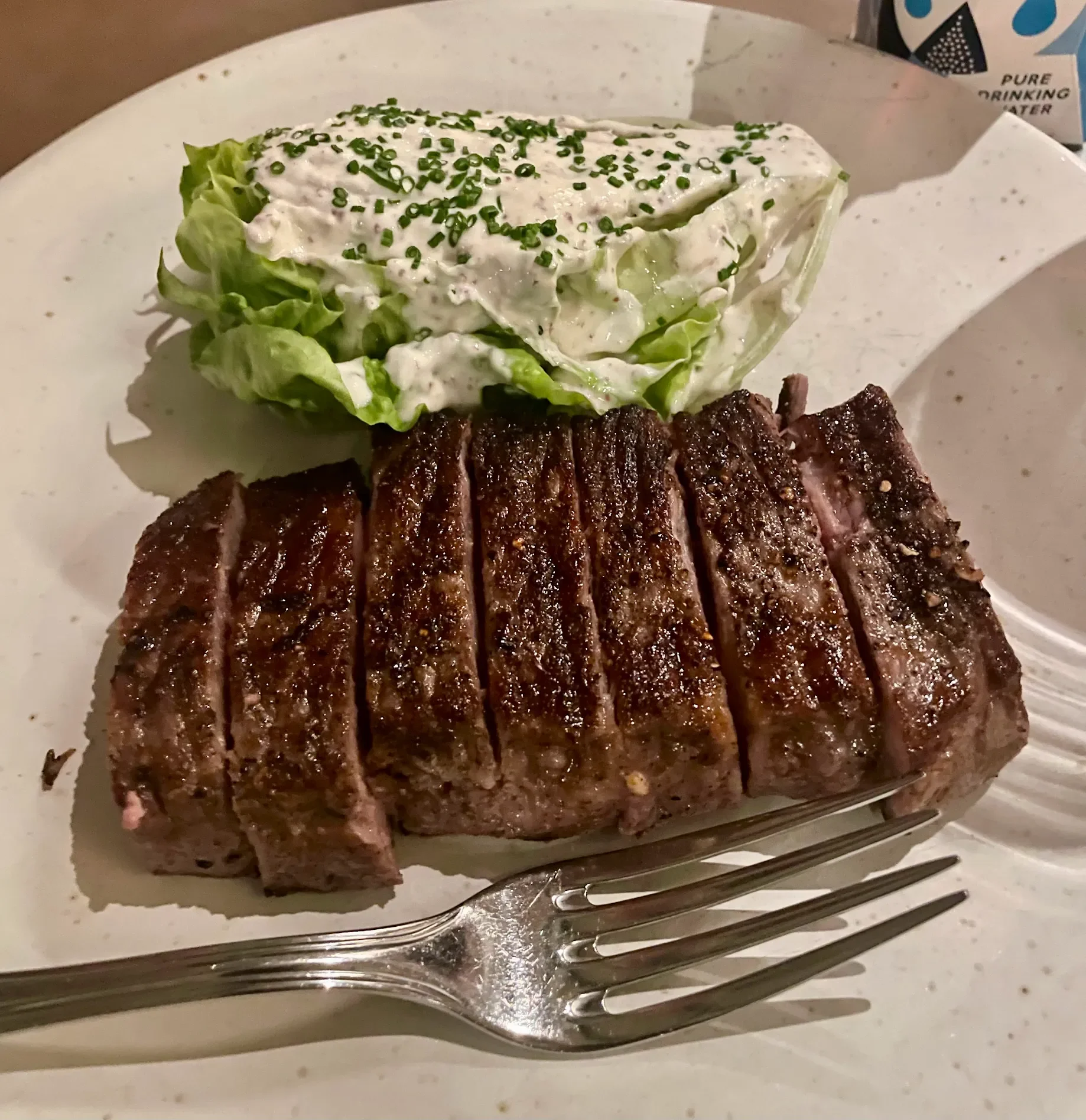
The restaurant has served substantial cuts intended for sharing as well as individual steak preparations and Rossini-style dishes.
Rossini represents French luxury almost in caricature.
Beef.
Foie gras.
Sauce.
Often truffle.
It is richness built upon richness.
There is very little pretending that the dish is light.
And that has value.
A restaurant does not need every plate to be restrained.
The point is choosing where excess belongs.
Within Maison Boulud, a richer beef preparation can act as the climax of a meal precisely because earlier courses can be lighter.
Luxury works best when it has contrast.
Without contrast, it becomes background noise.
Ratatouille, Gnocchi and the Sides That Diners Remember
One of the more interesting patterns in Maison Boulud's diner feedback is how often side dishes receive serious attention.
Ratatouille.
Gnocchi.
Brussels sprouts.
Fries.
These are not necessarily the dishes that headline menus.
Yet diners repeatedly remember them.
That is a useful sign.
Side dishes reveal whether a kitchen only concentrates on expensive centrepiece ingredients or whether the entire table receives attention.
Ratatouille can be terrible.
Overcooked vegetables collapse into indistinct softness.
Underseasoned versions taste virtuous rather than pleasurable.
Properly prepared ratatouille should preserve enough identity within the vegetables while allowing them to become part of the same dish.
Gnocchi presents an entirely different technical challenge.
Too much flour and they become heavy.
Too little structure and they disintegrate.
A restaurant taking these dishes seriously communicates something important about its priorities.
The steak is not allowed to carry the meal alone.
The Burger Still Belongs Here
A burger in a restaurant associated with a celebrated French chef might seem contradictory.
It is not.
Daniel Boulud has spent decades demonstrating that hierarchy in food is more complicated than simply dividing dishes into fine and casual.
A burger can contain serious technique.
Bread matters.
The grind of beef matters.
Fat ratio matters.
Seasoning matters.
Sauce matters.
Temperature matters.
What changes is the form.
This willingness to allow a burger to coexist with foie gras and seafood is part of what prevents Maison Boulud from becoming excessively self-important.
French cooking has a long tradition of grand cuisine.
It also has an equally important tradition of brasseries, bouchons, bistros and everyday eating.
Maison Boulud benefits from being able to move between those worlds.
The French Onion Soup Is More Divisive
Not every classic performs equally consistently in diner accounts.
French onion soup receives both praise and criticism.
Some guests enjoy it.
Others describe it as overly salty.
This is worth mentioning because salt is one of the recurring criticisms within the otherwise strongly positive review material.
A few diners have found individual dishes more heavily seasoned than they preferred, including coq au vin and onion soup.
Taste is subjective, particularly with reduced stocks, cheese, cured meat and wine-based preparations.
But repeated comments deserve acknowledgement.
They suggest that diners who prefer particularly restrained seasoning may experience some of the richer classics differently from those who enjoy more concentrated flavours.
A useful restaurant article should preserve that distinction rather than convert every piece of feedback into praise.
Bread: A Small Detail That Becomes Surprisingly Important
Another recurring criticism concerns bread.
Several diners have described the complimentary bread as cold.
At first glance, that seems trivial.
Within a restaurant of this level, it is not.
Bread establishes the meal before the first ordered dish arrives.
Warm bread signals care immediately.
Butter behaves differently against it.
Aroma becomes stronger.
Texture improves.
Cold bread can still be perfectly good bread, but expectations change when everything around it is polished.
This is a good example of how restaurant standards work.
The better the restaurant, the more visible small inconsistencies become.
Nobody visits Maison Boulud primarily for bread.
Yet several people remember whether it arrived warm.
Madeleines and the Importance of the Last Five Minutes
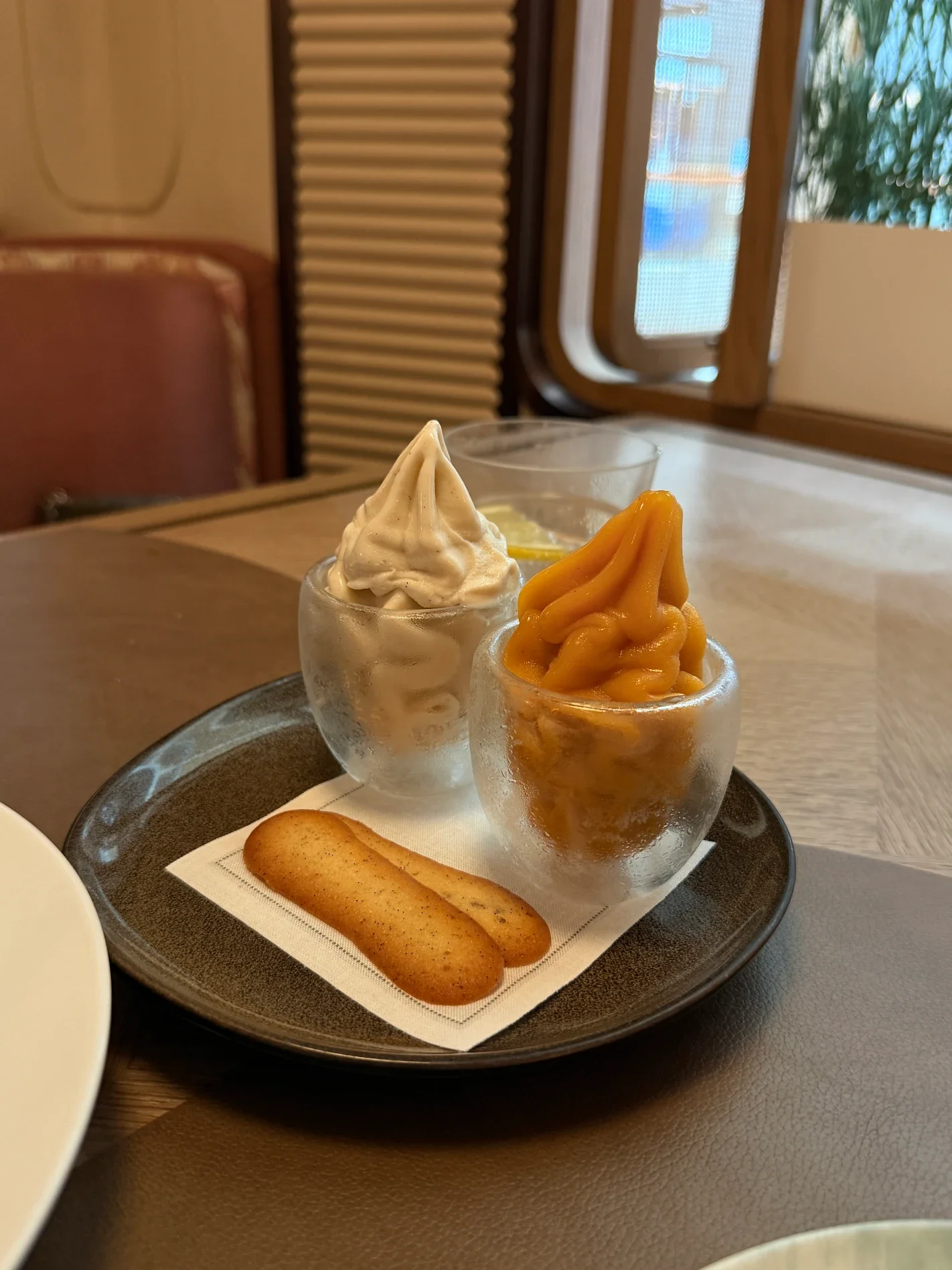
At the opposite end of the meal, madeleines appear repeatedly in enthusiastic diner feedback.
This makes sense.
A warm madeleine is almost perfectly designed to create affection.
It is small.
Buttery.
Soft.
Slightly crisp around the edges when fresh.
And deeply associated with French baking.
Serving madeleines at the end of dinner accomplishes something important.
It gives the restaurant one final opportunity to create a sensory memory after the main dessert has technically finished the meal.
Warm pastry has aroma.
Aroma lingers.
The diner leaves with it.
One guest joked that the only regret of dinner was not leaving enough room for the madeleines.
That is exactly the kind of reaction an ending should produce.
Citron, Pistachio and Desserts That Can Stand on Their Own
Maison Boulud's dessert programme extends considerably beyond the madeleines.
Diners highlight fruit desserts, pistachio preparations, ice creams and soufflés.
A citron-pistachio dessert appears particularly memorable in feedback, praised for balancing citrus acidity, nuts, creaminess and sweetness.
Dessert matters enormously in a restaurant built around French culinary identity.
France's savoury cooking may attract much of the attention, but pastry operates almost as a separate culinary discipline.
Sugar changes chemistry.
Temperature matters differently.
Precision becomes even more important.
A sauce can sometimes be adjusted during cooking.
Pastry is considerably less forgiving.
The presence of distinctive desserts prevents the final course from feeling like an obligation following the savoury menu.
It becomes another reason to visit.
The Restaurant Works Particularly Well for Celebrations
Birthdays and anniversaries appear repeatedly in Maison Boulud's diner feedback.
That is not surprising.
Marina Bay already gives the restaurant a sense of occasion.
The dining room adds polish.
The waterfront provides visual drama.
French food carries cultural associations with celebration.
And the service team frequently adds small gestures.
Complimentary desserts.
Candles.
Anniversary cakes.
Personal acknowledgement from staff.
These gestures are inexpensive compared with the cost of running a serious kitchen, but emotionally they can be more memorable than a complicated plate.
A diner might forget the exact garnish beside the duck.
They will remember that somebody noticed their birthday.
That is hospitality.
Service Is One of Maison Boulud's Strongest Assets
The majority of supplied diner feedback speaks very positively about service.
Staff are repeatedly described as warm, attentive and professional.
Individual employees are mentioned by name.
Guests describe recommendations delivered without pressure.
Special occasions are recognised.
Requests are accommodated.
The strongest accounts describe service that is present without becoming intrusive.
That balance is difficult.
Too little attention feels careless.
Too much feels oppressive.
The ideal server appears before the diner realises they need something.
That is easy to write.
Much harder to perform across an entire dining room.
Maison Boulud appears to achieve it often.
But Service Is Not Universally Consistent
There are exceptions.
A small number of diners describe communication failures.
One guest ordered coffee assuming it was included in a set lunch and wished the additional charge had been clarified.
Another reported coffee orders arriving incorrectly.
There are accounts of tables being asked to settle bills earlier than expected because of subsequent reservations.
Some guests feel the layout can make service less attentive when staff are spread across different areas.
These criticisms do not overwhelm the broader pattern.
But they matter because Maison Boulud sells more than food.
It sells ease.
When a restaurant asks diners to spend an evening in a polished waterfront environment, logistical friction becomes particularly noticeable.
Hospitality succeeds when the guest does not need to think about how the restaurant operates.
The moment they begin thinking about table turnover or ordering errors, the machinery becomes visible.
Two Floors, Two Experiences
Physical placement within Maison Boulud can also shape perception more than usual.
Guests seated upstairs frequently praise the waterfront setting.
Outdoor diners appreciate the quieter promenade atmosphere.
Some downstairs diners find the room cosy.
Others would prefer greater privacy or a more open outlook.
This is useful information because the restaurant is not spatially uniform.
Two tables ordering identical food can have noticeably different evenings simply because one overlooks Marina Bay and another sits nearer the interior bar.
That does not make one inherently superior.
It means diners should understand what kind of experience they want when reserving.
A private dinner may benefit from the more enclosed room.
A leisurely evening with drinks may suit the waterfront.
Lunch creates another atmosphere entirely.
Marina Bay Sands and the Destination Restaurant
Maison Boulud also belongs to a particular category of Singapore restaurant: the destination restaurant inside a destination.
Marina Bay Sands already combines hotels, shopping, entertainment, casinos and restaurants within one large ecosystem.
That changes how restaurants operate.
Some diners arrive specifically for Maison Boulud.
Others discover it because they are already at Marina Bay Sands.
This mix matters.
A destination restaurant cannot assume every guest has spent weeks planning dinner.
It needs to accommodate impulse alongside intention.
Maison Boulud's broad menu helps.
Someone can commit to a substantial dinner.
Someone else can order seafood and wine.
Another table can have burgers.
Another can celebrate an anniversary over several courses.
That versatility is a strength.
It resembles, in a different culinary register, the way KOMA Singapore turns dining into part of a larger Marina Bay Sands experience.
The difference is one of emphasis.
KOMA foregrounds spectacle.
Maison Boulud foregrounds conviviality.
Design Without Allowing Design to Become the Main Course
Maison Boulud is undeniably attractive.
The waterfront setting helps.
So does the Riviera-influenced interior language.
Yet the restaurant does not appear interested in allowing design to overpower food.
This distinguishes it from venues where architecture becomes the immediate reason people visit.
Maison Boulud takes a quieter approach.
The space tells diners where they are.
The food is still expected to give them a reason to remain.
That balance becomes increasingly important in Singapore, where visually striking restaurants are plentiful.
Beautiful restaurants are no longer unusual.
Restaurants need another argument.
French Food in an Increasingly International Singapore
Maison Boulud also exists within a dining culture where national cuisines are becoming less rigid.
A French restaurant can use Mediterranean ingredients.
An Italian restaurant can operate through a contemporary international lens.
Asian ingredients can enter European kitchens without automatically turning a dish into "fusion."
Maison Boulud performs a similar negotiation with French cuisine.
It needs to remain recognisably connected to Daniel Boulud's French heritage while making sense beside Marina Bay in Singapore.
That is why the lighter Mediterranean elements matter.
That is why seafood matters.
That is why tomato, herbs and acidity matter.
And that is why the restaurant can comfortably coexist with dishes as traditional as coq au vin and duck confit.
Identity does not require uniformity.
Value Appears More Often Than Expected in Diner Feedback
One surprising pattern in the review material is the number of diners who describe Maison Boulud as good value.
That does not mean inexpensive.
This remains a restaurant at Marina Bay Sands associated with a globally recognised chef.
But set lunches and multi-course menus have allowed some guests to experience the restaurant at prices they considered reasonable relative to the food, setting and service.
This is strategically important.
Luxury restaurants often struggle with repeat visits because every meal becomes a major financial event.
A set lunch creates another entry point.
Someone can experience the kitchen without committing to the most elaborate dinner.
They may return later.
A restaurant becomes more resilient when it can serve both milestones and ordinary days.
The Difference Between Fine Dining and Formal Dining
Maison Boulud also demonstrates that fine dining and formal dining are not necessarily the same thing.
The food can be carefully sourced.
The kitchen can be technically ambitious.
Service can be professional.
The wine programme can be serious.
None of that requires dinner to become stiff.
This may be one of the restaurant's most valuable characteristics.
Guests repeatedly describe the atmosphere as comfortable.
Couples talk.
Families celebrate.
People linger over wine.
Someone can sit outside.
Someone can order a burger.
The restaurant maintains standards without requiring guests to perform sophistication.
That aligns increasingly well with modern dining culture.
Luxury is moving away from intimidation.
Comfort has become part of refinement.
What the Reviews Reveal When Taken Together
Individual restaurant reviews are inherently subjective.
One person loves a dish another finds salty.
One diner finds a room intimate.
Another finds it insufficiently private.
One guest remembers perfect service.
Another remembers an ordering mistake.
The useful information appears when patterns emerge across many experiences.
At Maison Boulud, several patterns are clear.
The duck confit attracts consistent praise.
Seafood is a major strength.
Lobster bisque appears repeatedly.
Desserts often perform well.
Madeleines create disproportionate affection.
The waterfront and upstairs seating are frequently appreciated.
Service is usually described as warm and professional.
Set menus often receive positive comments on value.
And the criticisms are relatively concentrated: occasional over-seasoning, cold bread, communication lapses and inconsistent attentiveness during some services.
That is a considerably more informative picture than either universal praise or universal criticism.
It reveals a restaurant with strong fundamentals and identifiable imperfections.
Maison Boulud Does Not Need to Behave Like a Tasting Menu Restaurant
This may ultimately be one of the restaurant's greatest advantages.
Singapore already has numerous restaurants designed around tightly controlled culinary journeys.
Maison Boulud does not need to compete by becoming another one.
Its appeal lies elsewhere.
Choice.
Sharing.
Comfort.
Wine.
Classics.
Seafood.
Dessert.
The ability to order according to appetite rather than surrender the entire evening to a fixed sequence.
That makes the restaurant useful in ways a tasting-menu restaurant cannot always be.
A first date has different requirements from an anniversary.
A business lunch differs from a birthday dinner.
A visitor walking through Marina Bay Sands has different expectations from a diner who booked six weeks ago.
Maison Boulud can accommodate all of them.
A French Restaurant That Understands Pleasure
There is a tendency when discussing accomplished restaurants to focus heavily on technique.
Technique matters.
But diners do not eat technique.
They experience its results.
A perfectly cooked duck leg produces pleasure.
A well-made sauce produces pleasure.
Fresh oysters produce pleasure.
A cold glass of wine beside Marina Bay produces pleasure.
Warm madeleines produce pleasure.
French cuisine became influential partly because generations of cooks systematised technique.
But the objective was never the system itself.
The objective was a better meal.
Maison Boulud seems strongest when it remembers that distinction.
Maison Boulud at a Glance
Restaurant: Maison Boulud by Daniel Boulud
Cuisine: French, with Mediterranean and seasonal influences
Location: The Shoppes at Marina Bay Sands, 10 Bayfront Avenue, Singapore
Setting: Two-level restaurant with a main dining room and waterfront promenade seating
Known for: Duck confit, lobster bisque, seafood, escargots, coq au vin, substantial beef dishes, desserts and warm madeleines
Best suited to: Lunches, date nights, business meals, waterfront dinners, birthdays and anniversaries
Maison Boulud occupies an interesting place in Singapore's French dining landscape.
It is not trying to preserve French cuisine behind glass.
Nor is it trying to dismantle it simply to prove that it can.
Instead, it treats tradition as something usable.
Duck can still be confited.
Chicken can still be braised in wine.
Bisque can still taste unapologetically of lobster.
Madeleines can still arrive warm.
But those dishes can exist inside a brighter restaurant, beside Marina Bay, surrounded by seafood, Mediterranean flavours and a style of hospitality considerably less formal than the grand French dining rooms from which much of the cuisine originated.
That may be the clearest expression of Daniel Boulud's idea of a maison.
Not simply a restaurant.
A house built around the pleasure of feeding people.