KOMA Singapore: When the Restaurant Becomes Part of the Show
At KOMA Singapore, dinner begins before the food arrives. A tunnel of vermillion arches, a monumental Japanese bell, a footbridge and a cavernous dining room turn this Marina Bay Sands restaurant into one of Singapore’s most recognisable dining spaces — with contemporary Japanese food designed to participate in the spectacle rather than compete against it.
There are restaurants where the dining room exists to support the food.
At KOMA, the dining room is part of what you ordered.
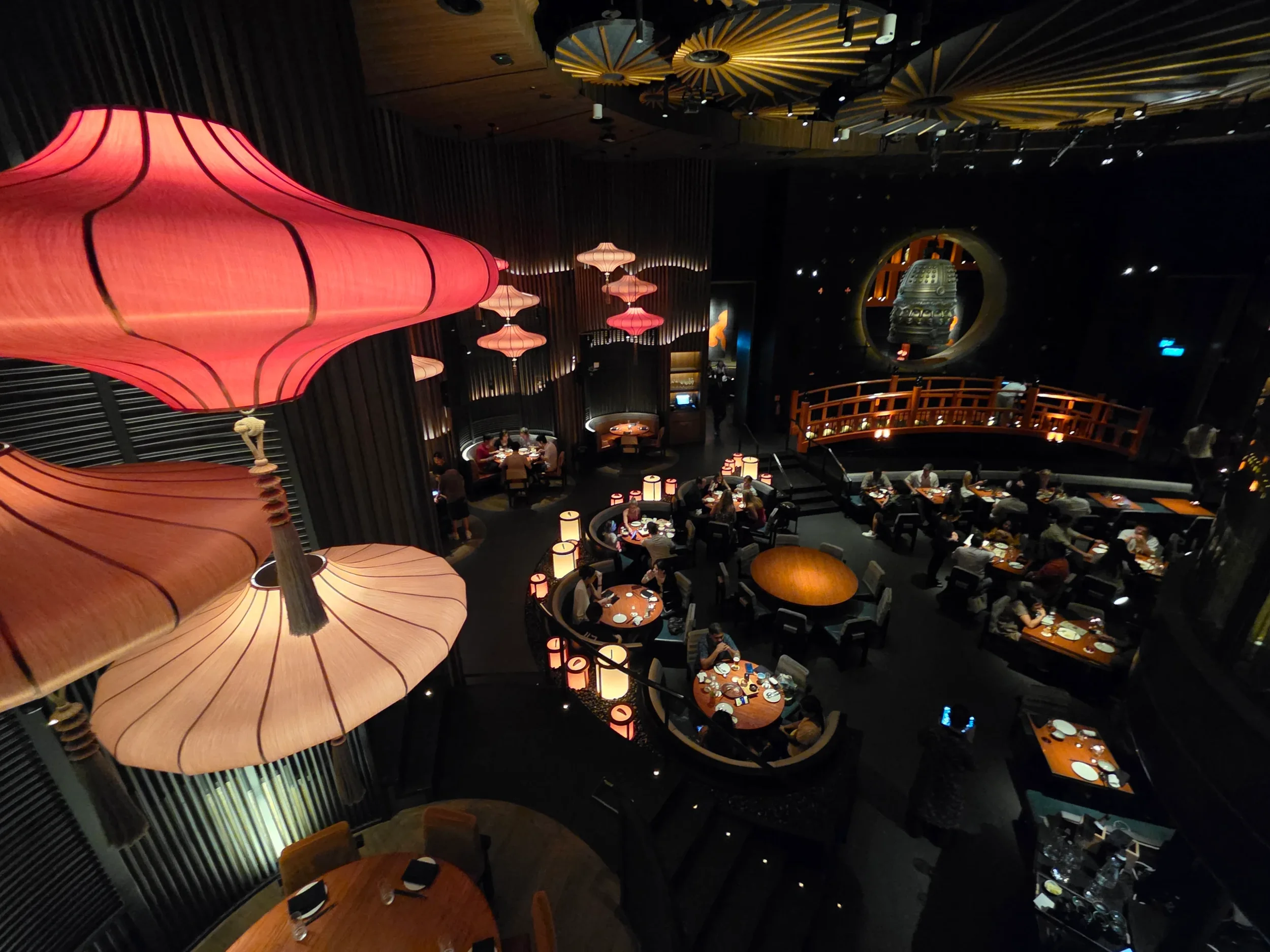
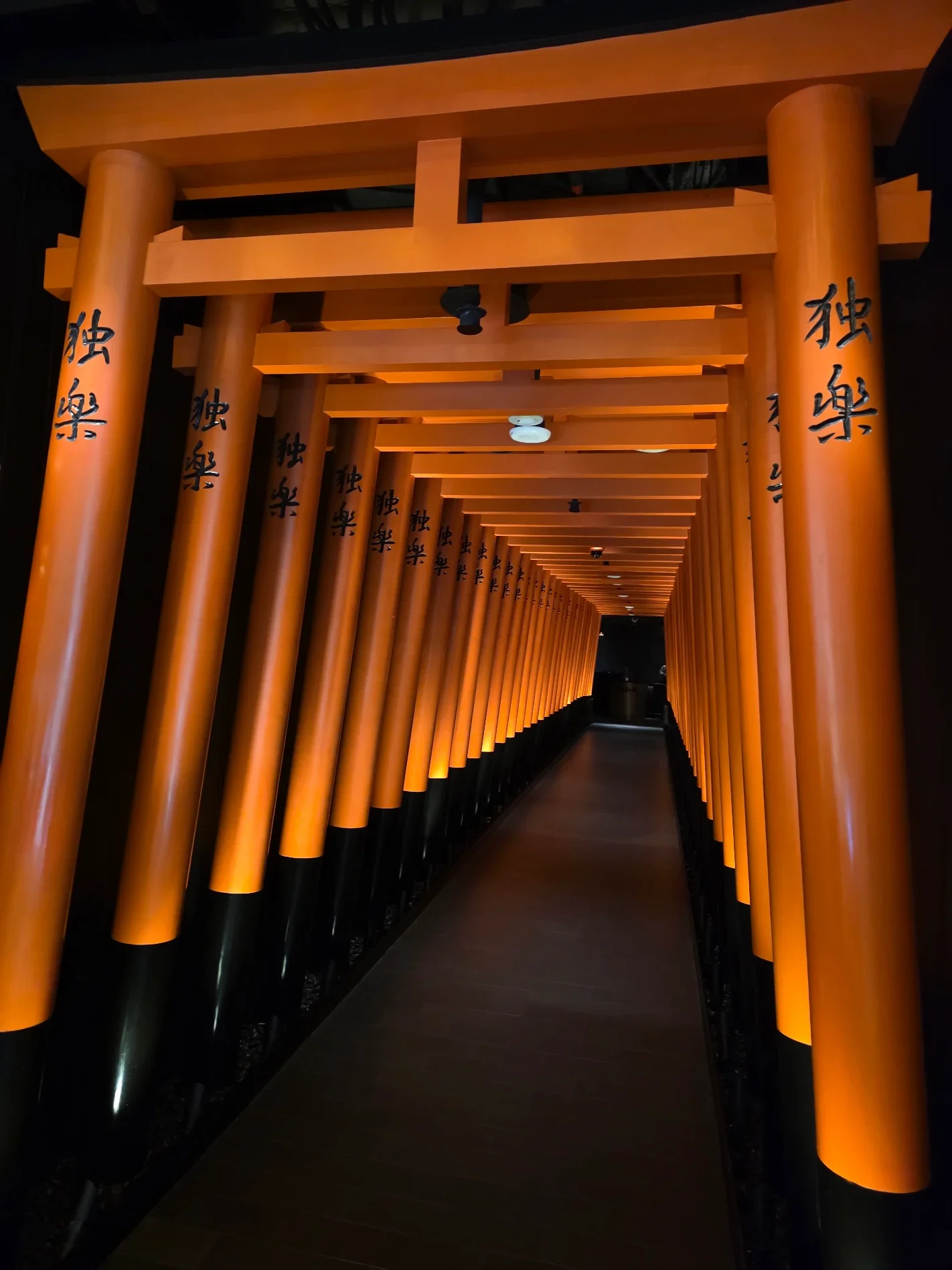
Located within The Shoppes at Marina Bay Sands, KOMA describes itself as a Japanese restaurant and bar built around an immersive experience. Guests approach through a passage of glowing vermillion arches inspired by Kyoto's Fushimi Inari Shrine, emerging into a dramatically darkened space dominated by a 2.5-metre Japanese bell positioned above a traditional footbridge.
It is one of those rare Singapore restaurants that can be identified from a photograph before any food appears in the frame.
And that matters.
Because KOMA is not trying to be a discreet neighbourhood Japanese restaurant.
It is trying to create an occasion.
The Walk to the Table Is Deliberately Dramatic
Most restaurant entrances are logistical.
KOMA's is theatrical.
The succession of red arches creates a transition between Marina Bay Sands and the restaurant itself. The effect references the seemingly endless torii gates associated with Fushimi Inari in Kyoto, although what waits on the other side is very much a contemporary interpretation rather than an attempt to recreate a Japanese shrine.
Then the scale changes.
The restaurant opens into a darker, much larger dining room where spot lighting picks objects out of the surrounding space. The bell, bridge, timber surfaces and red architectural details become focal points.
Diners notice.
Public feedback on KOMA returns to the interior almost obsessively. Guests describe the setting as magnificent, artistic, romantic and highly photographic. Even diners who are less convinced by individual dishes frequently concede that the room itself is memorable.
That is an important distinction.
At KOMA, atmosphere is not an accessory to the restaurant concept. Atmosphere is one of its products.
Explore more restaurants and food destinations through TCJ's Dining Venues.
Japanese Food Without the Omakase Rules
Despite its visual grandeur, KOMA is not an omakase restaurant.
That gives it a fundamentally different rhythm from many of Singapore's high-end Japanese dining rooms.
There is sashimi.
There is nigiri.
There are maki rolls.
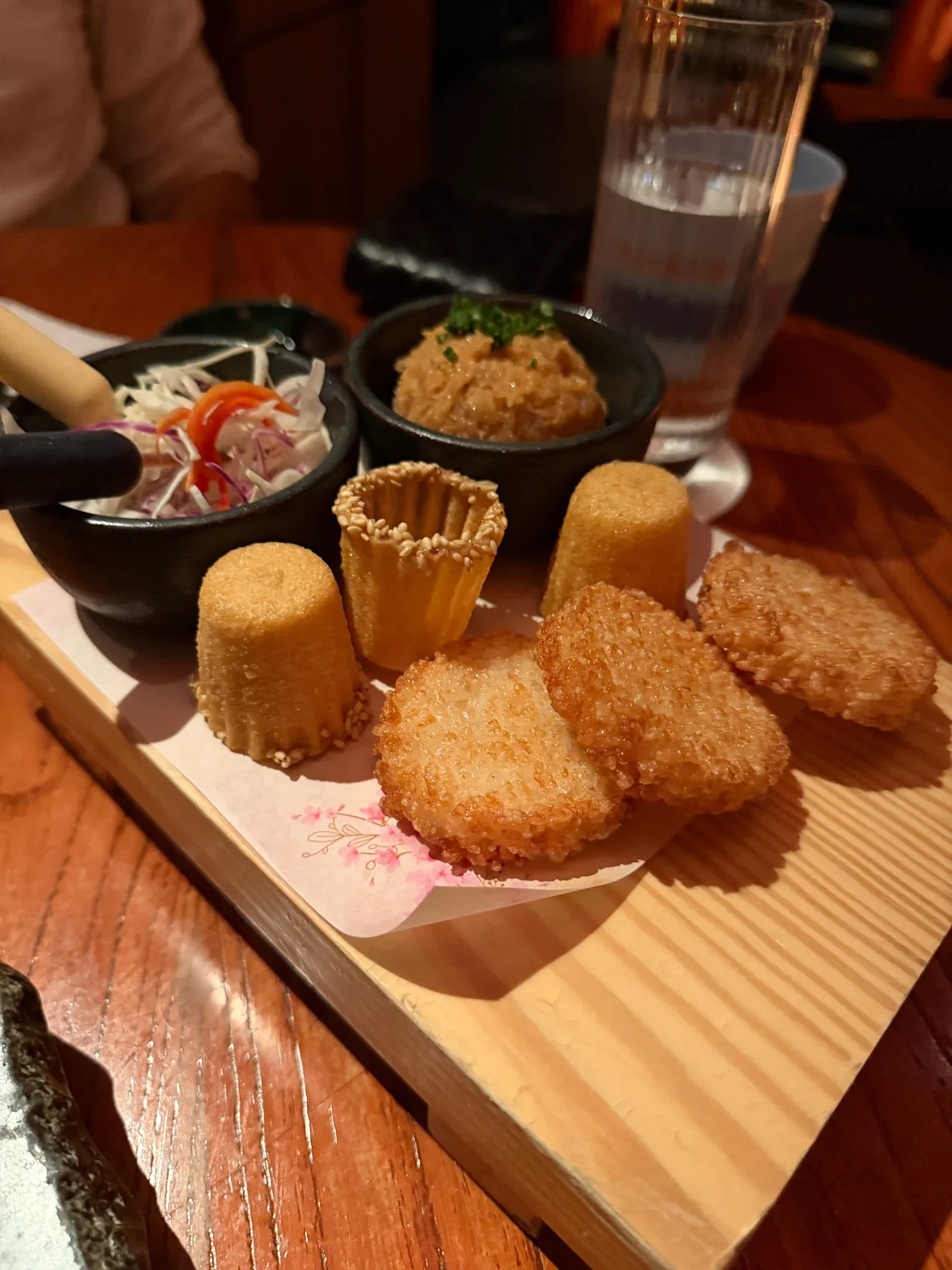
But there are also robata-grilled dishes, tempura, wagyu, fried rice, noodles, hot pots, large-format mains and desserts designed for the table.
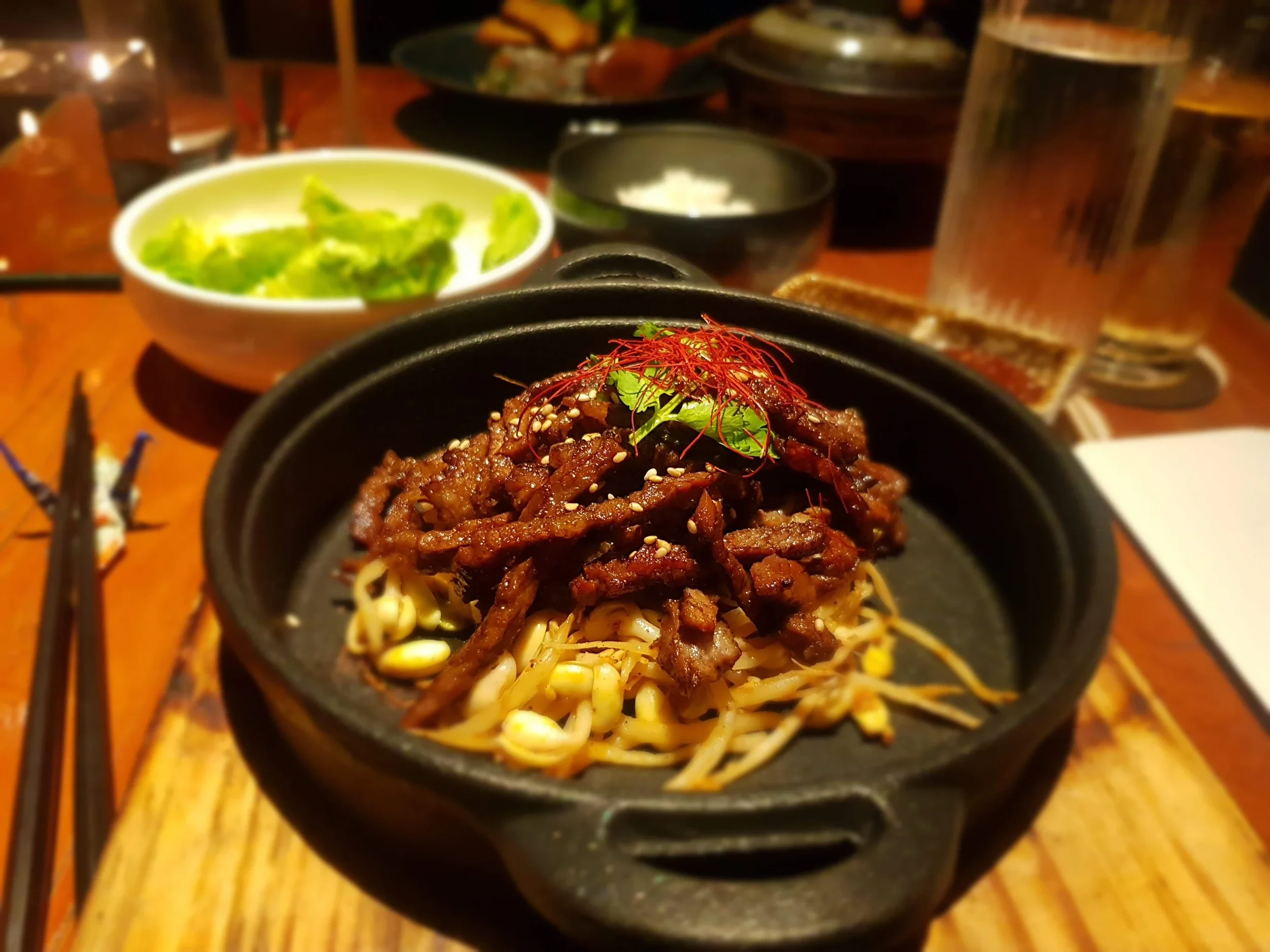
The current dinner menu includes dishes such as miso-marinated black cod, barbecued beef short rib, grilled soy-glazed octopus, scallion fried rice, una-ju and Japanese wagyu. Snow-aged Niigata Wagyu is available as both ribeye and tenderloin.
That breadth makes KOMA considerably easier to navigate for mixed groups than a chef-directed sushi counter.
Someone can order sashimi.
Someone else can eat wagyu.
Another person can order tempura or fried rice.
The table does not have to surrender itself to a predetermined sequence.
And that, in part, explains the restaurant's popularity for birthdays, dates and group celebrations.
The Black Cod Has Become One of the Safe Bets
One dish repeatedly emerging from recent diner accounts is the miso-marinated black cod.
The current version is served with marinated cucumber and hajikami ginger.
Diners consistently mention its flavour and texture, with several identifying the cod as one of the strongest dishes of their meal.
It is not a radical creation.
Miso-marinated black cod is by now firmly established within international Japanese dining.
But KOMA illustrates an important point about large destination restaurants: not every dish needs to reinvent its category.
Some dishes exist because people want them.
The important question is whether they are executed well enough to justify being there.
The same applies to many of KOMA's more familiar Japanese dishes. The restaurant's identity comes less from inventing a new culinary language than from placing recognisable Japanese flavours inside a highly distinctive environment.
Then There Is the Wagyu
At the other end of the menu sits KOMA's Japanese beef programme.
Its current dinner menu lists Snow-Aged Niigata Wagyu Ribeye and Snow-Aged Niigata Wagyu Tenderloin, served relatively simply with wasabi, ponzu and yuzu kosho.
Snow ageing is an interesting inclusion.
Rather than simply presenting Japanese wagyu as a luxury object, the technique introduces another story around handling and maturation.
Guests have responded particularly strongly to the ribeye, describing it as exceptionally tender and effective with the sharper accompaniment of wasabi.
This is characteristic of KOMA's menu.
Ingredients may be expensive and presentations polished, but the dishes remain relatively legible.
You usually know what you are ordering.
The Food Sometimes Has to Compete With the Room
KOMA has an unusual problem.
Its interior sets expectations before the first dish arrives.
That can work in the restaurant's favour.
It can also work against it.
A number of diners describe both the food and atmosphere enthusiastically. Others are more divided, praising the design and service while finding parts of the menu less memorable than the surroundings.
That criticism is useful because it gets to the central tension of a restaurant like KOMA.
If you build one of the most spectacular dining rooms in the city, ordinary good food can suddenly feel less impressive.
The room promises an event.
The food therefore has to perform inside one.
That does not necessarily mean every plate needs smoke, flames or elaborate presentation. In fact, doing so would probably become exhausting.
But KOMA occasionally embraces the theatrical possibilities.
Especially when dessert arrives.
The Bonsai That Became Part of KOMA's Identity
KOMA's Bonsai dessert may be almost as recognisable as the restaurant's entrance.
It is deliberately constructed to resemble a miniature bonsai tree, complete with an edible presentation extending beyond what diners ordinarily expect from a plated dessert.
Guests regularly mention the surprise that even components resembling the pot can be eaten.
This is dessert designed partly for taste and partly for recognition.
People photograph it.
People remember it.
People know which restaurant it came from.
In branding terms, that is extremely powerful.
A beautifully plated chocolate dessert can be served almost anywhere.
A dessert that visually belongs to one restaurant becomes part of the restaurant's iconography.
The Bonsai does exactly that.
And Sometimes KOMA Sets Dessert on Fire
For celebrations, the spectacle can go further.
Diners have reported ordering KOMA's Baked Alaska for birthdays and other occasions, with versions presented tableside and flambéed so that the exterior briefly catches fire.
It is hardly subtle.
It is also completely appropriate for the restaurant.
There is a tendency in serious food writing to treat theatrics as somehow less legitimate than technique.
That is unnecessary.
Restaurants serve experiences as well as calories.
A flaming dessert delivered during someone's birthday can become the thing they remember years later, even if another restaurant served them a technically superior quenelle.
KOMA understands this very well.
The Cocktails Understand the Assignment Too
The bar is not treated simply as somewhere to wait for a table.
Marina Bay Sands describes it as part of the progression through the restaurant, positioned after the torii-like entrance and before the main dining room. The wider beverage programme includes cocktails, wines, sake and spirits.
Diner feedback frequently singles out the cocktails for presentation as much as flavour, with some guests visiting the bar specifically for drinks and desserts after dinner elsewhere.
Again, this is consistent with KOMA's identity.
Nothing particularly wants to disappear into the background.
A drink can participate in the entertainment too.
Sushi Is Part of KOMA But KOMA Is Not Really About Sushi
There is a sushi counter.
The menu includes sashimi, nigiri and maki.
Guests sometimes choose counter seats specifically to watch the chefs prepare fish.
But judging KOMA purely as a sushi restaurant misses what it is trying to accomplish.
This is not the same proposition as an intimate sushiya where every decision revolves around the relationship between neta and shari.
KOMA operates on a much wider stage.
Its Japanese identity includes raw fish, but also charcoal grilling, wagyu, cooked seafood, tempura, rice dishes, cocktails and elaborate desserts.
The appropriate comparison is therefore not simply with Singapore's omakase counters.
It is with other destination restaurants, places where design, service, food and occasion are intentionally bundled together.
TCJ explores the people working across these different styles of restaurants through Professionals, while our Food Guides connect individual venues with broader questions of where and what to eat.
Lunch Offers a Different Way Into KOMA
KOMA does not have to be a S$200-per-person dinner.
Its current lunch offering includes a two-course set at S$58 and a three-course set at S$68, available daily except on public holidays and their eves.
Current appetiser options include dishes such as assorted tempura, salmon carpaccio, dried scallop chawanmushi, yellowtail salad and chicken karaage, while upgrades are available for items including sashimi and wagyu.
For diners primarily interested in seeing the restaurant rather than constructing an elaborate dinner, lunch therefore provides a considerably more accessible entry point.
It also changes the room.
A space deliberately engineered around dramatic lighting naturally feels different during lunch than during a long evening meal.
Both are KOMA.
But they are not quite the same KOMA.
Service Matters More in a Restaurant This Large
Spectacular rooms can sometimes produce impersonal restaurants.
KOMA's public feedback suggests service is one of the areas where it often avoids that problem.
Diners repeatedly mention individual staff members by name, describing servers who recommend dishes according to personal preferences, explain menu items, offer to take photographs or adjust tables when a party has ordered more food than expected.
Those are small actions.
But in a restaurant of this scale, small actions create the feeling that a guest has not disappeared into the machine.
This matters particularly because many people come to KOMA for birthdays, anniversaries and other occasions.
They are not simply asking a restaurant to feed them.
They are asking it to help produce a memory.
Is KOMA an Instagram Restaurant?
Yes.
But that description is not as damning as people sometimes think.
KOMA is plainly designed to be photographed.
The entrance is photogenic.
The bridge is photogenic.
The giant bell is photogenic.
The Bonsai dessert is photogenic.
The cocktails can be photogenic.
Even guests who use the term "Instagrammable" positively or negatively are recognising the same design decision.
The more useful question is whether there is anything underneath the photographs.
And KOMA's longevity suggests there is.
The restaurant has maintained significant demand in a dining market where visually spectacular venues regularly open and disappear.
Its appeal is not necessarily that it serves Singapore's most technically radical Japanese food.
It is that the entire package works together.
Who Is KOMA For?
KOMA makes the most sense for someone looking for a destination rather than simply dinner.
It works particularly well for:
birthdays,
anniversaries,
dates,
visitors to Singapore,
groups wanting different types of Japanese food,
and diners for whom the physical environment is an important part of choosing a restaurant.
It may be less compelling for someone whose only criterion is finding the city's most technically exacting sashimi or most traditional Japanese cooking.
That is not really the game KOMA is playing.
KOMA is selling Japanese food inside a fantasy.
And unusually, it does not pretend otherwise.
The arches announce it before you arrive at the table.
The bell makes it obvious once you get there.
The Bonsai reinforces it at dessert.
At KOMA, the room, the food and the photograph afterwards are all part of the same experience.
KOMA Singapore
10 Bayfront Avenue, #B1-67
The Shoppes at Marina Bay Sands
Singapore 018956
Cuisine: Contemporary Japanese
Format: À la carte / Set Lunch / Bar
Dress Code: Smart Casual
KOMA currently serves lunch daily from 11:30am, with the last seating at 2:30pm. Dinner runs from 5pm to 10pm Sunday to Thursday, and from 5pm to 11pm on Friday, Saturday and the eve of public holidays.
Reservations are recommended, particularly for dinner and special occasions.
Visit the official KOMA Singapore page.
Explore more through TCJ's Dining Venues, Professionals, Products and Food Guides.