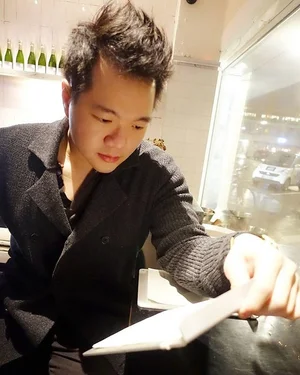
The chef-owner of Odette traces his respect for ingredients to a childhood in rural France. In Singapore, that inheritance has become a modern French restaurant shaped by Asian producers and a team he credits for its success.
Julien Royer begins the story of Odette with his grandmother. In Cantal, France, he grew up in a family of fourth-generation farmers and watched her turn the ingredients around them into food that could bring people together. The restaurant he opened in Singapore carries her name. It is a personal beginning for a chef whose work now takes place in one of the city’s most exacting dining rooms, within National Gallery Singapore.
That connection between ingredient and feeling is more than a naming story. Royer describes learning to value the care behind a meal before he understood the professional techniques that would later shape his cooking. The restaurant’s own account of him follows a childhood of harvesting and foraging, then an early kitchen experience under Michel Bras in Laguiole. It identifies that period as important to his respect for the integrity of each ingredient. Years of work in the French West Indies and London preceded his arrival in Singapore in 2008.
Building a cuisine in Singapore
Royer’s approach is French in structure but has been shaped by his years in Asia. Odette says its dishes begin with produce at its peak and with relationships among the farmers and artisans who supply it. A chef can import an ingredient for its reputation; Royer’s stated interest is in what it contributes to a particular plate. His restaurant’s page about the people behind Odette also makes clear how many cooks, bakers, sommeliers and service colleagues turn that philosophy into a guest’s actual meal.
His Singapore career before Odette included Brasserie Les Saveurs at The St. Regis and JAAN at Swissôtel The Stamford. He opened Odette in 2015 at the National Gallery, taking the step from leading other kitchens to building one around his own name and family story. A biographical chronology records the earlier appointments and the restaurant’s opening, while Odette’s own account gives the fuller sense of why he cooks as he does. Odette went on to earn three Michelin stars, but the distinction alone cannot explain its point of view.
The restaurant’s cuisine asks ingredients from different places to speak to one another. French technique gives the meal coherence, while the pantry reflects a chef cooking in this part of the world. Royer has spoken about his Kampot pepper-crusted pigeon as an example: the pepper comes from Cambodia, the bird from a producer in Brittany, and the dish depends on the care behind both. The point is not to display far-flung origins for their own sake. It is to make the combined ingredients worth the journey to the table.
Ten years, and a team
In a CNA Luxury interview marking Odette’s tenth anniversary, Royer returned repeatedly to the people around him. He credited a shared vision and daily work for the restaurant’s standards, and described time as increasingly precious after a decade of service. The interview also looked toward a refresh of Odette’s dining room. The chef was considering how the restaurant could continue to evolve without losing the sense of care that began its story.
Odette’s people page gives the team a specificity that the usual phrase “the brigade” can obscure. It lists colleagues across savoury cooking, pastry, bread, wine, hosting and the dining room, and welcomes stagiaires who want to learn. Royer’s own professional description stresses nurturing the next generation of hospitality leaders. That impulse connects to a broader responsibility of the chef-owner: the restaurant must keep its standards even as people grow, leave, arrive and bring new ideas.
Royer’s career also extends beyond Odette. He is associated with Claudine in Singapore and Louise in Hong Kong, each a different expression of French hospitality. The existence of those restaurants makes Odette’s identity more precise. It is the place where his grandmother’s influence, exacting technique, producer relationships and the collective work of a large team meet in a particularly ambitious format.
What the legacy might be
There is a temptation to tell a chef’s story as a sequence of prizes. Royer’s is more revealing when followed through the questions he keeps asking. What is the ingredient like at its best? Who grew or raised it? What does the team need to do so the guest understands it without an exhausting explanation? And how can a restaurant known for refinement remain welcoming? His professional profile offers a direct route to his work beyond the dining room, but those questions are visible in the restaurant’s public account and his interview.
Other chefs in Singapore have also built identities around inheritance and attentive hospitality. Shintaro Hozumi’s sushi story follows a family craft across generations, while Yuji Sato’s approach to the counter considers the guest as closely as the fish. Browse more chef-led restaurants in The Cuisine Journal’s venues.
For Royer, the lasting achievement may be the ability to carry a childhood lesson into an institution much larger than one person. Odette’s name honours his grandmother. Its daily work depends on the many hands that make her lesson legible to a guest today.