Les Amis Singapore: Three Michelin Stars and the Discipline of Classical French Fine Dining
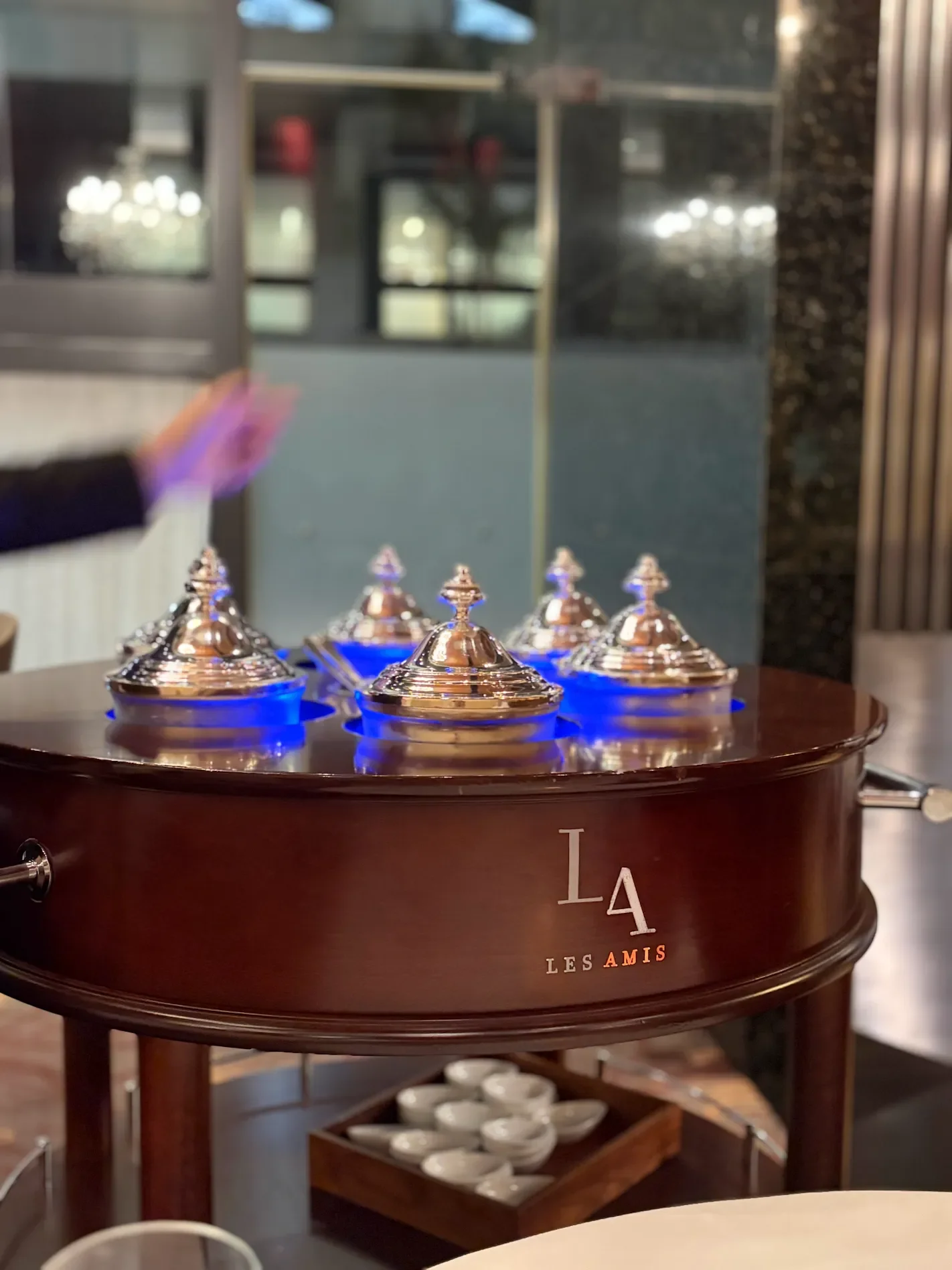
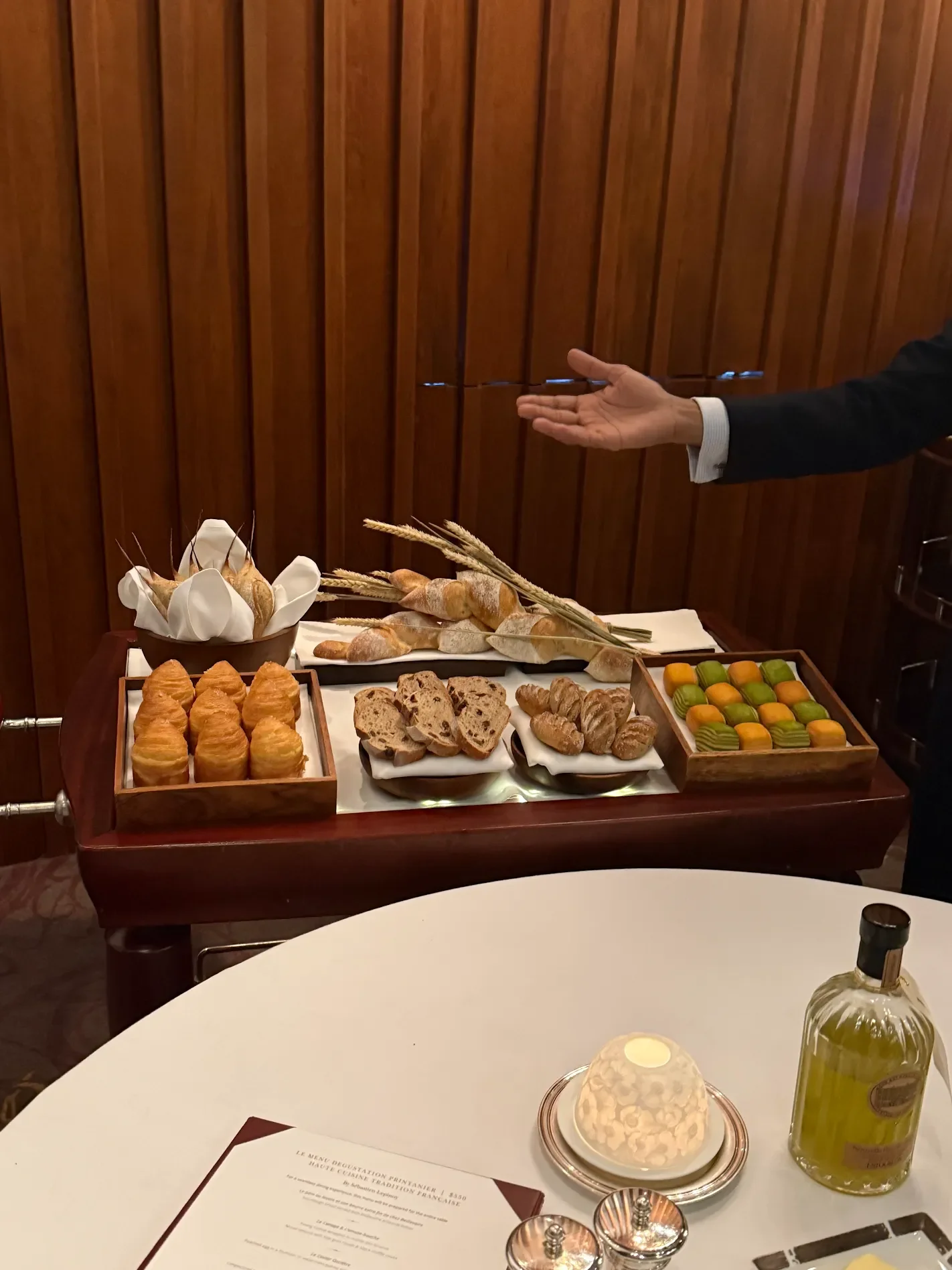
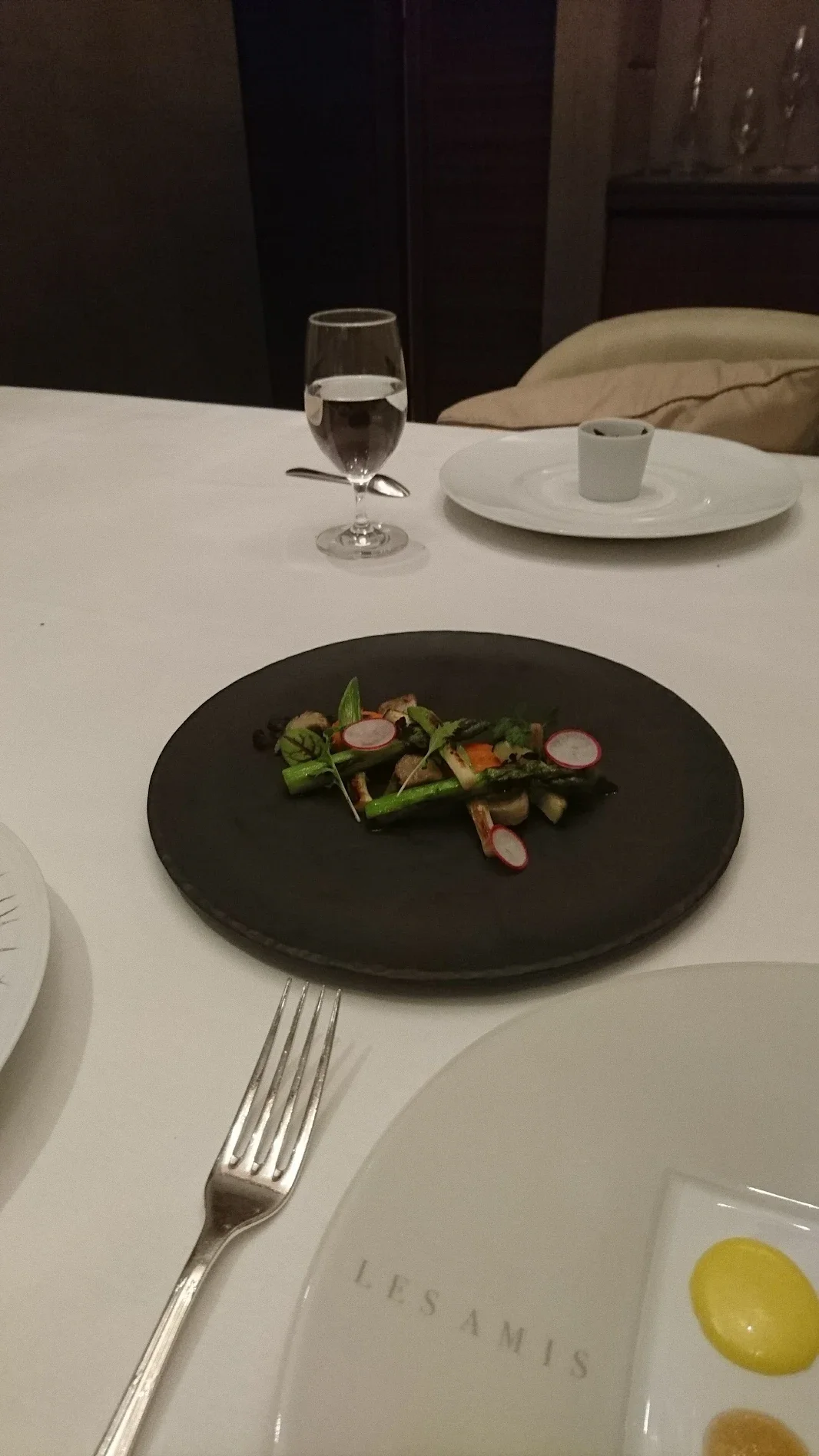

Les Amis has occupied the same corner of Shaw Centre since 1994, growing from Singapore’s first independent fine-dining restaurant into one of the country’s most decorated dining rooms. Under chef Sebastien Lepinoy, it has become increasingly committed to classical French haute cuisine, exceptional French produce, formal service and one of Asia’s most extensive wine programmes.
Les Amis does not behave like a restaurant trying to keep up with trends.
There are white tablecloths.
Silverware.
Crystal.
Cheese arrives on a trolley.
Bread receives its own ceremony.
Sauces matter.
Wine matters enormously.
Ingredients are introduced by where they come from, not simply what has been done to them.
And while much of contemporary fine dining has moved towards informality, open kitchens and globally blended tasting menus, Les Amis has increasingly travelled in the opposite direction.
It has become more French.
That evolution is particularly striking because Les Amis opened in 1994, long before Singapore developed the fine-dining landscape it has today.
More than three decades later, it remains at 1 Scotts Road in Shaw Centre, and in the 2026 Michelin Guide it retained three Michelin stars for another year.
The restaurant's longevity is therefore only part of the story.
The more interesting question is how a restaurant this old continues to remain relevant while insisting that some traditions are worth keeping.
Les Amis Means “The Friends”
The name is straightforward.
Les Amis means “the friends” in French.
The restaurant was founded by a group of friends who shared an interest in French food, wine and dining culture.
When it opened on 15 March 1994, Singapore's fine-dining landscape looked very different.
Many of the city's most formal restaurants were attached to luxury hotels.
Les Amis was independent.
Its founders wanted to reproduce the standards they had experienced in leading restaurants in France, but to do so through a standalone Singapore restaurant.
That made Les Amis an important early example of something now taken for granted: a serious fine-dining restaurant in Singapore that did not need a five-star hotel surrounding it.
Today, the restaurant is part of the wider Les Amis Group, but the original dining room remains the flagship around which much of the group's identity was built.
Thirty Years Is a Long Time in Restaurants
Restaurants disappear quickly.
Rent changes.
Chefs leave.
Customers move on.
Food trends change.
A restaurant operating continuously for more than thirty years therefore carries a different problem from a new opening.
It cannot survive purely through novelty.
People already know the name.
Some guests have been eating there for decades.
Others arrive precisely because they have heard that Les Amis represents an older, more formal tradition of fine dining.
One recent diner supplied to The Cuisine Journal described having visited Les Amis for around 20 years, noting that the staff still recognised him after long gaps between visits.
That kind of continuity is difficult to manufacture.
It requires institutional memory.
The restaurant has to remember its customers while simultaneously training new generations of staff.
Sebastien Lepinoy Arrived at a Difficult Moment
Chef Sebastien Lepinoy did not create Les Amis.
That distinction matters.
The restaurant existed for almost two decades before he took control of its kitchen.
But his arrival fundamentally changed its modern identity.
Lepinoy is a French chef whose career was strongly shaped by Joël Robuchon, one of the most influential French chefs of the late twentieth century.
He spent years within Robuchon's kitchens and later worked in Hong Kong and Las Vegas before joining the Les Amis Group.
When he eventually took responsibility for Les Amis, the restaurant was not necessarily in its strongest period.
Lepinoy has recalled inheriting a restaurant that was struggling commercially, along with a kitchen that had remained largely unchanged since the 1990s.
His task was therefore not simply to create new dishes.
He had to decide what Les Amis was supposed to be.
For more chef-led restaurant stories in Singapore, The Cuisine Journal's Venues follows restaurants across very different levels of formality and culinary tradition.
The Answer Was France
Lepinoy's eventual answer was remarkably uncompromising.
France.
Not French-inspired.
Not contemporary European.
Not French-Asian.
Not international fine dining with French technique.
French.
The restaurant increasingly focused on sourcing exceptional ingredients directly from France and presenting them through classical French culinary techniques.
That choice became particularly distinctive because Lepinoy had not always cooked this way.
Earlier in his career, particularly while working in Hong Kong, he experimented more heavily with Japanese ingredients and cross-cultural cooking.
As he grew older, he moved back towards classical French cuisine.
He has since described preserving that tradition as central to the restaurant's identity: silverware, tablecloths, formal service and the broader art de la table all belong to the experience.
That philosophy makes Les Amis very different from restaurants such as Marguerite at Gardens by the Bay, where contemporary fine dining is structured much more explicitly around global technique and modern ingredient combinations.
At Les Amis, boundaries matter.
Classical Does Not Mean Simple
Classical French cooking can sometimes look deceptively restrained.
A piece of fish.
A sauce.
Vegetables.
Perhaps caviar.
There may be fewer components than on a highly conceptual modern plate.
That does not necessarily mean less work.
French haute cuisine is built heavily around preparation that becomes almost invisible once the plate reaches the diner.
Stocks may take hours.
Sauces are reduced.
Clarified.
Mounted with butter.
Passed.
Reduced again.
Vegetables may be cooked individually.
Meat is rested.
Fish must arrive at a narrow point between translucent and overcooked.
The final plate can look almost obvious.
The difficulty lies in making every element taste as though nothing could be removed and nothing needs to be added.
Recent diners describe Les Amis in very different ways — some praising this restraint and others questioning whether its apparent simplicity justifies the restaurant's three-star status.
That disagreement is useful.
It reveals exactly what the restaurant is attempting.
Les Amis is not primarily chasing surprise.
It is chasing precision.
The French Supply Chain Is Part of the Cuisine
Lepinoy's cooking depends heavily on produce imported from France.
This can include:
Brittany blue lobster
Jersey blue lobster
Challans duck
French asparagus
truffles
caviar
artisanal butter
cheese
and seasonal vegetables sourced through specialist producers.
The restaurant's approach treats provenance almost as an ingredient.
A carrot from one producer is not considered interchangeable with another carrot.
A particular butter matters.
A particular lobster matters.
A particular cheese producer matters.
That focus resembles the ingredient-driven philosophy found at many Japanese restaurants, although the culinary language is entirely different.
At Sushi Sakuta, for example, provenance can determine the character of fish, rice and seasonal produce.
Les Amis applies a comparable obsession through France.
Caviar Has Become Almost a House Language
Few ingredients are associated with modern Les Amis as strongly as caviar.
It appears repeatedly.
Sometimes conspicuously.
Sometimes as seasoning.
One of Lepinoy's best-known compositions combines caviar with Roseval potatoes and crème fraîche.
Another long-associated dish pairs caviar with cold angel-hair pasta.
The reason caviar works so well in this environment goes beyond luxury.
Caviar contributes:
salinity,
fat,
marine aroma,
texture,
and small bursts of savouriness.
Potato provides softness and starch.
Crème fraîche adds acidity and richness.
Pasta provides a neutral carrier.
The expensive ingredient therefore has a technical role rather than simply functioning as decoration.
Recent diners continue to single out caviar courses among the restaurant's defining preparations.
Why Potato and Caviar Work Together
Potato and caviar is one of those combinations that sounds disproportionately luxurious until the structure is examined.
Potatoes are relatively mild.
Caviar is intensely salty and marine.
Potato starch softens that salinity.
Fat from butter or crème fraîche rounds it further.
The caviar then provides both seasoning and texture.
It is an old luxury-food logic.
Expensive ingredient.
Inexpensive ingredient.
Each improves the other.
French cuisine is full of combinations like this because classical cooking is often less concerned with making every ingredient equally prestigious than with giving each one a role.
Lobster Is Treated as a French Ingredient
Lobster appears frequently across Lepinoy's menus.
The restaurant has become especially associated with blue lobster, sourced from waters around France and the Channel Islands.
Blue lobster differs somewhat from the warm-water spiny lobsters more commonly encountered across Asia.
It has large claws.
Dense flesh.
Pronounced sweetness.
And enough richness to tolerate complex sauces.
At Les Amis, lobster may appear with classical veloutés, shellfish reductions or other preparations that reinforce rather than disguise its natural sweetness.
Recent customer accounts continue to mention lobster among the restaurant's more substantial courses.
Langoustine Occupies Another Category
Then there is langoustine.
Despite the name, langoustine is not simply a small lobster.
It belongs closer to the family of Norway lobster and has much more delicate flesh.
The texture can move quickly from tender to firm if overcooked.
That makes temperature control critical.
Recent Les Amis diners repeatedly mention langoustine preparations, including versions wrapped in extremely thin courgette.
That kind of dish demonstrates the restaurant's preferred style particularly clearly.
Excellent product.
Recognisable technique.
Minimal visual clutter.
Precise cooking.
Fish Depends on Sauce
French haute cuisine has historically treated sauce as one of the central measures of a kitchen.
At Les Amis, fish courses often make this obvious.
Recent diners mention preparations such as turbot with vin jaune sauce — yellow wine from France's Jura region.
Vin jaune has an unusual oxidative character.
Nutty.
Complex.
Almost sherry-like, although produced differently.
Reduced into a sauce with stock, cream or butter, it can produce enormous savoury depth.
Turbot is particularly suited to this treatment.
Its flesh is firm enough to support a strong sauce without disappearing beneath it.
The idea is classical French cooking in miniature:
excellent fish,
exact cooking,
complex sauce.
Challans Duck
Duck provides another recurring French reference.
Challans duck, associated with the Vendée region of western France, has long been valued in French restaurants.
The birds are known for flavourful meat and substantial fat.
At Les Amis, recent seasonal menus have paired duck breast with ingredients such as glazed cherries.
Fruit and duck have a long history together.
Duck is rich.
Fruit provides acidity and sweetness.
The sauce joins them.
The combination can appear old-fashioned until it is executed carefully.
That is a recurring theme at Les Amis.
Traditional combinations are not discarded simply because diners have seen them before.
Bread Service Becomes a Course
At most restaurants, bread arrives before dinner begins.
At Les Amis, bread can feel like part of dinner.
Recent customers mention sourdough, viennoiserie and multiple bread selections, sometimes in quantities substantial enough that diners have joked about filling themselves before reaching later courses.
The bread is typically accompanied by high-quality French butter.
Again, the ingredients appear simple.
Bread.
Butter.
But simplicity increases scrutiny.
Poor bread cannot hide.
Mediocre butter cannot hide.
The restaurant's treatment of bread reflects a broader French dining idea that apparently peripheral parts of the meal deserve the same attention as centrepiece courses.
This provides an interesting contrast with Burnt Ends Bakery, where bread becomes an entire standalone business rather than one component of a fine-dining sequence.
Then Comes the Cheese Trolley
Cheese service is another tradition many contemporary restaurants have reduced or abandoned.
Les Amis has kept it.
A large selection of French cheeses can be brought to the table, allowing diners to choose according to style:
soft-ripened,
washed-rind,
blue,
goat,
hard,
aged.
The trolley matters because cheese changes constantly.
A cheese at three weeks and the same cheese several weeks later may taste significantly different.
Temperature matters too.
Cold cheese can mute aroma and texture.
Proper service therefore requires staff who understand what is being served rather than simply cutting pieces from a wheel.
Recent diners continue to describe the glass-domed cheese trolley as one of the most recognisable parts of the Les Amis meal.
The Wine Cellar Is Almost Another Restaurant
Food alone does not explain Les Amis.
Wine has been central since the beginning.
The restaurant's founders were serious wine enthusiasts, and the cellar subsequently became one of the defining features of the business.
The wine programme has long been particularly strong in Burgundy and Bordeaux, while extending across the major regions of France and beyond.
Les Amis has also received Wine Spectator's Grand Award, the publication's highest recognition for restaurant wine programmes.
Its wine inventory extends into the thousands of labels.
For some diners, that cellar is almost as important as the kitchen.
Recent wine-focused customers specifically describe mature vintages, breadth of selection and sommelier knowledge as fundamental parts of the experience.
That makes Les Amis useful for understanding something sometimes forgotten about fine dining:
the restaurant is not only a kitchen.
Three Michelin Stars
Les Amis received its third Michelin star in 2019.
It has retained three stars continuously since then, including in the 2026 Michelin Guide Singapore.
Three stars are Michelin's highest restaurant distinction.
The guide describes the category as exceptional cuisine worth a special journey.
For Les Amis, the third star also represented the culmination of years of increasingly focused work under Lepinoy.
His Tatler Asia profile describes him as the chef responsible for returning Les Amis to the highest level of Singapore fine dining and maintaining its position there.
But the star is not simply a decoration beside the restaurant's name.
It creates a problem.
Expectations become enormous.
Three Stars Change the Way People Eat
A diner entering an ordinary restaurant asks:
Is dinner good?
A diner entering a three-Michelin-star restaurant may ask:
Is this one of the greatest meals available in the country?
Those are very different standards.
The customer material supplied to The Cuisine Journal demonstrates that pressure clearly.
Many diners describe exceptional service, technical cooking and memorable dishes.
Others question whether certain plates provide enough creativity or intensity for a restaurant carrying Michelin's highest rating.
Both responses can exist simultaneously.
Three stars do not make taste objective.
They amplify scrutiny.
Every sauce.
Every portion.
Every explanation.
Every piece of bread.
Everything becomes evidence for or against the stars.
Service Carries Equal Weight
Les Amis itself makes an important point about its philosophy:
food and service are treated as equally important.
That is unusual enough to state explicitly.
Chef-driven restaurants frequently make the kitchen the centre of everything.
Les Amis operates closer to the traditional grand restaurant model.
The dining room has its own expertise.
Servers know returning customers.
Sommeliers understand the cellar.
Cheese requires explanation.
Bread requires timing.
Dishes may involve tableside elements.
Preferences have to be remembered.
Recent diners repeatedly name individual service staff — including Catherine, Manoj and Murugan — when describing their meals.
That frequency is significant.
People remember people.
The Arts de la Table
Lepinoy frequently refers to arts de la table.
Literally, the arts of the table.
The phrase encompasses far more than plating.
Table linen.
Glassware.
Silverware.
Ceramics.
Service sequence.
Wine presentation.
Carving.
Cheese.
Bread.
How a table is cleared.
When the next course arrives.
Where objects sit relative to the diner.
These details can sound excessively formal when listed individually.
Together, they create rhythm.
Les Amis has deliberately retained them at a time when many fine-dining restaurants have become more casual.
That does not mean one style is superior.
It means Les Amis knows which tradition it belongs to.
The Dining Room Remains Formal
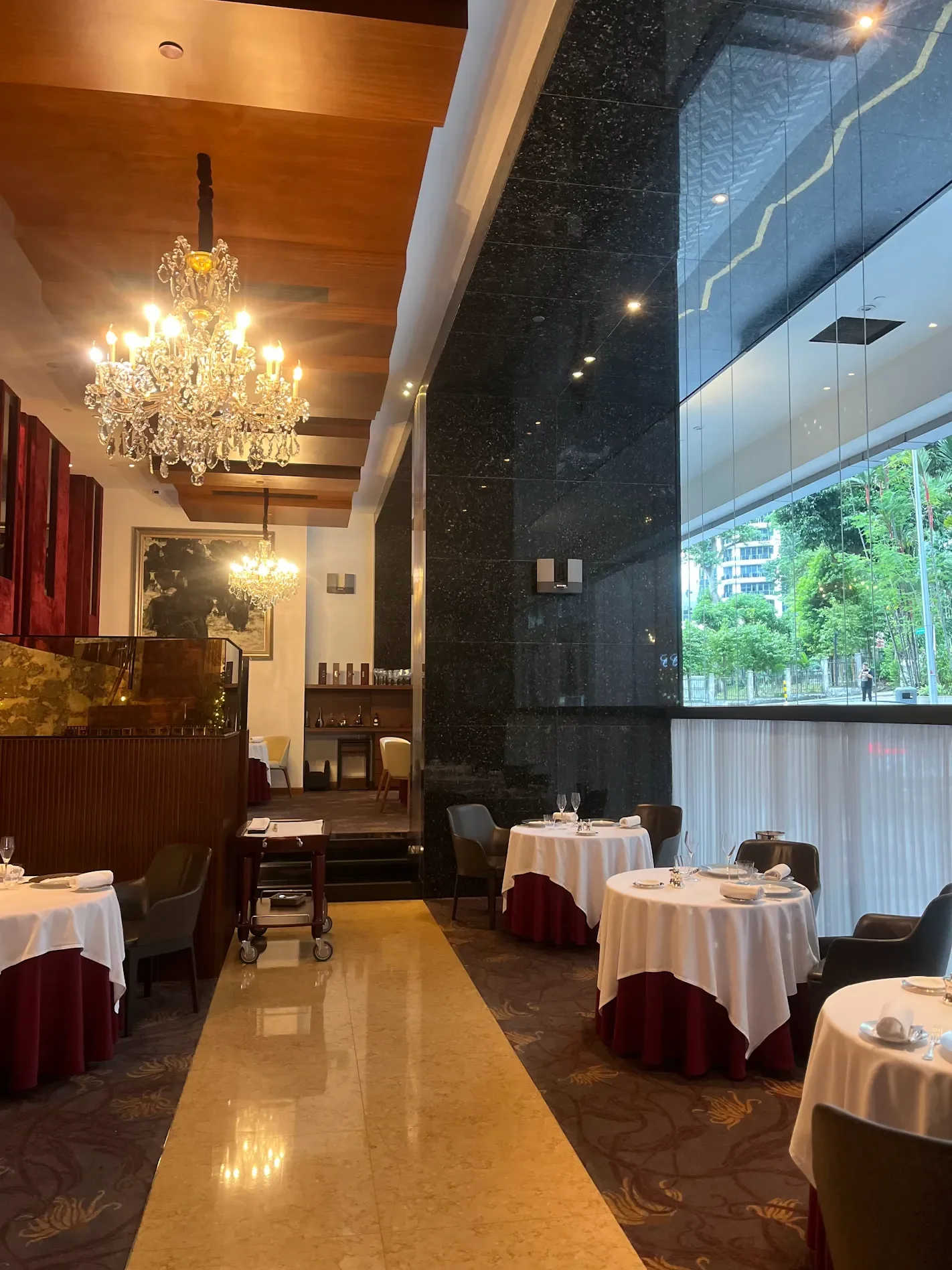
The physical restaurant reflects that decision.
Les Amis occupies a multi-level space within Shaw Centre.
The room is elegant rather than theatrical.
Crystal chandeliers provide one of its most recognisable visual features.
Tables are generously spaced.
The colour palette remains restrained.
The restaurant also includes private dining spaces, including one with a direct view into the kitchen.
Recent diners consistently describe the room as quiet, formal and suited to long meals and special occasions.
That approach differs dramatically from restaurants such as KOMA Singapore, where architecture and visual spectacle become central to the restaurant's identity.
Les Amis wants the table to remain the focal point.
Shaw Centre Is Part of the Story
There is something almost counterintuitive about the address.
Les Amis is not inside a heritage mansion.
It does not occupy a dramatic waterfront building.
There is no garden surrounding it.
It is inside Shaw Centre on Scotts Road.
The restaurant has remained there since 1994.
That continuity has effectively transformed the location.
Instead of the building giving prestige to the restaurant, the restaurant has gradually given prestige to the address.
Guests now arrive at Shaw Centre because Les Amis is there.
This is what happens when a restaurant survives long enough.
Place and business become difficult to separate.
Les Amis Does Not Want to Become a Museum
The interesting danger facing Les Amis is obvious.
A restaurant dedicated to tradition can become trapped by tradition.
Lepinoy himself has rejected the idea that Les Amis should be considered an institution precisely because, in his view, institutions can imply something static.
He wants the restaurant to continue changing.
The distinction is subtle.
The restaurant does not want to abandon classical French cuisine.
It wants to keep improving how classical French cuisine is expressed.
Better sourcing.
Better equipment.
Better technique.
Better service.
Better training.
Evolution inside a fixed culinary language.
Preserving French Technique in Asia
Lepinoy also sees training as part of his responsibility.
The restaurant describes him as a guardian of French culinary arts in Asia, with an emphasis on mentoring younger chefs and transmitting classical technique.
That matters because techniques disappear if restaurants stop using them.
A cook cannot learn sauce-making only by reading Escoffier.
They have to make sauce.
Again.
Again.
Again.
The same applies to butchery.
Fish cookery.
Pastry.
Stocks.
Terrines.
Vegetable preparation.
Service.
If classical haute cuisine becomes uncommon even in France, a restaurant in Singapore preserving those techniques occupies an unusual position.
For a completely different example of culinary knowledge being transmitted through a highly disciplined craft tradition, Sushi Sakuta offers an interesting parallel.
Different cuisine.
Similar insistence that mastery comes through repetition.
More Than Thirty Years After Opening
Les Amis opened before Michelin had a Singapore guide.
Before Instagram.
Before contemporary tasting-menu culture took its current form.
Before many of today's leading Singapore restaurants existed.
It has survived different chefs.
Different economic cycles.
Different dining trends.
A pandemic.
And the transformation of Singapore into one of Asia's major restaurant cities.
The restaurant now occupies an unusual position.
It is both old and highly decorated.
Traditional and internationally relevant.
Formal in an increasingly informal restaurant world.
The Restaurant Is the Story
Sebastien Lepinoy is essential to modern Les Amis.
His influence explains the restaurant's contemporary identity.
But Les Amis is larger than one chef.
That may be the most important distinction.
The restaurant began in 1994.
Lepinoy arrived later.
The wine cellar has its own history.
The service team has its own culture.
Regular diners have relationships with individual staff.
Chefs have trained there and moved elsewhere.
Different generations have celebrated birthdays and anniversaries at the same address.
The three Michelin stars belong to the restaurant.
So does the thirty-year history.
That is why Les Amis is best understood not simply as Sebastien Lepinoy's restaurant, but as a dining room whose current chef has chosen to sharpen what was already present in its name:
France,
friendship,
wine,
food,
and the table.
For more restaurants documenting how different culinary traditions have taken root in Singapore, explore The Cuisine Journal Collections.
Les Amis Singapore
Restaurant: Les Amis
Cuisine: Classical French haute cuisine
Established: 15 March 1994
Director of Culinary and Operations: Sebastien Lepinoy
Address: 1 Scotts Road, #01-16 Shaw Centre, Singapore 228208
Michelin Rating: Three Michelin stars, retained in the 2026 Michelin Guide Singapore
Known For: French seasonal produce, caviar, blue lobster, classical sauces, bread service, French cheese and an extensive wine cellar
Dining Style: Formal French fine dining
Reservations: Strongly recommended
Frequently Asked Questions
What is Les Amis?
Les Amis is a classical French fine-dining restaurant at Shaw Centre in Singapore. It opened in 1994 and was Singapore's first independent fine-dining restaurant.
What does Les Amis mean?
Les Amis means “the friends” in French, reflecting the group of friends whose shared enthusiasm for French food and wine led to the restaurant's creation.
Does Les Amis have three Michelin stars?
Yes. Les Amis first received its third Michelin star in 2019 and retained all three in the 2026 Michelin Guide Singapore.
Who is the chef at Les Amis?
The restaurant is led by Sebastien Lepinoy, its Director of Culinary and Operations. Lepinoy trained extensively within Joël Robuchon's culinary organisation before eventually taking charge of Les Amis.
What kind of food does Les Amis serve?
Les Amis focuses deliberately on classical French haute cuisine, using seasonal French ingredients and traditional French techniques rather than defining itself primarily through fusion or contemporary international cooking.
Is Les Amis mainly a tasting-menu restaurant?
The restaurant offers structured multi-course dining, with menus changing according to season and ingredient availability. Recent diners describe both longer tasting experiences and shorter multi-course formats.
Why is caviar so prominent at Les Amis?
Caviar has become one of the ingredients most closely associated with Lepinoy's cuisine. It is used not only as a luxury garnish but for its saltiness, marine flavour and texture in dishes involving ingredients such as potatoes, crème fraîche and pasta.
Is the wine programme important at Les Amis?
Very much so. Wine has been fundamental to Les Amis since its founding, and the restaurant is particularly associated with deep collections from Burgundy and Bordeaux alongside a much broader international cellar.
Does Les Amis serve a cheese course?
Yes. French cheese remains part of the restaurant's classical dining tradition, with recent diners continuing to describe an extensive tableside cheese trolley.
Where is Les Amis?
Les Amis is located at 1 Scotts Road, #01-16, Shaw Centre, Singapore 228208, near Orchard Road.