Jarrod Poh: The Peranakan Chef Teaching a New Generation to Eat Buah Keluak
Jarrod Poh did not become a hawker because he had run out of places to go as a chef.
Quite the opposite.
By the time he opened Panginut, Poh had spent roughly three and a half decades in professional kitchens, rising through restaurants, hotels, catering operations and corporate chef positions before becoming an executive chef.
Then, in his early fifties, he left that career behind and opened a small Western-food stall in Ang Mo Kio.
But Panginut was never really about Western food.
It was about Peranakan food — specifically, finding a way to make the flavours Poh grew up eating understandable to a generation that might never think of ordering ayam buah keluak.
His solution was unusual.
Put the buah keluak on a chicken chop.
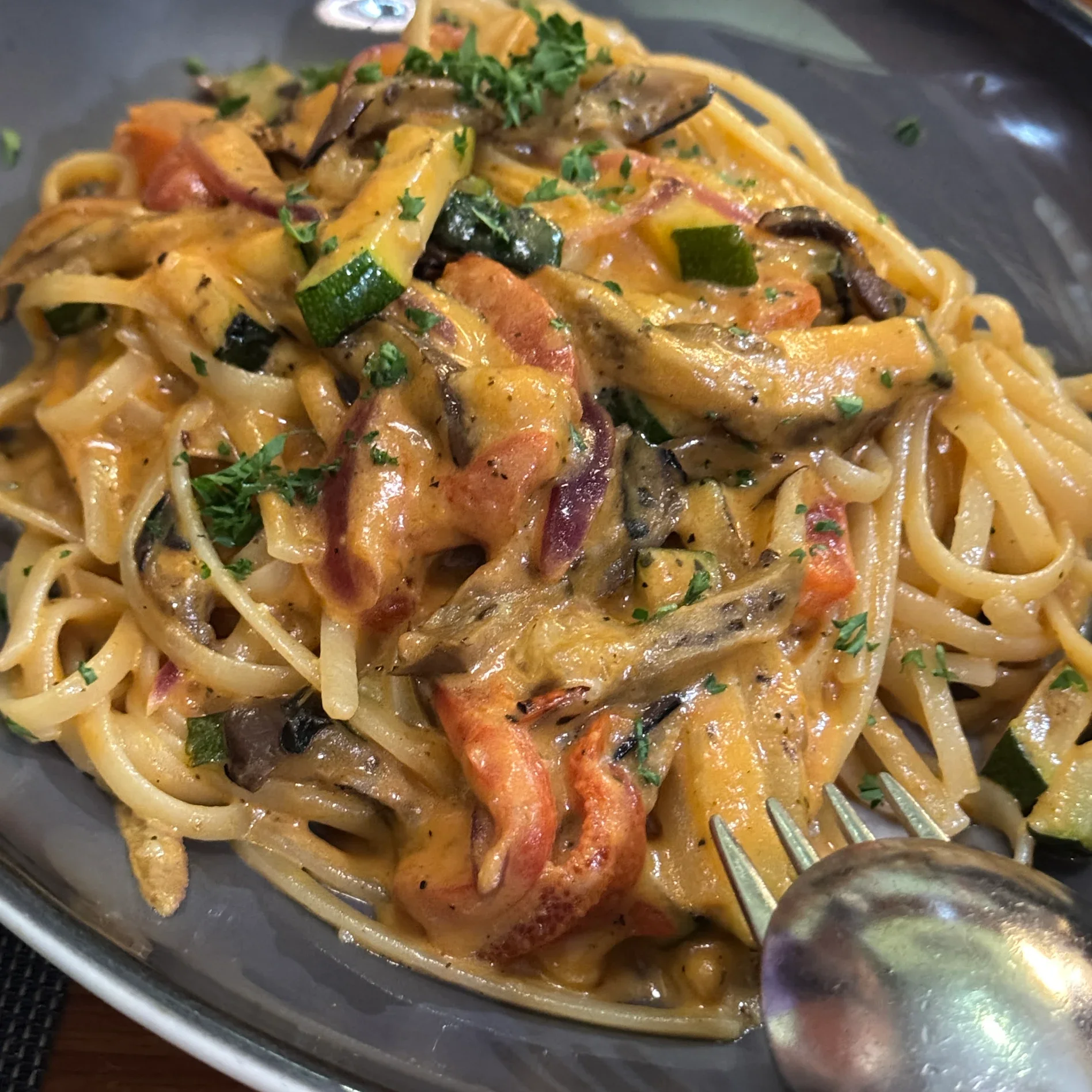
Turn beef rendang into pasta and pizza.
Use laksa as a pasta sauce.
Take flavours inherited from his mother and grandmother and place them inside dishes younger Singaporeans already knew how to approach.
For Poh, preserving tradition did not mean leaving it untouched.
It meant making sure somebody still wanted to eat it.
Growing Up Peranakan in Katong
Poh grew up in a third-generation Peranakan family around Katong and Joo Chiat.
The kitchen was an important part of that childhood.
He remembers being drawn towards it by the smell of spices frying while his mother and grandmother cooked. These were not necessarily small family meals either. Celebrations could involve preparing food for extended-family gatherings numbering more than a hundred people.
The recipes belonged to a form of cooking that was transmitted through families rather than formal culinary systems.
That becomes important later in Poh's story.
Long before he attempted to turn Peranakan food into a business, he first knew it as family food.
This relationship between inherited culinary identity and professional cooking appears throughout Singapore in different forms. Antonio Manetto, for instance, carries the food of Naples into the restaurants he builds, while Ciro Sorrentino expresses a similarly strong connection to place through pizza and dough.
Poh's inheritance was Nyonya cooking.
But he would eventually decide that simply reproducing it was not enough.
Thirty-Five Years Before Becoming a Hawker
Poh went through formal culinary training at SHATEC before embarking on a long professional career.
Over the following decades, he worked through restaurants, hotels, catering companies and fine-dining operations, eventually holding head-chef and executive-chef positions. His career included organisations such as Pentagon Group and Tribe at The Arts House, as well as consultancy work for new restaurant concepts.
That is significant because Panginut was not the project of someone experimenting with cooking for the first time.
It was the project of an experienced chef deliberately choosing a much smaller platform.
There are parallels with chefs such as Dave Pynt at Burnt Ends, where years of professional kitchen experience eventually become concentrated around a clearly defined cooking philosophy.
For Poh, however, that philosophy became increasingly tied to heritage.
After approximately 35 years as a professional chef, he stepped away from the corporate kitchen in December 2022.
The executive-chef jacket was replaced by a hawker's wok.
Why Peranakan Food?
The idea had been building for some time.
While working in themed catering, Poh noticed that younger customers often knew surprisingly little about Peranakan culture.
That bothered him.
In Singapore, he felt that Straits Chinese heritage had become particularly associated with enclaves such as Katong and Joo Chiat, while Peranakan cuisine itself was frequently encountered through restaurants rather than inexpensive everyday meals.
That created two problems.
The first was accessibility.
The second was taste.
Some of Peranakan cuisine's most distinctive ingredients are not necessarily easy for an unfamiliar diner to love immediately.
Buah keluak is perhaps the clearest example.
Earthy, dark, slightly bitter and extraordinarily distinctive, the fermented seed of the pangium tree has a flavour unlike most ingredients in Singapore cooking.
For someone raised with ayam buah keluak, that taste may carry memory.
For someone encountering it for the first time, it can be challenging.
Poh recognised that asking younger diners to embrace the food simply because it was traditional was unlikely to work.
So he changed the entry point.
Put the Buah Keluak on a Chicken Chop
Panginut's defining dish became the buah keluak chicken chop.
The concept is immediately understandable.
Western-style chicken chop is familiar hawker-centre food.
Instead of the usual mushroom, black pepper or brown sauce, Poh covers the chicken with a gravy built around buah keluak and Peranakan aromatics.
Suddenly, the unfamiliar flavour has a familiar structure.
This is the central idea behind much of Poh's cooking.
He does not necessarily alter the identity of the Peranakan flavour.
He changes the vehicle carrying it.
The same logic produces rendang pasta.
Rendang pizza.
Laksa pasta.
Peranakan-inspired burgers.
Western grills dressed with Nyonya sauces and rempah.
Like the playful reinterpretation of familiar Singaporean comfort food at Claypot Daddy, Poh uses recognition as the doorway to something more individual.
You know what a chicken chop is.
Now try buah keluak.
Translating His Grandmother's Recipes
Making those flavours commercially repeatable presented another problem.
Poh's inherited recipes were not written like professional recipes.
His grandmother was illiterate, and the family's old recipe books could contain drawings and measurements such as a handful of one ingredient, a thumb-sized piece of another or quantities expressed according to the conventions of another generation.
Those instructions worked when an experienced family cook was standing beside the stove.
They were considerably less useful when Poh needed to train staff and produce the same sauce every day.
So he reconstructed them.
He relied on memory.
He experimented.
He cooked versions of familiar dishes and invited relatives to taste them.
Beef rendang and ayam buah keluak were tested against the family's collective memory until Poh believed he had reached the flavours he remembered.
This may be one of the most interesting parts of his work.
Tradition had to be standardised before it could be reinvented.
The old recipes first had to become measurable.
Only then could Poh begin putting them on pizzas and chicken chops.
Authenticity Does Not Have to Mean Reproduction
Poh describes his cooking carefully.
It is Peranakan-influenced Western food.
That distinction allows him considerable freedom.
He is not claiming that buah keluak chicken chop is a traditional Nyonya dish.
It clearly isn't.
Instead, the authenticity exists within the flavours he uses and the recipes from which those flavours developed.
That approach differs markedly from chefs who preserve a highly codified culinary form. At a counter such as Sushi Sakuta, continuity can come through precise repetition of techniques belonging to a particular tradition.
Poh uses another form of continuity.
Keep the flavour.
Change the format.
For him, adaptation is not necessarily the enemy of preservation.
It may be what allows preservation to happen.
The Work Behind Buah Keluak
There is also nothing particularly convenient about the ingredient around which Poh built his signature.
Preparing buah keluak takes time.
The nuts need extensive soaking, with the water repeatedly changed. They are subsequently opened, checked and the flesh extracted before Poh can begin constructing the gravy around ingredients such as blue ginger, turmeric, shallots and other aromatics.
His laksa rempah is similarly elaborate, incorporating a long list of spices and aromatics.
The rendang requires another mixture.
This is not fusion achieved by taking two ready-made sauces and combining them.
The Western component may make Poh's food visually accessible, but the Peranakan component still relies upon the labour of rempah-based cooking.
That distinction matters.
Panginut Struggled
The idea was inventive.
The first location was difficult.
Panginut opened at Thye Guan Eating House in Ang Mo Kio in December 2022.
Foot traffic proved weak.
The stall was located relatively deep within the neighbourhood, away from an MRT station and with less convenient public transport access than Poh needed.
For a new hawker concept attempting to persuade customers to eat something as unconventional as buah keluak chicken chop, location mattered enormously.
The stall eventually gained attention.
Media coverage followed.
Regular customers appeared.
But the economics remained difficult.
When the tenancy ended in June 2024, Poh closed the Ang Mo Kio operation.
From the outside, that could easily have looked like the end of Panginut.
It wasn't.
Going Back to Joo Chiat
Three months later, Panginut returned.
This time, Poh took it somewhere that made almost symbolic sense.
Joo Chiat.
The chef who had grown up around Katong and Joo Chiat cooking Peranakan food with his family brought the concept back into one of Singapore's neighbourhoods most closely associated with Peranakan culture.
Panginut reopened at Chew N Chat Food Court at Joo Chiat Complex in September 2024.
The move also gave Poh much more control.
He became involved in managing the food court itself, including its drinks operation, while Panginut occupied sufficient space for recipe development and staff training.
The move demonstrated something useful about Poh's career.
When the first version of the business did not work, he did not necessarily conclude that the food was wrong.
He changed the environment around it.
Panginut Became More Than One Stall
The Joo Chiat move also allowed Poh to expand the ideas surrounding Panginut.
In October 2024, he launched Copra, a sister concept based around Peranakan-influenced nasi lemak.
Blue-pea-infused rice provided the visual foundation, while the broader idea remained familiar: take a format Singaporeans already understand and use it to introduce Peranakan flavours.
The approach is strikingly similar to what Poh had done with Western food.
Chicken chop provided the gateway at Panginut.
Nasi lemak provided another at Copra.
The cuisine remained rooted in the same heritage.
The delivery system changed.
What Jarrod Poh Is Doing Now
The closure of the original Ang Mo Kio stall therefore turned out to be a relocation rather than an ending.
Panginut remains associated with Poh's Joo Chiat operation, where its large menu continues to combine Western comfort food with Peranakan sauces and preparations.
And Poh has kept expanding.
In 2026, he launched Toppot Seafood & Mala, another concept at Chew N Chat Food Court.
This one moves in yet another direction.
Toppot focuses on halal Chinese zi char and mala, with dishes including seafood hor fun, fried rice, whole fish, vegetables and customisable mala pots.
The concept reportedly developed after Poh noticed that the food court's predominantly Muslim customer base had relatively few Chinese-style halal options.
Once again, the idea started with an audience.
What are people not eating?
Why aren't they eating it?
How can the format change without losing the thing that makes the food worth eating?
It is remarkably similar to the question that created Panginut.
A Chef Who Designs Bridges
This is perhaps the clearest way to understand Jarrod Poh's food philosophy.
He builds bridges between diners and flavours.
With Panginut, the bridge was Western food.
A younger diner might not order ayam buah keluak.
They might order chicken chop.
So Poh put one inside the other.
With Copra, the bridge became nasi lemak.
With Toppot, the challenge changed again: how can the flavours and wok character associated with Chinese zi char become available to Muslim diners while meeting halal requirements?
It is a very different sort of creativity from the spectacle surrounding a restaurant such as KOMA Singapore, or the highly controlled craft of Sushi Masaaki.
Poh's creativity begins with accessibility.
The diner comes first.
Then he works backwards towards the dish.
Preservation Through Change
There is an understandable fear around adapting traditional cuisines.
Change too much and something important may disappear.
Poh seems acutely aware of that tension.
His solution is not simply to modernise everything indiscriminately.
He went back to family recipes.
He reconstructed the measurements.
He asked relatives to taste his food.
He developed his rempahs.
Only after establishing the flavour did he begin changing its surroundings.
That makes his cooking less a rejection of tradition than a strategy for keeping tradition in circulation.
A recipe sitting untouched in an old notebook may be perfectly authentic.
But nobody can taste it there.
Poh would rather put some of that history on a chicken chop and have a 20-year-old ask him what buah keluak is.
Because then a conversation begins.
Coming Full Circle
Jarrod Poh spent around 35 years becoming a professional chef before becoming a hawker.
Then his first hawker location failed to provide the traffic the concept needed.
He closed it.
Moved.
Started again.
Expanded the menu.
Added another concept.
Then another.
And, fittingly, ended up back in Joo Chiat — close to the cultural landscape that produced the food he had been trying to preserve in the first place.
His career makes a useful argument about heritage cooking.
Tradition does not survive merely because someone declares it important.
People have to cook it.
People have to order it.
And eventually, another generation has to decide that it belongs to them too.
Jarrod Poh's solution is not to demand that younger diners meet Peranakan food exactly where his grandmother left it.
He moves the food towards them.
Sometimes that means pasta.
Sometimes pizza.
Sometimes nasi lemak.
And sometimes it means covering a chicken chop in buah keluak.
The format may change.
The memory underneath it does not.