Marguerite Singapore: Modern Australian Fine Dining Inside the Flower Dome
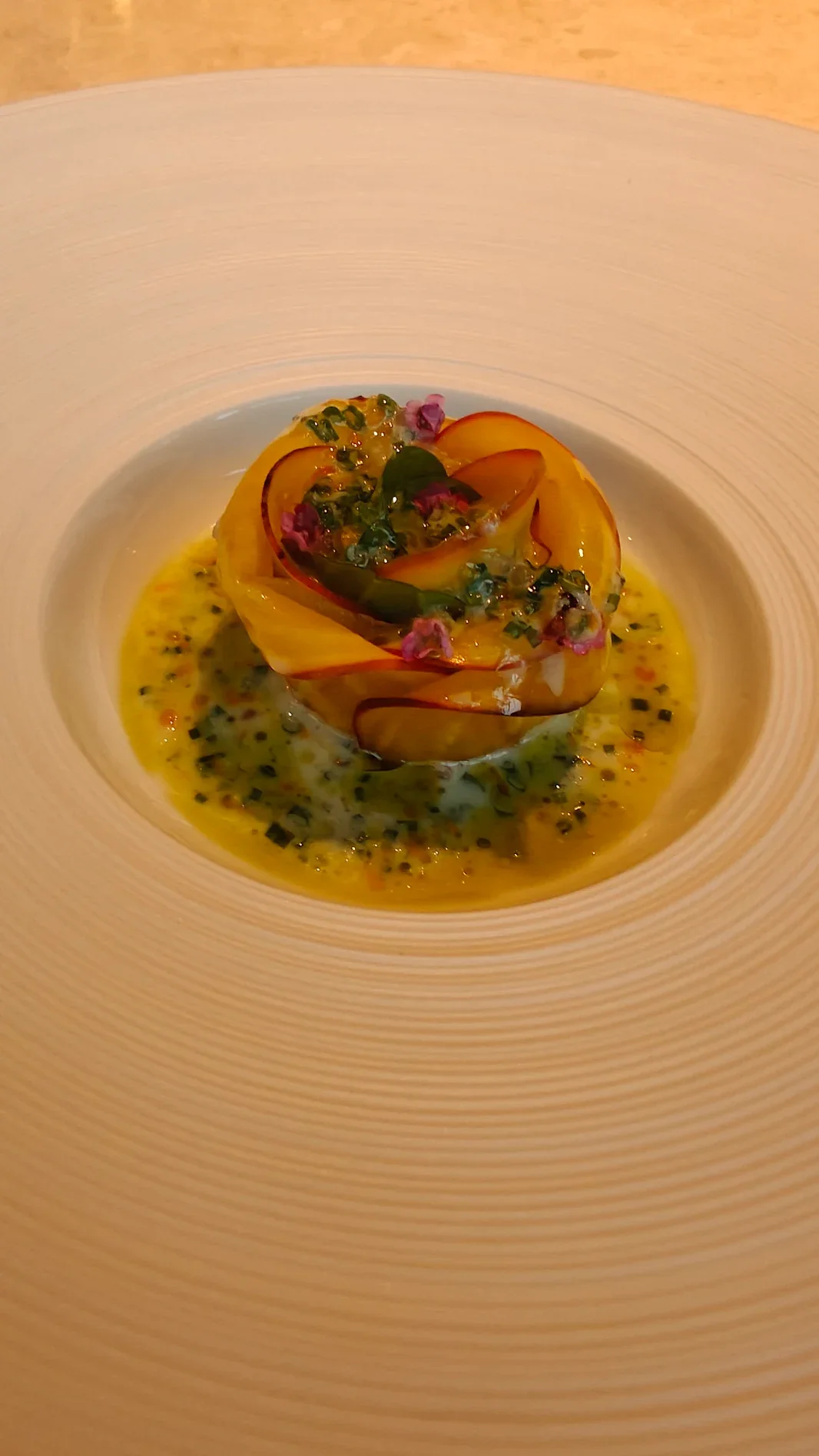
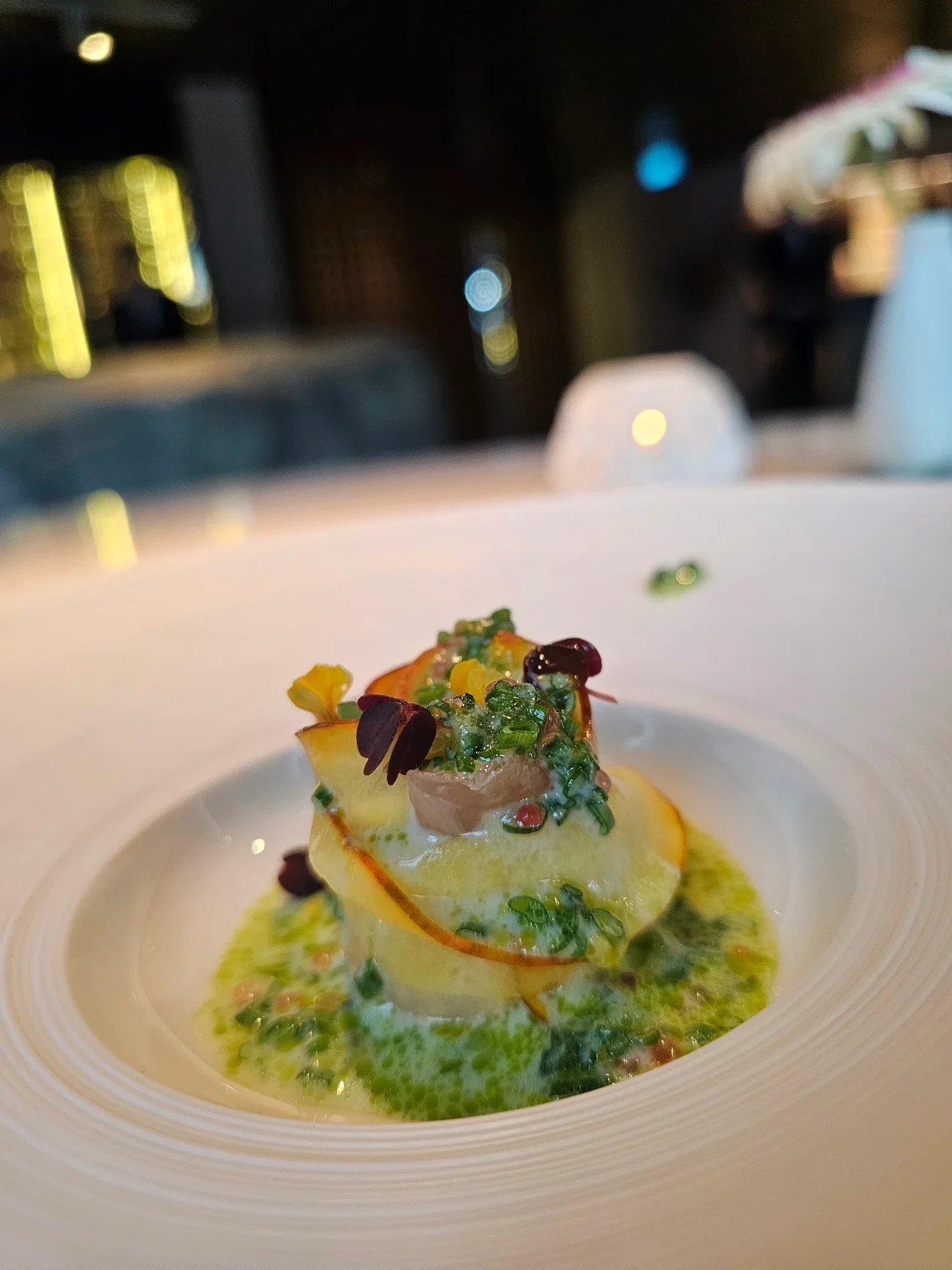
At Michelin-starred Marguerite inside Gardens by the Bay’s Flower Dome, Melbourne-born chef Michael Wilson has developed a style of Modern Australian cooking that combines classical technique, precise tasting-menu structure and an increasingly direct connection to the ingredients of his home country.
Michael Wilson spent much of his career cooking away from Australia.
Melbourne came first.
Then Shanghai.
Then Singapore.
But at Marguerite, the restaurant he opened inside Gardens by the Bay’s Flower Dome in 2021, Australia has gradually moved from background influence to something much more explicit.
Wild red kangaroo.
Coral trout from Western Australia.
Warrigal greens.
Wattleseed.
Anise myrtle.
Saltbush.
Native sea succulents.
Macadamias.
These ingredients now sit beside French technique, fermentation, charcoal cooking and the controlled progression of a Michelin-starred tasting menu.
Marguerite describes Wilson’s cooking as Modern Australian cuisine, centred on produce, provenance and the seasons. Its official profile of Michael Wilson and the restaurant also makes clear that technique serves the ingredient rather than replacing it.
That approach places Wilson within a broader generation of chefs in Singapore who have brought their own culinary histories into the city rather than simply reproducing the cuisine of somewhere else.
For another Australian chef whose restaurant identity has been strongly shaped by technique and personal experience, read Dave Pynt and Burnt Ends at Dempsey Hill.
Michael Wilson Started in Melbourne
Wilson was born in Melbourne.
His early career included work with prominent Melbourne restaurateur and chef Guy Grossi, followed by time at Cutler & Co, one of the restaurants that helped define contemporary Australian dining in the city.
That foundation matters because modern Australian cuisine is difficult to define through one set of dishes.
Australia does not have a single classical restaurant canon comparable to French or Italian cuisine.
Instead, contemporary Australian cooking has often developed around:
strong produce,
European techniques,
Asian influence,
immigration,
native ingredients,
and comparatively few rules about which traditions are allowed to occupy the same plate.
Wilson would eventually take that flexibility with him into Asia.
Shanghai Came Before Singapore
One of the most important stages of Wilson’s career came in Shanghai.
He became chef at Phénix in The PuLi Hotel and Spa.
Five months after opening, the restaurant earned one Michelin star.
That was Wilson’s first Michelin star.
It also meant that he arrived in Singapore already familiar with the particular pressures involved in building and maintaining a Michelin-level restaurant.
Fine dining at that level is not simply about creating individual dishes.
It requires consistency across hundreds of details:
sourcing,
preparation,
sauces,
temperature,
service timing,
wine,
tableware,
bread,
petit fours,
staff training,
and the sequence through which a meal unfolds.
Marguerite would eventually become Wilson’s second Michelin-starred project.
Singapore and Unlisted Collection
Wilson later joined Unlisted Collection, the hospitality group behind several distinctive restaurants in Singapore and overseas.
His work with the group led to two concepts at Gardens by the Bay:
Hortus, built around Mediterranean sharing food;
and Marguerite, built around tasting menus.
Marguerite opened in 2021, during the pandemic.
The timing could hardly have been more difficult.
Singapore was still moving between dining restrictions, international supply chains were unstable and restaurants had little certainty about how many customers they would even be permitted to seat.
Yet eight months after opening, Marguerite received its first Michelin star.
By 2026, it had retained that star for four consecutive years.
Within the wider landscape of Singapore fine dining, Marguerite sits alongside restaurants with very different culinary identities. Bottega di Carna at Mondrian Singapore Duxton, for example, approaches modern restaurant cooking through Italian tradition and fire rather than Wilson’s increasingly Australian interpretation.
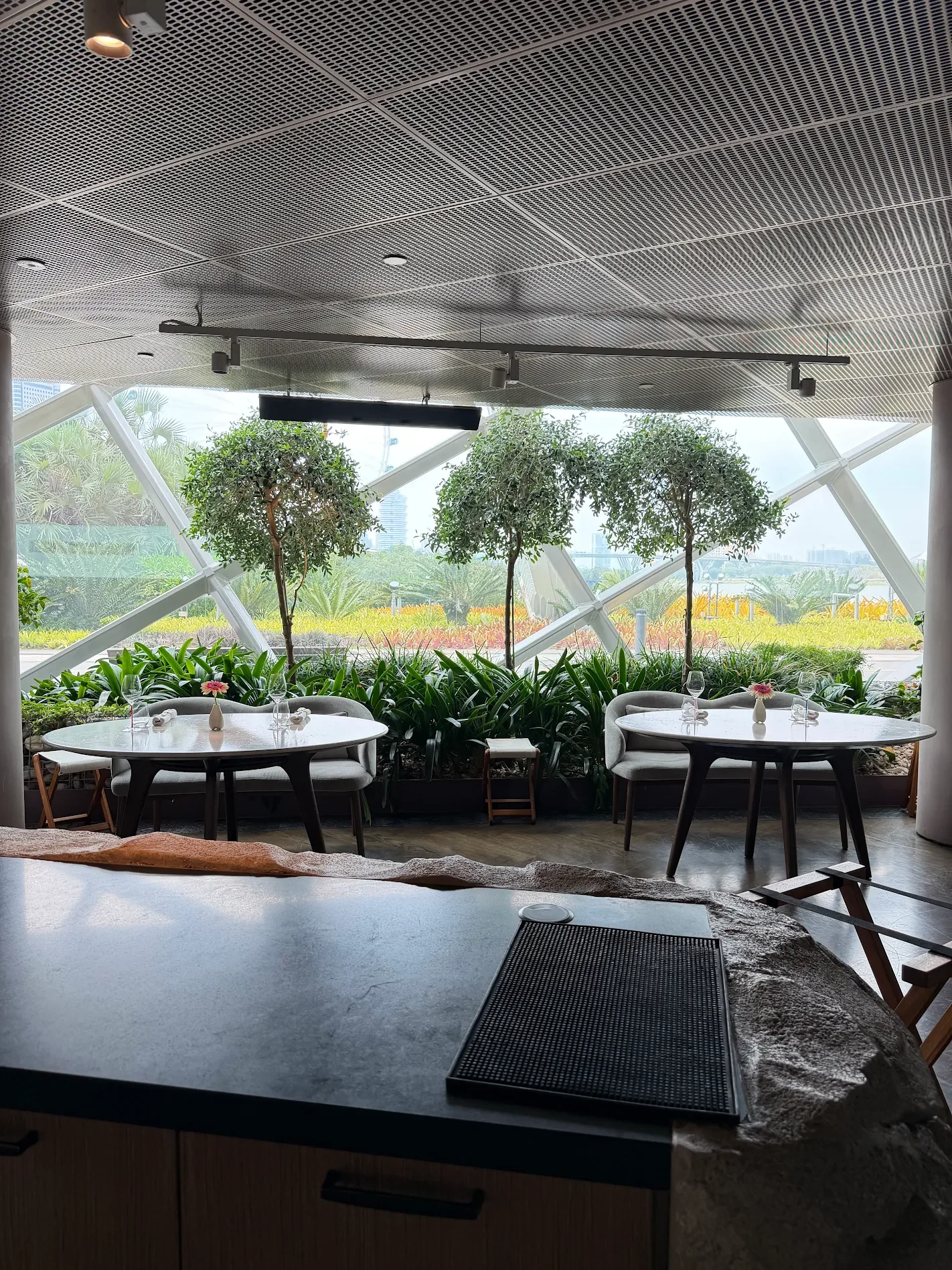
Marguerite Is Inside the Flower Dome
The location matters more at Marguerite than it would at most restaurants.
The restaurant sits inside the Flower Dome at Gardens by the Bay.
It is surrounded by one of Singapore’s most elaborate controlled botanical environments.
That naturally creates a visual relationship between the restaurant and plants.
The room uses sculpted boulders, Scandinavian-style furniture, white marble surfaces, handmade ceramics and objects from local and international craftspeople.
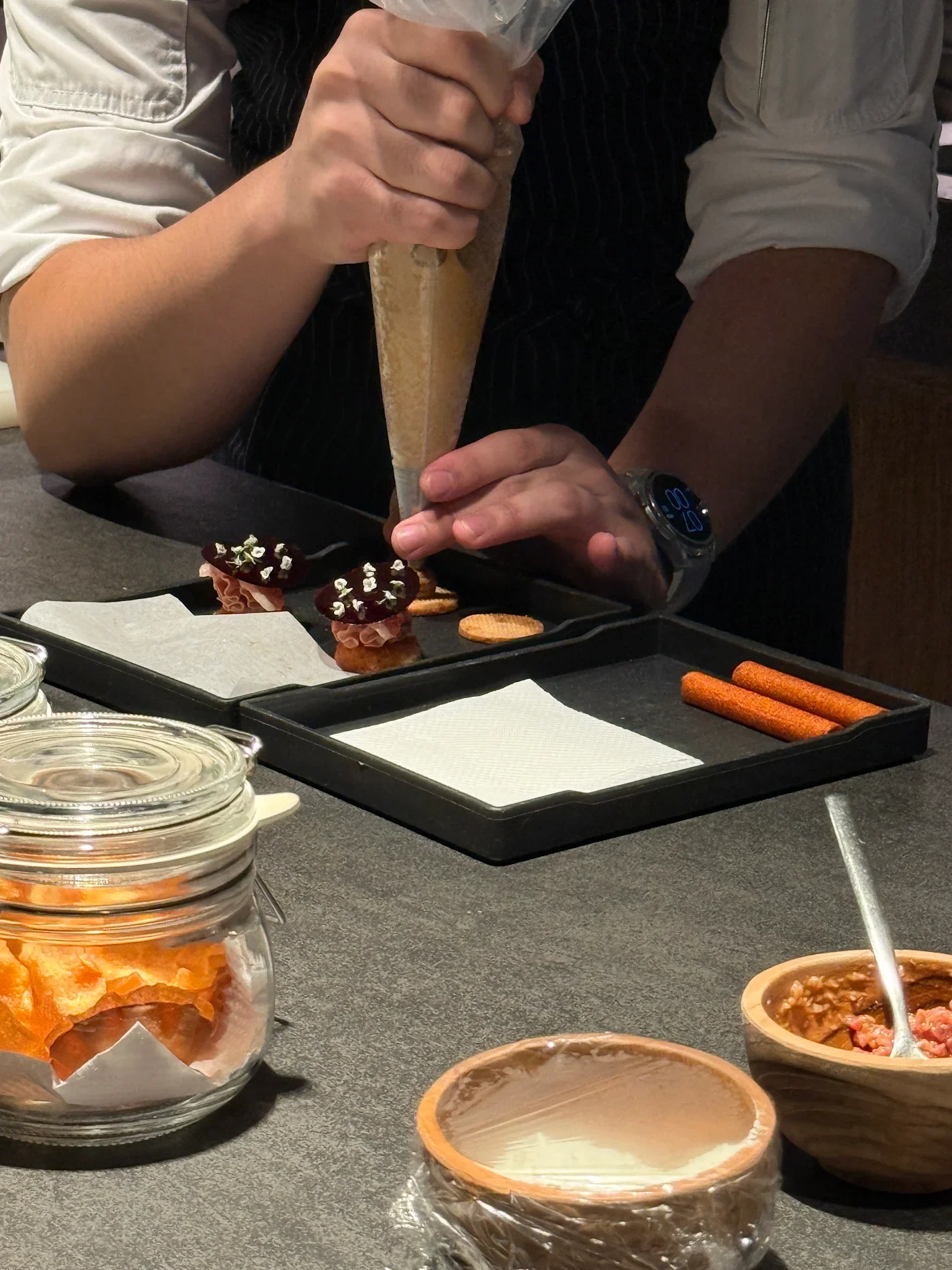
Three kitchen islands sit directly within the dining room, allowing guests to watch parts of the meal being assembled.
Recent diners supplied to The Cuisine Journal consistently mention that relationship between restaurant and garden.
The Flower Dome is not simply something visible through a window.
Guests frequently describe walking through it as part of the overall Marguerite experience, while the restaurant’s floral and botanical presentation often echoes its surroundings.
That makes Marguerite part restaurant and part destination — something also seen, in a much more theatrical way, at KOMA Singapore.
Produce Comes Before Cuisine
Wilson’s cooking is easiest to understand through ingredients.
Marguerite describes his process as using cooking techniques to extract, concentrate and intensify flavours.
That can involve:
fermentation,
dry-ageing,
charcoal,
reduction,
preservation,
raw preparations,
or classical sauce work.
But the intention is not to make technique the spectacle.
The ingredient remains the centre.
That philosophy has become even more apparent as Wilson has begun looking more deliberately towards Australia.
Australia Came Back Into the Menu
During recent trips home, Wilson travelled through Port Douglas, Perth and Gippsland, reconnecting with Australian farmers, growers, fishermen, foragers and producers.
He also appeared as a guest judge on MasterChef Australia.
Those trips changed Marguerite.
In 2026, Wilson moved Australian terroir much closer to the centre of the restaurant’s identity.
The resulting menu was documented in a CNA Luxury feature on Michael Wilson’s new Australian direction at Marguerite.
This was not simply a matter of importing Australian beef.
The menu began examining ingredients that are much less commonly exported.
Native plants.
Bush foods.
Wild game.
Regional seafood.
Wild Red Kangaroo Pho
One of the clearest expressions of this approach is Wild Red Kangaroo Pho.
The dish immediately demonstrates how Wilson thinks about Australian food.
Kangaroo is unmistakably Australian.
Pho is Vietnamese.
The preparation sits inside a Modern Australian tasting menu in Singapore.
That mixture would become incoherent if nationality were treated as a rigid boundary.
Instead, the dish uses Australian produce as the starting point and another culinary language as the framework.
Recent diners supplied to The Cuisine Journal specifically mention the kangaroo pho as one of the more memorable parts of Marguerite’s current menu.
It also reflects something fundamental about Australian cooking.
Modern Australia has been shaped heavily by Asian immigration and proximity to Asia.
Using pho as a reference therefore does not necessarily make the dish less Australian.
It can make it more representative of contemporary Australia.
Coral Trout from the Pilbara
Another current course uses coral trout from the Pilbara region of Western Australia.
The fish is dry-aged for five days.
Then cooked over charcoal.
It is served with lemon koshō, wild fennel and monk’s beard, while Wilson has also paired it with a sabayon using Australian botrytis Semillon.
The method brings together several culinary languages.
Japanese citrus fermentation.
French sauce structure.
Australian wine.
Western Australian fish.
Charcoal.
What unifies them is the ingredient.
The trout remains recognisable as trout rather than becoming merely a platform for technique.
Wilson’s use of charcoal provides another loose connection with Burnt Ends, although the two restaurants use fire very differently.
At Burnt Ends, fire defines almost the entire restaurant.
At Marguerite, it is one tool among many.
Australian Native Botanicals
Some of the more difficult ingredients Wilson works with are not meat or seafood.
They are plants.
Warrigal greens.
Australian seablite.
Samphire.
Pepper berries.
Wattleseed.
Old man saltbush.
Anise myrtle.
Many of these ingredients rarely travel far outside Australia.
Some deteriorate quickly.
Others are gathered by specialist growers and foragers rather than being produced through large agricultural supply chains.
That created a logistical problem.
Wilson could design an Australian menu.
But the restaurant is approximately 6,000 kilometres from Australia.
Building a Supply Chain
Marguerite has consequently started developing direct relationships with Australian specialist suppliers and foragers.
Some products arrive fresh.
Others travel dried.
Pickled.
Preserved.
Fermented.
Those methods are not merely logistical compromises.
Preservation changes flavour.
That gives the kitchen additional ingredients to work with rather than simply degraded versions of fresh produce.
This relationship between chef and supplier increasingly forms part of how higher-end restaurants define themselves.
Provenance is no longer simply a line on the menu.
It becomes part of recipe development.
Bunya Nut Becomes Miso
Perhaps the most interesting example is bunya nut.
Bunya nuts come from the bunya pine and have an important history as food among Aboriginal Australian communities.
But traditional boiling or stewing creates a texture Wilson found difficult to translate into his style of fine dining.
So the Marguerite team changed the process.
The nuts were fermented with koji rice and salt.
The result became a form of bunya nut miso.
The technique is Japanese.
The ingredient is Australian.
The application belongs to Marguerite.
That small example says quite a lot about Wilson’s approach.
He is not trying to reconstruct traditional Australian dishes.
He is trying to understand Australian ingredients well enough to move them through the cooking techniques available to him.
Fermentation Is Becoming More Important
The kitchen is also developing:
house vinegars,
garums,
fermented preparations,
and fruit wines.
These take time.
A sauce can be made today.
A vinegar may take months.
Fermentation therefore changes how a kitchen thinks.
Ingredients prepared during one menu may only become usable during another.
It creates a pantry with memory.
Wilson himself has described the current Australian direction as still evolving.
Rather than presenting the menu as a completed statement on Australian cuisine, Marguerite appears to be treating it as an ongoing investigation.
The Meal Is Still Highly Structured
Despite the experimentation, Marguerite remains a formal tasting-menu restaurant.
The current signature menu runs through a sequence of snacks, seafood, meat, desserts and mignardises.
Courses have included:
Wild Red Kangaroo Pho,
Southern Bluefin Tuna Belly,
Smoked Eel with Oyster Pearl,
Pilbara Coral Trout,
Manjimup Marron,
Kinross Station Lamb,
Wagyu with Warrigal Greens,
Rhubarb with Anise Myrtle,
and Marguerite’s “Opera”.
Recent customer material shows the menu functioning exactly as tasting menus are intended to function: as a progression rather than a collection of unrelated plates.
The Open Kitchen Changes the Relationship
Marguerite’s three kitchen islands create another unusual feature.
Some finishing work happens in full view of the dining room.
Guests can watch cooks arranging dishes only metres away.
That changes the normal separation between kitchen and table.
Fine dining often hides enormous amounts of labour behind swinging doors.
At Marguerite, a portion of that labour becomes visible.
Several diners specifically mention observing the kitchen team during their meals.
The idea has parallels with intimate omakase counters, where watching the chef is part of the meal itself.
For a Japanese example of that relationship between diner, chef and preparation, read Sushi Sakuta: Quiet Precision at One of Singapore’s Leading Omakase Counters.
Service Is Part of the Cooking
At this level of dining, the kitchen cannot create the experience by itself.
Service determines pacing.
Wine changes perception of a dish.
Explanations provide context.
Dietary requirements have to move from front-of-house staff into the kitchen and back again without disrupting the meal.
Recent customer accounts repeatedly focus on Marguerite’s service, including assistance with dietary restrictions, explanations of dishes and the logistical experience of arriving at the restaurant within Gardens by the Bay.
This is one reason Michelin-level restaurants require much larger teams than the number of plates on the table might suggest.
Wine and Non-Alcoholic Pairings
Marguerite also treats beverages as part of the tasting structure.
There is a global wine programme.
But the restaurant has also developed non-alcoholic pairings using clarified juices and fermented teas.
That is increasingly significant.
Historically, fine-dining pairing menus assumed wine.
Modern restaurants increasingly need to create equally deliberate options for people who do not drink alcohol.
A fermented tea or clarified fruit drink therefore has to perform many of the same functions as wine:
acidity,
aroma,
tannin,
sweetness,
or contrast.
The beverage becomes part of how the dish is constructed in the diner’s mouth.
Desserts and Mignardises
The final stages of Marguerite’s meal are unusually prominent in diner accounts.
Several customers specifically mention the mignardises, petits fours and dessert presentations rather than treating them as incidental endings.
Marguerite’s “Opera” remains one recurring dessert reference.
Australian native ingredients now appear here too.
Wattleseed.
Saltbush.
Native aromatics.
Macadamia.
This creates another opportunity for the restaurant to express Australia without simply presenting a recognisable Australian national dessert.
A Michelin Star Came Quickly
Marguerite opened in 2021.
Within eight months, it earned one Michelin star.
It has subsequently retained the distinction for four consecutive years as of 2026.
The speed of that first star is notable.
But its retention may be more informative.
Opening a strong restaurant is difficult.
Maintaining one requires repeating the standard while the menu keeps changing.
Wilson’s Australian direction therefore represents a risk.
The restaurant has already developed a successful identity.
He is now deliberately moving it.
Marguerite Is Becoming More Australian, Not Less International
That may be the most interesting part of Wilson’s current work.
The more Marguerite focuses on Australia, the less useful simplistic ideas of “Australian cuisine” become.
The menu contains French technique.
Japanese fermentation.
Vietnamese references.
Singapore influences.
Australian ingredients.
European pastry.
Asian condiments.
These do not cancel each other out.
They reflect the country Wilson comes from and the places he has cooked since leaving it.
Modern Australian cuisine has always been difficult to separate from migration.
Wilson’s version simply happens to be expressed from Singapore.
A Chef Coming Back to His Starting Point
Michael Wilson’s career moved outward.
Melbourne.
Shanghai.
Singapore.
Now, without physically leaving Singapore, his cooking is moving back towards Australia.
Not through nostalgia.
Not by recreating childhood dishes.
But by rebuilding relationships with Australian producers and asking what can be done with ingredients he once took for granted.
That gives Marguerite an increasingly clear identity.
It is a restaurant inside one of Singapore’s most famous gardens.
Run by an Australian chef.
Using global technique.
And gradually becoming more interested in exactly what Australian produce can mean when it is cooked somewhere else.
For more profiles of restaurants and chefs shaping contemporary dining in Singapore, explore The Cuisine Journal Collections and TCJ Venues.
Michael Wilson & Marguerite
Chef Patron: Michael Wilson
Restaurant: Marguerite
Cuisine: Modern Australian
Location: Flower Dome, Gardens by the Bay
Address: 18 Marina Gardens Drive, #01-09 Flower Dome, Singapore 018953
Recognition: One Michelin star
Opened: 2021
Known For: Seasonal tasting menus, Australian produce, native botanicals, fermentation and contemporary fine dining
Frequently Asked Questions
Who is Michael Wilson?
Michael Wilson is a Melbourne-born chef and the Chef Patron of Marguerite in Singapore. He previously worked with Guy Grossi and Cutler & Co in Australia before moving into senior restaurant roles in Asia.
Did Michael Wilson have a Michelin star before Marguerite?
Yes. Wilson earned his first Michelin star at Phénix in The PuLi Hotel and Spa in Shanghai, five months after the restaurant opened.
Does Marguerite have a Michelin star?
Yes. Marguerite earned one Michelin star approximately eight months after opening and had retained it for four consecutive years by 2026.
What kind of food does Marguerite serve?
Marguerite describes its cuisine as Modern Australian, using seasonal produce, Australian ingredients and techniques drawn from several culinary traditions.
Why is Australian produce becoming more important at Marguerite?
Wilson’s recent travels through Australia reconnected him with growers, producers and foragers. The restaurant subsequently began building more direct supply relationships and incorporating native Australian ingredients into its tasting menus.
What Australian ingredients does Marguerite use?
Recent menus have included wild red kangaroo, coral trout, warrigal greens, wattleseed, anise myrtle, saltbush, native sea succulents, macadamia and other Australian produce.
Is Marguerite inside Gardens by the Bay?
Yes. The restaurant is located inside the Flower Dome at Gardens by the Bay, and the botanical setting is incorporated into both the restaurant design and the wider dining experience.
Does Marguerite offer non-alcoholic pairings?
Yes. Alongside wine, Marguerite has developed non-alcoholic beverage pairings using preparations including clarified juices and fermented teas.