Keng Eng Kee Seafood: The Family Zi Char Restaurant That Took Wok Hei from Havelock Road to Netflix
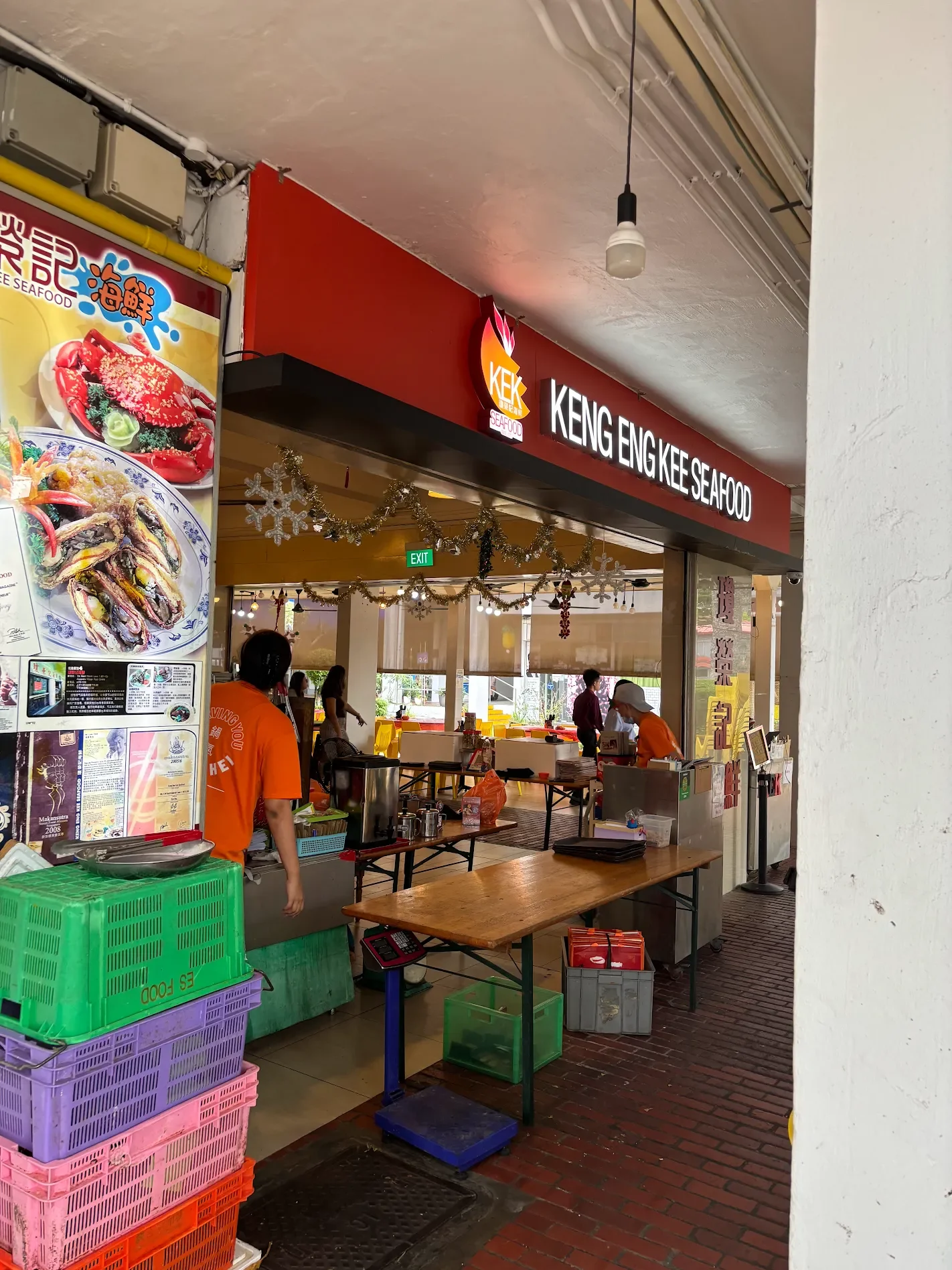
Keng Eng Kee Seafood began as a modest Havelock Road hawker stall in the 1970s and grew into one of Singapore’s best-known family-run zi char restaurants, built around wok hei, seafood and dishes such as Moonlight Hor Fun and Coffee Pork Ribs.
Some restaurants are defined by a dining room.
Keng Eng Kee Seafood is defined just as much by a smell.
Oil hits a hot wok.
Noodles go in.
Sauce follows.
Steam rises.
And somewhere inside that rush of heat, the kitchen tries to create wok hei.
At Keng Eng Kee Seafood, usually shortened to KEK, that style of cooking has passed through several generations of the same family.
The business began at Old Havelock Road Hawker Centre in the 1970s, later relocating to Alexandra Village and gradually growing into a multi-outlet Singapore zi char restaurant.
Today, KEK sits comfortably within the kind of restaurants documented across The Cuisine Journal’s Venues: places where the story is not simply about one chef, but about how a restaurant develops its own identity over decades.
From Havelock Road to Alexandra Village
Keng Eng Kee did not begin as a polished seafood restaurant.
It began as a hawker business.
The first generation operated from Old Havelock Road Hawker Centre before redevelopment forced the family to relocate.
Alexandra Village became the new home.
That move ultimately gave KEK the location with which it would become most closely associated.
The restaurant expanded around a very recognisable Singapore dining format:
large tables,
shared dishes,
outdoor seating,
families eating together,
and a kitchen expected to produce many different dishes simultaneously.
The Mothership account of KEK’s family history captures this particularly well, connecting the smell of Alexandra Village’s woks with the family that kept the restaurant going across generations.
What Makes a Zi Char Restaurant?
Zi char, sometimes written tze char, is less a single cuisine than a way of eating.
A typical menu can contain:
seafood,
pork,
chicken,
vegetables,
tofu,
soups,
rice,
fried noodles,
crab,
and dishes invented by the restaurant itself.
That breadth is central to the format.
One table can contain six completely different cooking techniques.
A steamed fish may sit beside deep-fried squid.
A claypot arrives beside wok-fried noodles.
Chilli crab appears next to sambal kangkong.
This shared-table approach is one reason zi char occupies such a distinctive position in Singapore dining.
KEK represents that tradition particularly clearly.
For another Singapore restaurant built around familiar local comfort-food formats rather than formal courses, see Claypot Daddy at Changi Airport Terminal 2.
The restaurants are very different, but both show how everyday Singapore food can be built into a larger restaurant identity.
Wok Hei Is the Centre of KEK
A great deal of KEK’s identity comes down to wok technique.
Wok hei is often translated as the “breath of the wok”.
The phrase is poetic.
The cooking is not.
Commercial wok burners generate extremely intense heat.
Ingredients must be moved rapidly.
Moisture evaporates almost immediately.
Sauce reduces as it hits the metal.
Oil heats far beyond what most home kitchens can comfortably produce.
Handled correctly, this creates roasted, smoky and lightly charred aromas without simply burning the food.
It is one of the defining skills of Cantonese-style wok cooking.
KEK’s clearest demonstration of it is probably Moonlight Hor Fun.
Recent diners continue to repeatedly mention the strong wok aroma of the dish.
Moonlight Hor Fun
KEK’s Moonlight Hor Fun has become one of the restaurant’s signature dishes.
Wide rice noodles are wok-fried before raw egg is placed over the top.
The yolk resembles a moon sitting over the noodles.
Hence the name.
The diner then breaks the egg into the hor fun.
That changes both texture and flavour.
The hot noodles cook the egg slightly while the yolk coats the sauce, producing a richer and silkier finish.
It creates an interesting contrast.
The noodles are defined by intense wok heat.
The egg softens everything afterwards.
Smoke and creaminess occupy the same plate.
Recent diners supplied to The Cuisine Journal continue to identify Moonlight Hor Fun among the dishes most strongly associated with KEK, frequently mentioning both the wok hei and the creamy effect of the egg.
The importance of controlling intense heat also connects KEK, in a very different culinary context, with Burnt Ends at Dempsey Hill.
One cooks with restaurant-scale live fire.
The other relies on the violent heat of a wok burner.
In both cases, heat is not simply a utility.
It becomes part of the flavour.
Coffee Pork Ribs
Another dish closely associated with KEK is Coffee Pork Ribs.
Coffee and pork may sound like an unusual combination.
But coffee brings exactly the flavours that work well with heavily caramelised meat.
Bitterness.
Roasted aroma.
Darkness.
Sugar then provides sweetness.
The fried pork supplies fat and texture.
The final sauce wraps everything together.
KEK’s Coffee Pork Ribs became one of the restaurant’s long-standing signature dishes and was specifically highlighted during its early Michelin Guide recognition.
Recent diners still mention the dish frequently, usually alongside Moonlight Hor Fun and crab.
Seafood Is Still in the Name
Despite the fame of its noodles and pork ribs, Keng Eng Kee Seafood remains very much a seafood restaurant.
Crab occupies a particularly important place on the menu.
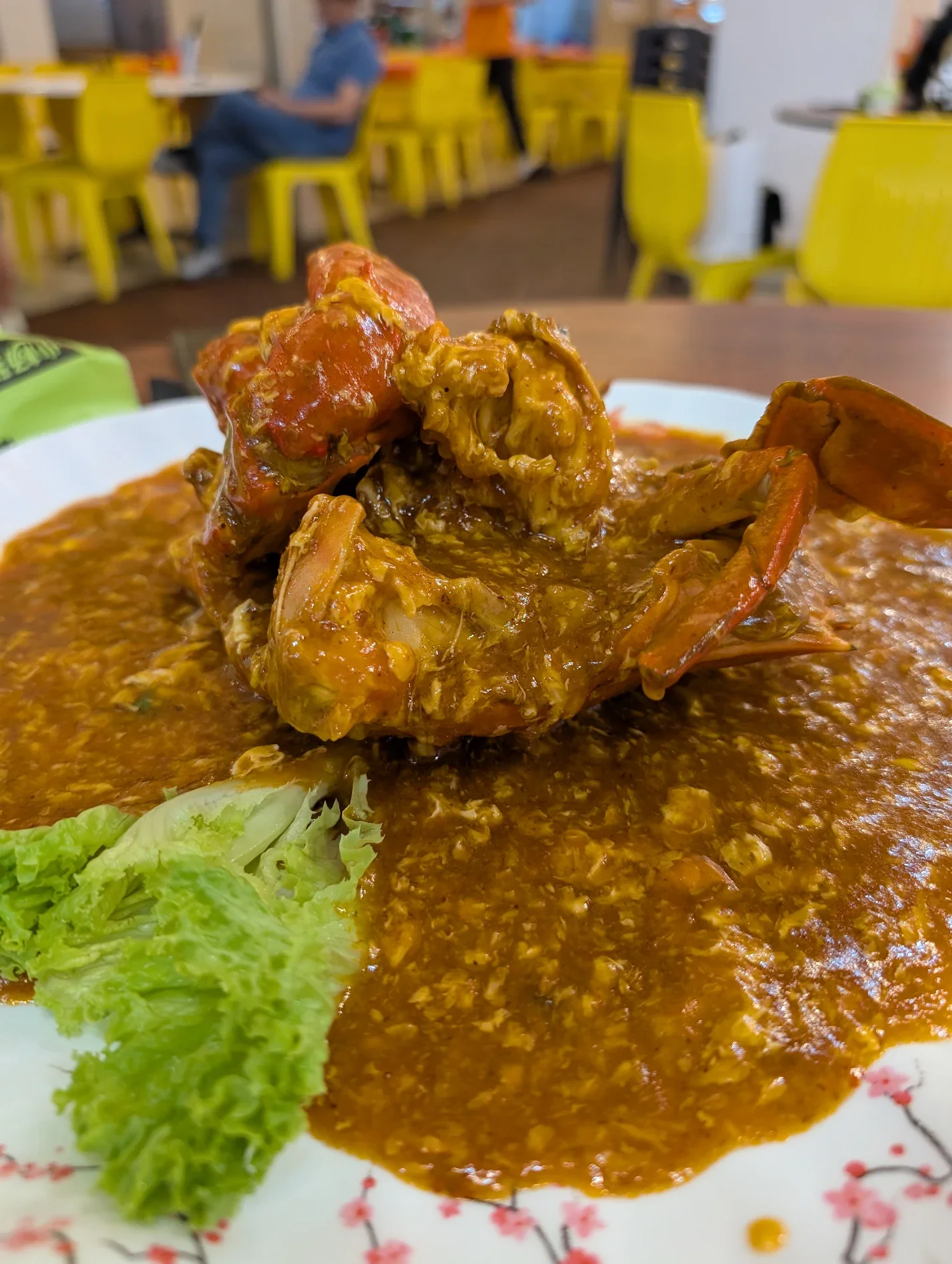
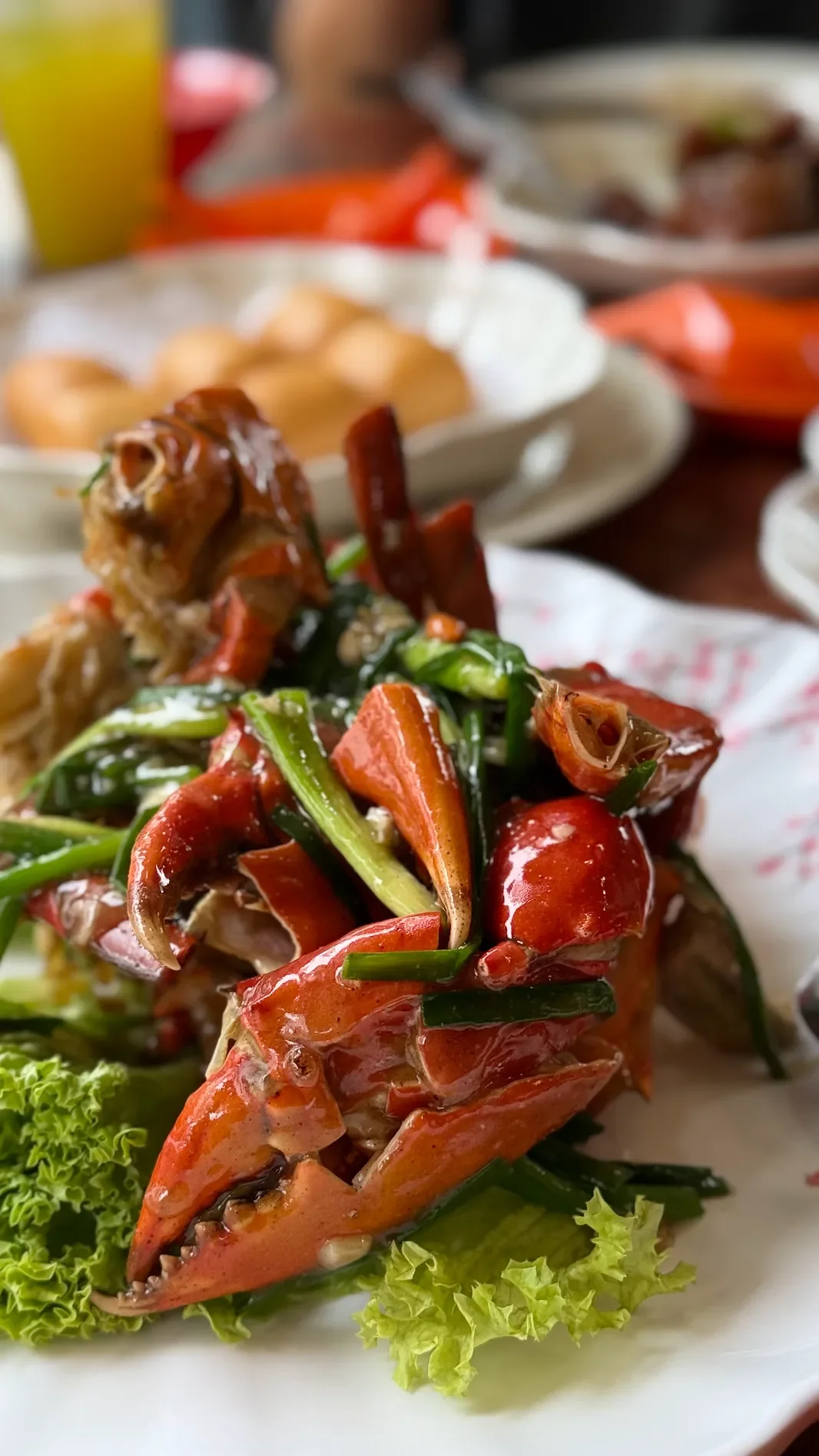
The restaurant serves preparations including Chilli Crab and pepper-based crab dishes.
Chilli crab works because of the contrast between naturally sweet crab meat and a thick sauce that combines sweetness, chilli, savoury seasoning and egg.
The mantou is not incidental.
It exists partly to absorb the sauce once most of the crab has been eaten.
Pepper crab takes another route.
The sauce becomes less dominant.
Pepper becomes more aromatic.
The crab itself comes forward.
Recent diner material continues to show crab appearing at larger family and group meals, particularly chilli crab and pepper-based preparations.
Golden Pearl Roll
KEK also illustrates another important side of zi char culture.
Restaurants invent things.
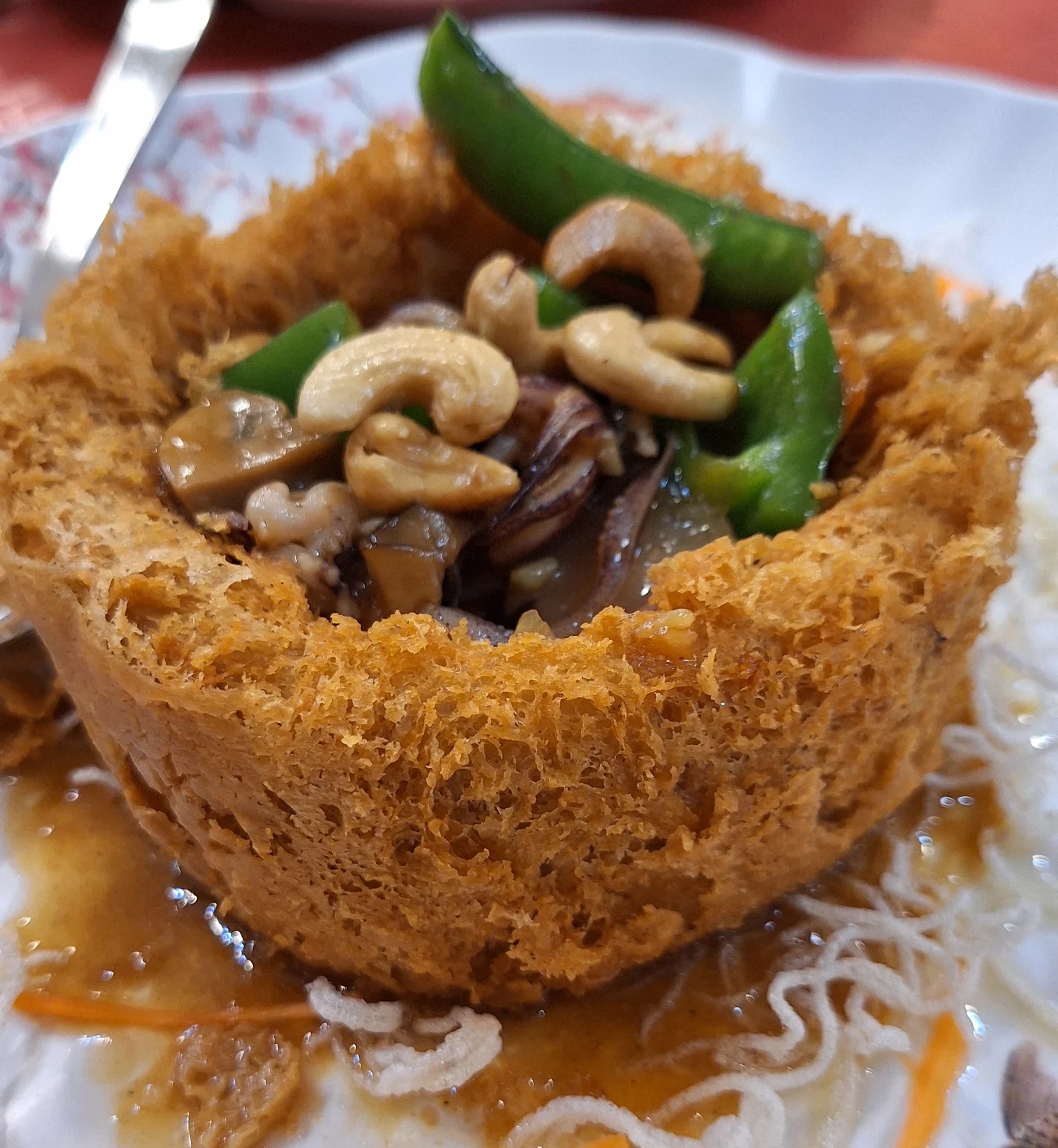
One of KEK’s better-known house creations is the Golden Pearl Roll, sometimes called Mingzhu Roll.
The dish combines fried tau pok with fillings that have included prawns, salted egg yolk, ham, mushroom and herbs.
It is not simply another classical Cantonese dish copied from an old recipe.
It belongs to the restaurant.
That is one of the reasons long-running zi char restaurants develop such distinct identities.
Their menus slowly accumulate dishes.
Some disappear.
Some become permanent.
Eventually, the survivors become part of the restaurant’s history.
The Family Became an Organisation
Keng Eng Kee is now a multi-generation family business.
The younger Liew siblings gradually assumed greater responsibility across cooking, operations and management.
One of them, Paul Liew, became especially involved in modernising the business side.
His SIM Trailblazers profile describes how his business education helped him approach KEK as something that needed more than good recipes.
A growing restaurant needs:
staff systems,
purchasing,
training,
accounting,
marketing,
reservations,
delivery,
quality control,
and eventually multiple outlets.
That changes what a family restaurant has to become.
One outlet can run substantially on experience and instinct.
Several outlets require structure.
Netflix Came to Alexandra Village
KEK eventually became visible far beyond Alexandra.
The restaurant appeared in Netflix’s Street Food: Asia, in the Singapore episode released in 2019.
That appearance placed the restaurant within a wider story about Singapore street and hawker food rather than simply presenting it as another seafood restaurant.
For KEK, the family mattered as much as the menu.
Its development from a Havelock Road hawker business into a major zi char restaurant provided exactly the kind of generational food story the series was built around.
Netflix exposure also changed the audience.
A restaurant that had spent decades feeding Singapore families increasingly became a destination for international travellers.
That can still be seen in contemporary customer material, where overseas visitors frequently mention seeking out KEK specifically as a Singapore food experience.
Michelin Recognised KEK — But It Was Not Michelin-Starred
The Michelin claim also needs precision.
Keng Eng Kee has received Michelin Guide recognition.
It should not be described as Michelin-starred.
Historically, KEK received the Michelin Plate distinction, beginning with the early Singapore editions of the guide.
That placed the restaurant within Michelin’s recommended selection without awarding it one, two or three Michelin stars.
The distinction matters.
A Michelin Guide listing is recognition.
A Michelin star is a separate award.
KEK’s international reputation therefore comes from several overlapping sources rather than one single accolade:
family history,
word of mouth,
Michelin recognition,
Netflix,
international food media,
and decades of Singapore diners.
Alexandra Village Remains the Centre
Despite all that attention, Alexandra Village remains KEK’s spiritual centre.
The flagship is at:
124 Bukit Merah Lane 1, #01-136, Singapore 150124.
Much of the seating remains informal.
Large tables dominate.
Outdoor dining remains part of the experience.
During busy periods, the restaurant can become extremely crowded.
That matters because zi char is fundamentally communal.
The meal is designed to spread across the table.
One person orders vegetables.
Someone else wants seafood.
Another chooses pork.
A noodle dish fills the remaining space.
The meal grows horizontally rather than sequentially.
It is almost the opposite of a tasting menu.
And that shared-table culture is as important to KEK as any individual signature dish.
The Restaurant Expanded East
The family eventually expanded beyond Alexandra.
KEK opened outlets in areas including Tampines and later Punggol, bringing the restaurant to another generation of diners who no longer needed to travel across Singapore for it.
The expansion created a new challenge.
How do you reproduce zi char across multiple kitchens?
That is harder than it sounds.
A written recipe can specify:
grams,
millilitres,
time,
temperature.
But wok cooking involves instinct.
The cook can hear when ingredients are frying correctly.
They can see when a sauce is reducing too quickly.
They know when the wok has lost heat.
They understand how long noodles can remain against the metal.
Those things are difficult to communicate purely through written recipes.
The Pandemic Tested the Business
Covid-19 was especially difficult for restaurants built around communal dining.
Zi char depends on groups.
A table of six can order five dishes.
A table of two cannot behave in quite the same way.
Restrictions therefore struck directly at the restaurant format.
KEK’s response became part of its more recent family story.
The CNA Lifestyle feature on KEK’s pandemic years documented how the family prioritised staff and continued developing the business rather than simply cutting costs and retreating.
The company subsequently expanded eastwards.
That decision says something important about the restaurant.
Family heritage at KEK is not only about preserving recipes.
It also influences how the business treats the people working inside it.
Heritage Does Not Mean Refusing to Change
Restaurants often use the word heritage to mean old.
KEK provides a more useful definition.
The business changed constantly.
It moved from Havelock Road.
It expanded at Alexandra.
The next generation entered.
Management became more structured.
Digital ordering arrived.
Netflix arrived.
New outlets opened.
The dining audience became international.
Almost every part of the business changed.
Yet dishes such as Moonlight Hor Fun and Coffee Pork Ribs remained recognisable.
The family remained involved.
The wok remained central.
That is continuity without stagnation.
The same tension can be seen elsewhere across The Cuisine Journal Collections, where long-established food traditions often survive precisely because the businesses carrying them are willing to change everything around the food.
What People Still Order
Despite the media attention, the contemporary KEK table still revolves around familiar dishes.
Recent diners repeatedly mention:
Moonlight Hor Fun
Coffee Pork Ribs
Chilli Crab
Salted Egg Squid
Butter Cereal Prawns
Prawn Paste Chicken
Three-Egg Spinach
The combination says something about KEK.
This is not a restaurant built around one famous plate.
Its identity comes from assembling several dishes into a meal.
That is why different diners can go to KEK and remember entirely different things.
One remembers the crab.
Another remembers the hor fun.
Someone else returns for Coffee Pork Ribs.
That breadth is the strength of zi char.
The Singapore Shared Table
KEK also demonstrates something broader about Singapore restaurant culture.
Some restaurants organise dinner around individuals.
Each diner has a plate.
Zi char organises dinner around the table.
That changes everything.
Portions are designed to share.
Ordering becomes collaborative.
Everyone tastes nearly everything.
The meal develops as a group decision.
That format appears simple, but it is deeply connected to how many Singapore families eat together.
KEK has spent decades working inside that structure.
Its fame did not require abandoning it.
A Different Kind of Singapore Food Institution
Keng Eng Kee Seafood began with none of the things now associated with its reputation.
No Netflix.
No Michelin Guide recognition.
No multiple outlets.
No international media attention.
No online reservations.
There was a hawker stall.
A family.
A wok.
And customers.
Nearly half a century later, the restaurant is considerably larger.
The family business has become more sophisticated.
Its audience reaches well beyond Singapore.
But the most useful way to understand KEK is still surprisingly simple.
Stand near Alexandra Village around dinner time.
Wait for the burners to come alive.
The smell arrives first.
For more restaurants documenting the breadth of contemporary Singapore dining, explore The Cuisine Journal and its growing collection of venue profiles.
Keng Eng Kee Seafood
Restaurant: Keng Eng Kee Seafood (KEK)
Cuisine: Singapore zi char / Chinese seafood
Established: 1970s
Original Location: Old Havelock Road Hawker Centre
Flagship: 124 Bukit Merah Lane 1, #01-136, Singapore 150124
Known For: Moonlight Hor Fun, Coffee Pork Ribs, chilli crab, pepper crab, Golden Pearl Roll and prawn paste chicken
Recognition: Michelin Guide selection; featured on Netflix Street Food: Asia
Other Locations: Tampines and Punggol
Frequently Asked Questions
What is Keng Eng Kee Seafood known for?
KEK is particularly associated with Moonlight Hor Fun, Coffee Pork Ribs, chilli crab, Golden Pearl Roll and other classic zi char dishes.
Was Keng Eng Kee Seafood featured on Netflix?
Yes. KEK appeared in the Singapore episode of Netflix’s Street Food: Asia in 2019.
Does Keng Eng Kee Seafood have a Michelin star?
No. KEK has received Michelin Guide recognition, including historical Michelin Plate recognition, but it should not be described as Michelin-starred.
What is Moonlight Hor Fun?
Moonlight Hor Fun is wok-fried flat rice noodles topped with raw egg. The yolk is mixed into the hot noodles, adding richness and a silkier texture while retaining the smoky wok hei underneath.
What is wok hei?
Wok hei means roughly the “breath of the wok” and describes the roasted, smoky and lightly charred aroma created by extremely high-heat wok cooking.
Is Keng Eng Kee still family-run?
Yes. KEK remains a multi-generation Liew family business, with family members involved across cooking, operations and management.
Where is the original KEK restaurant today?
Its best-known flagship is at 124 Bukit Merah Lane 1, #01-136, beside Alexandra Village.
Is KEK mainly a seafood restaurant?
Seafood remains important, particularly crab, prawns and squid, but KEK is better understood as a full zi char restaurant, with pork, chicken, noodles, tofu and vegetables forming major parts of the menu as well.