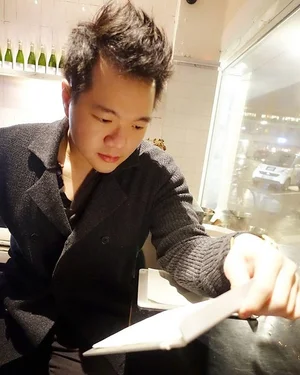
Isaac Lim: The Restaurant Chef Who Brought Steamed Fish to the Hawker Centre
For Isaac Lim, Nian Nian You Yu represented a considerable change of environment.
Before opening the steamed fish stall at Maxwell Food Centre with his friend Eric Kee, Lim had spent years working in professional restaurant kitchens. His experience included time at Michelin-starred establishments, most notably the one-Michelin-starred Restaurant Ibid.
Moving from that world into a compact hawker stall meant leaving behind much of the infrastructure of restaurant cooking. But it also gave Lim an opportunity to apply professional kitchen experience to something considerably simpler: making a good steamed fish meal practical for one person.
From Restaurant Kitchens to Hawker Food
Lim's culinary career began well before Nian Nian You Yu.
According to a 2022 profile by 8days, he studied culinary arts at SHATEC before building experience in professional kitchens. His résumé included Restaurant Ibid, which held one Michelin star, as well as other restaurant roles before he eventually decided to pursue a business of his own.
That background is important because Nian Nian You Yu was not an attempt to reproduce fine dining at hawker prices.
Lim went in the opposite direction.
The food was deliberately familiar. Steamed fish, rice, soup, steamed egg and seafood formed the backbone of the offering. Instead of using his restaurant experience to make the dishes more elaborate, he used it to make a very simple concept workable.
A Steamed Fish for One
The idea emerged while Lim and Kee were eating zi char together.
They noticed that steamed fish was generally sold whole and intended for sharing. It made sense for a family dinner, but considerably less sense for someone who simply wanted steamed fish during lunch.
That became the problem they wanted to solve.
At Nian Nian You Yu, fish could instead be ordered as an individual set with rice and soup. Sea bass and golden pomfret were among the early options, bringing a dish normally associated with a communal Chinese meal into the format of an everyday hawker lunch.
It sounds like a small change.
In practice, it required thinking differently about the dish.
Portioning had to work for one diner. Pricing had to make sense in a hawker centre. Preparation needed to remain manageable during service. Most importantly, the fish still needed to retain the qualities that make steamed fish appealing in the first place.
There is very little room for error when steaming fish.
Letting the Fish Remain the Main Ingredient
Steaming is an unusually revealing cooking method.
There is no heavy crust, aggressive sear or thick sauce to hide behind. Texture matters. Timing matters. Freshness matters.
Lim's Hong Kong-style preparation kept things relatively restrained, using ingredients such as soy sauce, ginger and chicken stock around the fish. A Thai-inspired version moved towards garlic, chilli and lime.
The preparations were different, but the underlying approach remained straightforward.
The fish was still recognisably the centre of the meal.
That simplicity makes sense when viewed against Lim's professional background. Technical experience does not necessarily have to result in increasingly complicated food. Sometimes it provides the confidence to remove things.
At Nian Nian You Yu, the technique served an everyday dish rather than becoming the attraction itself.
Building a Kitchen Around Steaming
The physical stall reinforced that philosophy.
Nian Nian You Yu operated with a relatively compact setup centred around a commercial multi-tier steamer. Fish, seafood, vegetables and eggs could all be prepared using variations of the same fundamental cooking method.
For two people working in a small hawker kitchen, this was an efficient system.
It reduced the number of separate cooking stations required while allowing Lim to build a menu with enough variation to feel like more than a single-dish operation.
There was fish, certainly, but also clams, prawns, grouper, vegetables and steamed egg.
The common thread wasn't a particular sauce.
It was the steamer.
Passing on the Craft
The partnership between Lim and Kee was also interesting because the two men entered the stall with very different skill sets.
Kee had experience with the operational side of F&B through his family's kopitiam. Lim brought professional cooking experience.
Initially, those roles were clearly divided. Lim cooked while Kee handled customers, suppliers, marketing and other aspects of running the stall.
But Lim also began teaching his partner.
During quieter periods, he showed Kee how to clean fish, prepare it and steam it properly. The intention was not merely to have an extra pair of hands. Their early ambitions included eventually operating more than one outlet, which would require Kee to become capable of handling the kitchen himself.
In that sense, Lim was doing something familiar to professional kitchens: transferring technique from one cook to another.
Only this time, the classroom was a hawker stall.
Professional Technique Without Restaurant Formality
Nian Nian You Yu offers an interesting example of what happens when a restaurant-trained chef moves into hawker cooking without trying to turn hawker food into restaurant food.
There was no need to dress steamed fish up as something luxurious.
Instead, Lim's professional experience appeared in less visible places: preparation, organisation, consistency, menu construction and the ability to build several dishes around a constrained kitchen.
This is perhaps the most useful way to understand his food philosophy.
Technique was a tool rather than an identity.
The point wasn't to remind customers that their fish had been prepared by someone who had worked in Michelin-starred kitchens. The point was to give someone sitting alone at Maxwell Food Centre a properly prepared portion of steamed fish.
That distinction matters.
When Nian Nian You Yu Came to an End
Nian Nian You Yu attracted attention quickly after opening in April 2022, with the partners reporting that daily sales had risen substantially during its early months.
The stall subsequently moved within Maxwell Food Centre and reopened in December 2022.
Then, in 2023, it closed.
Contemporary reports, including coverage by SETHLUI.com, noted that the closure was permanent, but no detailed public explanation was given.
That means there is little value in speculating about why the business ended.
What can be examined is what Lim attempted while it existed.
Isaac Lim Beyond Nian Nian You Yu
Restaurant chefs moving into hawker centres are often described through the language of prestige: a chef leaves an expensive restaurant and brings Michelin-level cooking to inexpensive food.
Lim's story is more interesting when viewed without that framing.
What he brought with him was not Michelin-starred food.
He brought experience.
He took the discipline of professional kitchens and applied it to a narrow problem: how to prepare steamed fish consistently, efficiently and affordably from a tiny stall for customers who might be eating alone.
The result did not need to look like restaurant food.
It needed to work as hawker food.
Nian Nian You Yu ultimately had a short life, but Lim's approach demonstrated something worth remembering about culinary training. The value of professional technique isn't measured by how complicated a chef can make a dish.
Sometimes it is measured by how confidently the chef can keep one simple.