Peter Smit: The Chef Who Would Rather Use the Whole Animal
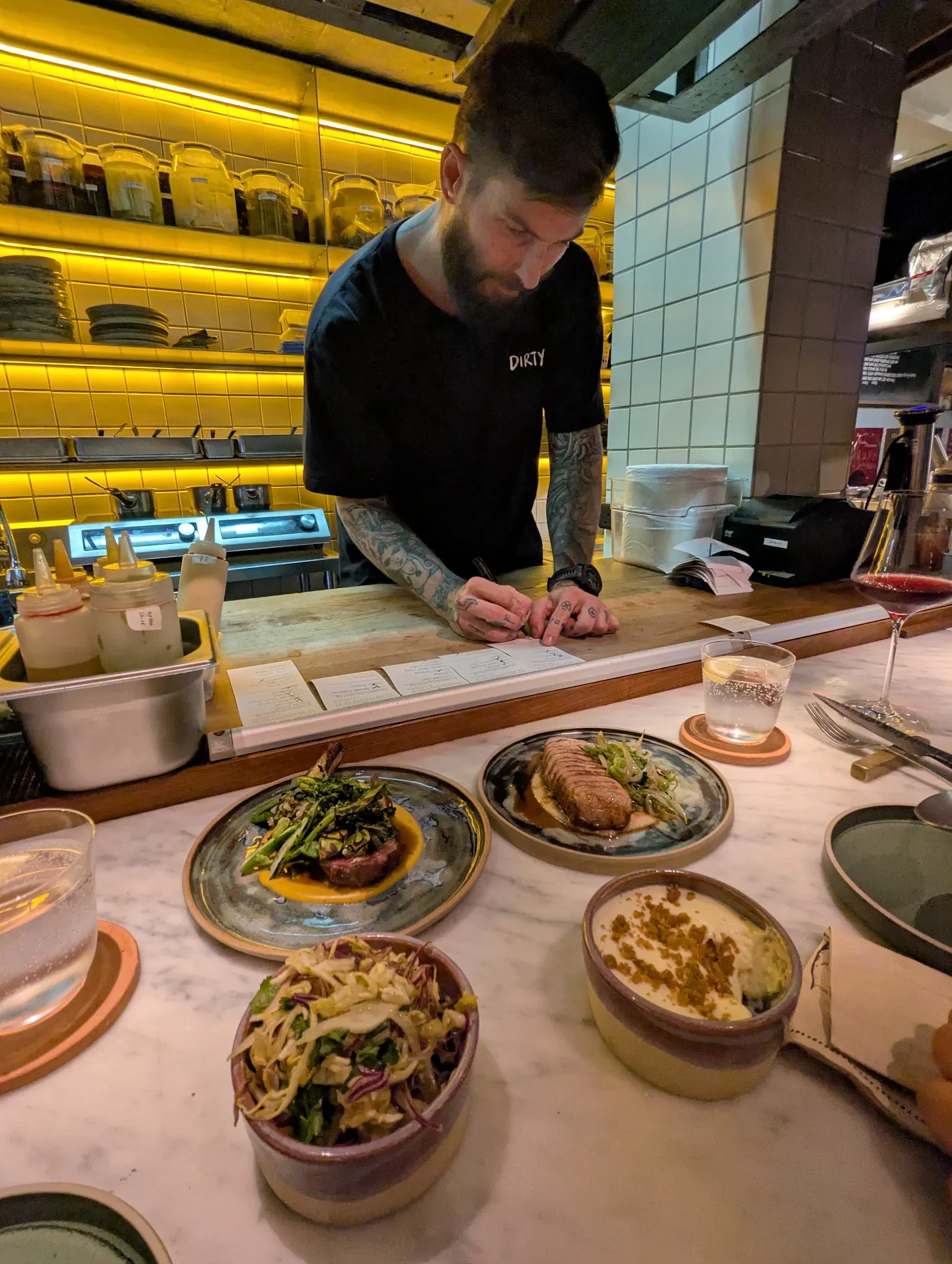
There are easier ways to run a restaurant than building a menu around what other kitchens might throw away.
Chef Peter Smit does it anyway.
At Dirty Supper in Singapore, the Australian chef-owner works around whole-animal cooking, grilling and an ever-changing supply of produce. Duck necks, hearts and heads are not treated as awkward leftovers from more desirable cuts. They are ingredients.
That philosophy did not begin in Singapore.
Smit developed his cooking through kitchens in Australia, London and Singapore, including senior roles at Rogan & Co., Pitt Cue and Adrift. But one of the most important ideas in his career appears to have taken shape much earlier, while he was cooking in South Australia.
That was where nose-to-tail cooking started becoming something more than a concept.
It became part of how he cooks.
Australia Came First
Smit is Australian-born, and his early career included time cooking in his home country.
Among those experiences was work at a luxury lodge on Kangaroo Island in South Australia. It was during his time in the region that he began experimenting with nose-to-tail cooking.
That idea is fairly simple in principle.
If an animal has been raised, slaughtered and brought into a kitchen, then the chef should find value beyond the obvious premium cuts.
In practice, that requires considerably more imagination.
A tenderloin has an established role.
A duck head does not.
The less familiar parts of an animal ask more of the cook: different techniques, different textures and sometimes a willingness to convince diners that something they would normally overlook is worth eating.
Smit kept exploring that territory.
London Added Another Layer
His career eventually took him to the United Kingdom, where he became Head Chef at both Pitt Cue and Rogan & Co.
They were very different kitchens.
Pitt Cue became known for meat, barbecue and cooking with smoke and fire, while Rogan & Co. sits within Simon Rogan's restaurant world, where produce and seasonality occupy a central place.
It is difficult not to see echoes of both approaches in Smit's later cooking.
At Dirty Supper, fire matters.
So does the ingredient.
The menu does not appear designed to force produce into a fixed collection of dishes regardless of what is available. Instead, the restaurant keeps the offering intentionally lean and allows it to change with the day's supply.
Whole-animal cooking becomes part of that same philosophy.
Use what arrives.
Find the best way to cook it.
Waste as little as possible.
Singapore in 2019
Smit moved to Singapore in 2019 to become Executive Chef at Adrift, the restaurant created by chef David Myers.
Adrift has since closed, but Singapore became Smit's home.
He later served as Executive Chef across Sago House, Low Tide and Underdog Inn, placing him inside a part of Singapore's hospitality scene that was considerably less formal than the fine-dining kitchens he had experienced earlier in his career.
Eventually, he began building something of his own.
Dirty Supper first appeared not as a permanent restaurant, but as a series of pop-up dinners created in partnership with Sago House.
The temporary format made sense.
A chef working with whole animals and changing produce does not necessarily need a rigid menu.
Dirty Supper could evolve.
And eventually it did.
A Supper Club Finds a Permanent Home
In 2024, Dirty Supper became a permanent restaurant at Hua Bee Restaurant in Tiong Bahru.
The setting is unusual.
Hua Bee is a long-standing local noodle shop during the day. Later, the same space transitions into Dirty Supper.
Rather than completely erasing the older coffee-shop identity, the restaurant deliberately retained much of it. Vintage elements remain alongside stainless steel and more industrial touches, while an open kitchen gives diners a direct view of the grill.
There is something appropriate about Smit putting a restaurant built around resourcefulness into a space that itself has been reused rather than replaced.
The same basic idea runs through both.
Keep what still has value.
Then do something new with it.
Nothing Goes to Waste
Whole-animal cooking is now the clearest expression of Smit's food.
Dirty Supper does not hide the less glamorous parts of the animal.
They can become the point.
Duck heads have appeared as bar snacks. Duck hearts have been turned into sausage. Smit has also served items such as barbecue duck neck and pork heart.
The restaurant's menu has also included dishes such as raw prawn with black lime and pickled green chilli, chicken-skin terrine with smoked mackerel, and aged duck breast with beer-pickled figs and capers.
That combination tells us something important about his approach.
Whole-animal cooking does not mean every dish has to be confrontational.
A diner can order the breast.
But the rest of the animal still has somewhere to go.
That is the difference.
Produce Decides the Menu
Dirty Supper describes its approach as having “pride in produce” at its core.
The menu is deliberately small and changes according to what is available.
Robb Report noted that the restaurant has sourced from Tiong Bahru wet market, Vertical Farms for prawns and Malaysia for duck.
That makes the menu less predictable.
It also means the kitchen has to respond to ingredients rather than simply ordering whatever is required to reproduce the same plate indefinitely.
For Smit, this appears to be part of the appeal.
His restaurant is not built around a large catalogue of permanent signatures.
It is built around a cooking method.
Grill it.
Use the animal properly.
Pair ingredients in unexpected ways.
And change things when the produce changes.
Dirty Supper Is Not Trying to Be Polished
There is another useful clue in the restaurant's name.
Dirty Supper does not sound particularly interested in ceremony.
The room is described by the restaurant itself as intimate, vintage, underground and grungy.
The food follows a similar instinct.
There is technique here, but it does not appear desperate to look delicate.
Fire leaves colour.
Off-cuts remain recognisable.
The restaurant can serve a serious piece of cooking without insisting that the experience itself become serious.
That distinction matters.
Smit has worked in accomplished kitchens and held senior positions, but Dirty Supper feels less like an attempt to reproduce those environments and more like an opportunity to decide which lessons were actually worth keeping.
Peter Smit Doesn't Need the Best Cut
There is an obvious way to judge a chef.
Give them the finest ingredient available and see what they can do with it.
Peter Smit's cooking suggests another test might be more interesting.
Give the chef everything else.
The neck.
The heart.
The head.
The parts without prestige attached to them.
Then see whether people still want to eat.
That is where whole-animal cooking becomes more than an ethical slogan.
It becomes a demonstration of skill.
Smit has spent years cooking across Australia, Britain and Singapore, moving between lodges, barbecue restaurants, produce-driven kitchens, hotel dining and bars before eventually opening Dirty Supper.
And after all of that experience, one of the clearest ideas in his cooking is also one of the simplest:
The animal is already there.
You might as well learn how to cook all of it.